Do Southwest Rapid Rewards points expire? No. Southwest states it in three separate places, in almost the same words, and has committed to it again for the 2027 program: points do not expire, no activity is required, and there is no annual deadline to beat. That is the whole answer, and it is also the least useful thing about the program, because the ways a balance actually disappears have nothing to do with time.
The short version: no expiry date, no activity requirement, no elite-status exemption to qualify for. What clears a balance is an account event, not a calendar event. Close the account and the points are forfeited the same day. Let Southwest close it and the result is the same. And the program rules say plainly that members do not acquire property rights in accrued points, which means the balance is a promise the airline can re-price, restrict or suspend, subject to whatever notice it chooses to give.

The short answer, from three official pages
Southwest does not leave this ambiguous, and it does not depend on your tier, your card or how long you have been a member. The same sentence appears on the help centre, on the buy-points page and on the page describing the 2027 changes.
| Source | Wording | What it covers |
|---|---|---|
| Rapid Rewards help centre | “No, your Rapid Rewards points do not expire.” | All points, earned any way, at any tier. |
| Buy, gift and transfer page | “No, your Rapid Rewards points do not expire. However, if you choose to close your account, the points in your account will be terminated.” | Adds the only stated exception. |
| 2027 program changes | “Rapid Rewards points don’t expire, so you can keep what you earn and use them when you’re ready.” | Confirms the rule survives the rewrite. |
Read together, these three statements settle the question and also point at the real risk. The second one names the exception in the same breath as the reassurance, which is unusual: most programs bury the forfeiture clause three pages into the terms. Southwest puts it in a sentence you cannot miss, and most guides quoting the first half of that sentence leave the second half out.
There is no activity requirement either. You do not need to fly, spend on a co-branded card, shop through the portal or redeem anything to keep a balance alive. This is worth stating plainly because the opposite is true of almost every other program a US reader holds, and the habit of manufacturing activity every year is hard to unlearn.
The one event that does clear a balance
Closing the account forfeits the points immediately. That is the entire mechanism. What matters is that there are three ways an account closes, and you only control one of them.
You close it. This is the case the terms describe, and it is deliberate rather than accidental. Members close accounts to consolidate duplicate profiles, to stop marketing email, or in the mistaken belief that the balance can be reopened later. It cannot. Once the account is closed the points are gone, and Southwest does not operate a reinstatement process the way American and Alaska do, because there is nothing to reinstate: the balance was terminated, not expired.
Southwest closes it. The program rules reserve the right to suspend or terminate an account for violations, and the ones that matter in practice are the ordinary ones: duplicate accounts opened to farm sign-up bonuses, points obtained through a partner without a qualifying transaction, and accounts flagged after a payment dispute. A chargeback on a points purchase or on a card payment that generated points is the most common trigger, because the points arrive before the dispute does.
An outside event closes it. Accounts are individual, not household, and the rules make no provision for passing a balance to an estate. Families that assume otherwise find out at the worst possible moment. If a balance matters to an estate, the only workable approach is to redeem it while the member is alive, or to move it to another member through the transfer tool while the account is still open, because neither step is available afterwards.
Points are not your property
Every Southwest press release carries the same two sentences in its boilerplate, and they are the most important lines in the program documents:
Southwest reserves the right to amend, suspend, or change the Rapid Rewards program and/or Rapid Rewards program rules at any time without notice. Rapid Rewards Members don’t acquire property rights in accrued points.
The first sentence is standard across the industry. The second is the one worth reading twice. A points balance is not an asset you own; it is a liability the airline carries, and the only thing standing between the balance and a rule change is the airline’s own commercial interest in not alarming its best customers. That is a real constraint, and it is why mass forfeitures do not happen, but it is not a legal one.
This is not a reason to avoid the program. It is a reason to stop treating a balance as savings. A balance is a claim on future award space at a price Southwest has not committed to, in a currency it can redefine, and the practical consequence is a holding period, not a holding limit. Points that sit for two years are not at risk of expiring. They are at risk of being worth less when you finally use them, which is a different problem with a different fix.
Where the 24-month story comes from
Search the question and a large share of the results answer “24 months of inactivity,” usually with a straight face and sometimes in a table. That rule belongs to American AAdvantage and Alaska Mileage Plan. It has never applied to Rapid Rewards, and the sites repeating it have copied a competitor’s policy into a Southwest article.
| Program | Expiry rule | Activity needed |
|---|---|---|
| Southwest Rapid Rewards | None | None. Only account closure forfeits. |
| American AAdvantage | 24 months without qualifying activity | Earn or redeem. Primary cardholders and members under 21 are exempt. |
| Alaska Mileage Plan | 24 months without qualifying activity | Earn or redeem. Cardholders are exempt while the card is open. |
| United MileagePlus | None | None, but the account must stay in good standing. |
| Delta SkyMiles | None | None, but the account must stay in good standing. |
| Air Canada Aeroplan | 18 months without activity | Earn or redeem at least one point. |
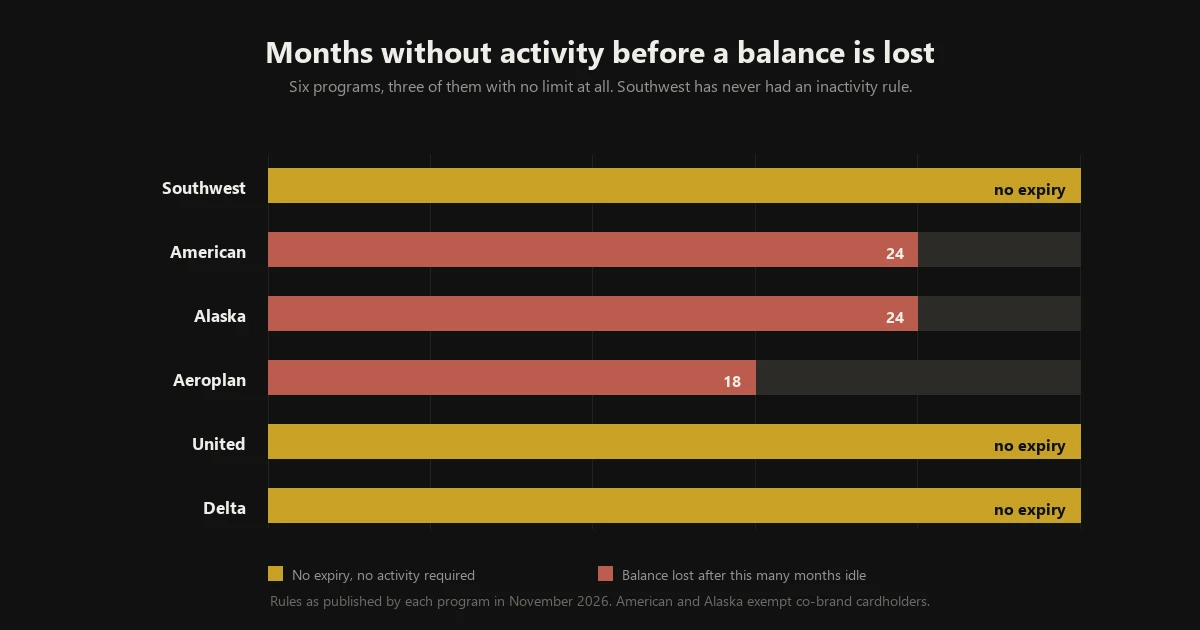
The pattern is that the three largest US programs split roughly down the middle, and the expiry rules move over time: American AAdvantage shortened its window and then added exemptions, Aeroplan cut its to 18 months when it was rebuilt in 2020. A rule copied from a 2017 article may describe a program that no longer exists. Southwest’s rule has been stable, and the 2027 rewrite explicitly keeps it.
What actually makes points disappear
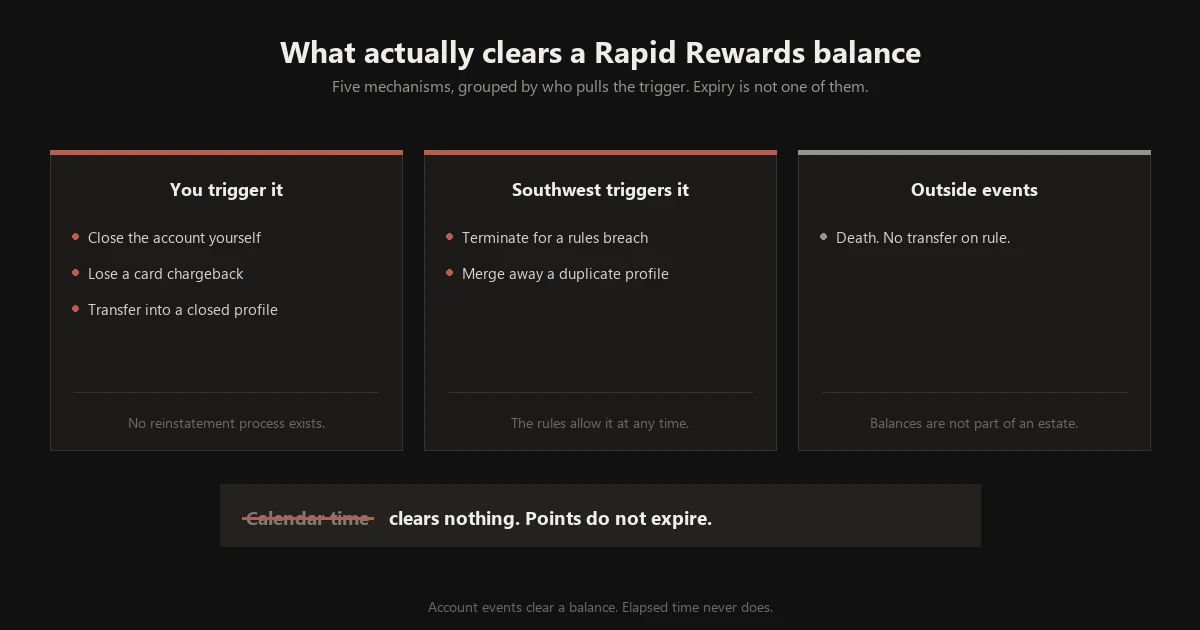
If the balance cannot expire, the useful question becomes what can remove it. There are five mechanisms, and four of them are administrative.
| Mechanism | How it happens | Recoverable |
|---|---|---|
| Account closure | Member requests it, or Southwest terminates for a rules violation | No |
| Chargeback reversal | A card dispute pulls back the purchase, and the points that came with it | Only by repaying |
| Duplicate-account cleanup | Two profiles merged, with the smaller balance absorbed or removed | Sometimes, on request |
| Transfer to a closed profile | Points sent to a member whose account was later terminated | No |
| Program rule change | Conversion ratios or redemption options revised | Not applicable |
None of these is a deadline. All of them are worth knowing, because each one is triggered by an action rather than by the passage of time, and three of the five are triggered by the member. The chargeback case is the one that catches people out: dispute a card charge that earned 60,000 points and the issuer claws back the payment, which makes the points balance negative if you have already spent them. A negative balance is not an expiry, but it has the same effect on your next redemption.
Expiry is not the risk. Depreciation is.
A point that never expires still loses value, and this is the only part of the question that changes an actual decision. Since Southwest moved to revenue-based awards, the points price of a flight tracks the cash fare, so the value of a point depends on which fare you redeem against and what status you hold.
The ceiling is 1.35 cents, and that is the best case: a Basic award on a trip you would have paid cash for, with no status and no Tier Qualifying Points forgone. On Choice Extra it falls to 1.21 cents, and for a Platinum member booking Choice Extra it falls to 0.99 cents, because the cash fare would have earned 8 points and 8 TQPs per dollar and the award earns neither. The full valuation sets out the arithmetic; the point here is that the spread between 0.99 and 1.35 is wider than any year-to-year drift, and it is decided by how you redeem rather than when.
So the balance you are protecting by holding is already shrinking in real terms every time the cash fare on your intended route rises faster than the award price falls. Holding points is not free. It is a bet that the award you want will still be priced the same when you get round to booking it, and in a program that prices awards off the cash fare, that bet is on airfares.
What 2027 changes, and what it does not
From 1 January 2027 the program moves to three tiers, Silver at 35,000 TQPs, Gold at 65,000 and Platinum at 140,000, with points and TQPs both earned at 2X, 6X, 8X and 10X depending on fare. None of that touches expiry. The program page lists points retention under “what’s staying the same,” which is as close to a guarantee as this industry offers.
What does change is the qualification value of a balance. The Companion Pass is earned only through Tier Qualifying Points or qualifying segments from 2027, at 95,000 TQPs for three companion trips and 140,000 for unlimited ones, and points earned from credit card spending, partner activity or purchases do not count. That closes a route that a lot of members were quietly using: accumulate a large balance, let the card and partner earnings push the Companion Pass over the line, and treat the balance as the by-product. Under the new rules the balance and the qualification are separate ledgers.
Redemption options expand at the same time. Car rental redemption opened in mid-November 2026 on cars.southwest.com, three international loyalty partners arrive in spring 2027, and seat upgrades paid in points are promised for late 2027. More places to spend is not the same as more value per point: a new redemption channel almost always launches at a worse rate than the best existing one, which is how the car rental option prices out at roughly 0.25 cents. The partner guide works through the ratios.
Three rules for holding a balance
Do not close the account to tidy up. If you want to stop marketing email, unsubscribe. If you have two profiles, ask for a merge rather than closing one. Closing is the only action in this program that destroys a balance outright, and it is the one members take for reasons that have nothing to do with points.
Redeem on a schedule, not on a trigger. Because nothing expires, there is no forcing function, and the absence of one is why balances grow. Set a review every six months and ask a single question: is there a trip in the next twelve months where this balance covers a fare I would otherwise pay cash for? If the answer is no for two reviews running, the balance is not savings, it is a bet on airfares. The order to spend in matters more than the timing.
Do not buy to protect a balance. If you are short of an award and considering a top-up, price the award first: on the buy-points page a sale price of 1.5 cents a point sits above the 1.35-cent ceiling, so buying to reach an award you have already found is a convenience fee, and buying to build a balance is a loss. The buy-points arithmetic is set out in full, the official purchase links page lists every program’s buy page in one place, and the short version is that the only defensible purchase is a small top-up on a specific booking.
Verdict
Southwest Rapid Rewards points do not expire, and no amount of inactivity will take them. That is a genuine advantage over American and Alaska, and it is stable through the 2027 rewrite. Members who fly Southwest a few times a year can hold a balance without thinking about it, which is more than can be said for most programs.
The catch is that the promise protects the wrong thing. It guarantees the balance will still exist, not that it will still be worth what it is worth today, and the mechanisms that do clear a balance are all triggered by an action rather than by time. A closed account, a chargeback, a merged profile, a transfer into a dead profile: four administrative events, none of them a deadline, all of them avoidable.
So the answer to the question is yes, forever, and the useful question is the next one: what is the balance worth today, and is there a trip before the next review where it buys something you would otherwise pay for. If you are starting from zero rather than holding a balance, the earning guide ranks the twelve routes in by cost, and how loyalty points work explains why a currency with no expiry date usually has a faster depreciation rate instead.
Last updated: 25 November 2026. Expiry terms reflect the Rapid Rewards rules and the 2027 program changes published on 15 October 2026.
Frequently asked questions
Do Southwest Rapid Rewards points expire?
No. Southwest states on its help centre, on the buy-points page and in the 2027 program changes that Rapid Rewards points do not expire, and that no activity is required to keep them. The rule applies at every tier and to points earned from any source, and it survives the move to Silver, Gold and Platinum on 1 January 2027.
Will my points disappear if I do not fly for a year?
No. There is no activity requirement, so a year without flying, spending on a co-branded card or shopping through the portal costs you nothing. The only thing that clears a balance is the account closing, either because you request it or because Southwest terminates it for a rules violation.
What happens to my points if I close my account?
They are forfeited immediately. Southwest’s own wording is that the points “will be terminated” if you choose to close the account, and there is no reinstatement process to appeal to, because the balance was terminated rather than expired. If you are closing to consolidate duplicate profiles, ask for a merge instead.
Is there a 24-month inactivity rule for Southwest points?
No. That rule belongs to American AAdvantage and Alaska Mileage Plan. It has never applied to Rapid Rewards, and articles that state it have copied a competitor’s policy. Southwest’s rule has been no expiry for years, and the 2027 changes keep it in place.
Do points transfer to someone else when a member dies?
The rules make no provision for it. Accounts are individual and there is no mechanism for passing a balance to an estate, so the workable approach is to redeem it or transfer it to another member while the account is open. Southwest’s rules also state that members do not acquire property rights in accrued points, which is why there is nothing to inherit.
Should I spend points sooner because they might expire?
Not because of expiry, which does not happen, but because of depreciation, which does. The best case is 1.35 cents a point on a Basic award with no status, and it falls to 0.99 cents for a Platinum member redeeming Choice Extra, so the fare you redeem against matters more than the date. Review a balance every six months and spend it on a trip you would otherwise pay cash for.
More guides
This page answers the expiry question. The rest of the cluster covers what the points are worth, where to spend them and what each tier costs.
- Southwest Rapid Rewards promotions: what is live and what it is worth
- Southwest Rapid Rewards elite status: Silver, Gold and Platinum in full
- Southwest Companion Pass: three trips or unlimited, and what each costs
- How to earn Southwest Rapid Rewards points
- How much are Southwest Rapid Rewards points worth
- The best way to use Southwest Rapid Rewards points
- Southwest Rapid Rewards credit cards compared
- Southwest Rapid Rewards partners: what each kind of partnership actually gets you
- Buy Southwest Rapid Rewards points — when a sale beats the redemption rate, and when it does not.
- Do points expire? All thirteen programmes compared — the windows, the exemptions, and why no clock is not the same as no risk.
Next step: open your Rapid Rewards account and check two things: that the email address on file is one you still read, and that no duplicate profile exists under a second address. Those are the two conditions that lead to an account closure you did not intend, and both take a minute to fix.