Rapid Rewards has eight ways to earn points, and their headline rates run from 1 point per dollar to 20. That range is misleading in a specific way: the highest rates are attached to spending you would not otherwise do, while several of the lowest-cost sources pay nothing visible at all. A member who buys Choice Extra fares to farm points is paying real money for a rate they could beat by opening a card and doing their grocery shopping through a portal.
The short version: three sources cost you nothing beyond money you were already going to spend, and they should come first. Flights earn the most per dollar but only make sense when the trip was happening anyway. Buying points is last, at 1.5 to 3 cents each. From 1 January 2027 the arithmetic gets a second layer, because points and Tier Qualifying Points are earned at the same rates on flights, which means the fare you pick now decides two outcomes at once.

Every earning source at a glance
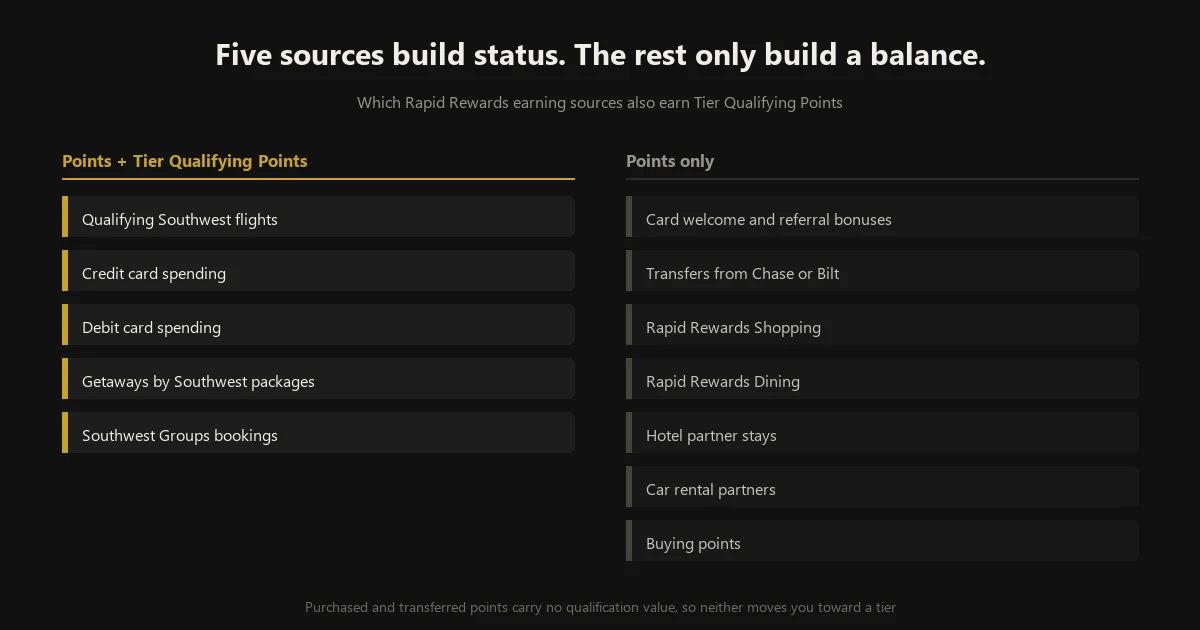
The table separates the sources by the one distinction that matters more than the headline rate: whether the points also move you toward status. Five sources earn both points and Tier Qualifying Points; everything else earns redeemable points only. A member chasing Silver cannot get there through a shopping portal no matter how many points it pays.
| Source | Rate | Counts toward status | Practical ceiling |
|---|---|---|---|
| Qualifying flights | 2 to 10 points per dollar of base fare, before tier bonus | Yes | Unlimited |
| Rapid Rewards credit card spending | 1 point per dollar | Yes, from 1 January 2027 | Unlimited |
| Rapid Rewards debit card spending | Varies by card | Yes | Unlimited |
| Getaways by Southwest packages | About 5 points per dollar | Yes | Unlimited |
| Southwest Groups bookings | Varies by booking | Yes | Unlimited |
| Credit card welcome bonus | 50,000 to 90,000 points | No | One per card, Chase 5/24 applies |
| Transfers from Chase or Bilt | 1 to 1 | No | Limited by the balance you hold |
| Rapid Rewards Shopping | 1 to 20 points per dollar at 1,100+ retailers | No | Unlimited |
| Rapid Rewards Dining | 3 points per dollar, or 1 per 2 dollars if opted out of email | No | Unlimited |
| Hotel partner stays | 600 points per qualifying stay | No | Unlimited, one per stay |
| Car rental partners | 600 points per qualifying rental | No | Unlimited, one per rental |
| Buying points | 1.5 to 3 cents per point | No | 100,000 points per day |
Two rows deserve attention because they are routinely filed in the wrong column. A credit card welcome bonus has never counted toward Southwest status, and from 1 January 2027 that exclusion is explicit: welcome bonuses, referral bonuses, anniversary points, category bonuses and partner earning all still buy points, but none of them buy Tier Qualifying Points. The second row is the reverse. Every Rapid Rewards card now earns one Tier Qualifying Point per dollar, which turns ordinary spending into a status tool worth $35,000 of spending a year at the Silver threshold.
Flying: the fare decides the rate
Points on a Southwest flight are calculated on the base fare, not the total ticket price, so taxes and fees earn nothing. The rate you get depends on two variables: the fare class you book and the tier you hold. From 1 January 2027 the base rates are 2 points per dollar on Basic, 6 on Choice, 8 on Choice Preferred and 10 on Choice Extra, and tiers add a flat percentage on top: 40% at Silver, 60% at Gold and 120% at Platinum.
| Fare class | No status | Silver | Gold | Platinum |
|---|---|---|---|---|
| Basic | 2 | 2.8 | 3.2 | 4.4 |
| Choice | 6 | 8.4 | 9.6 | 13.2 |
| Choice Preferred | 8 | 11.2 | 12.8 | 17.6 |
| Choice Extra | 10 | 14 | 16 | 22 |
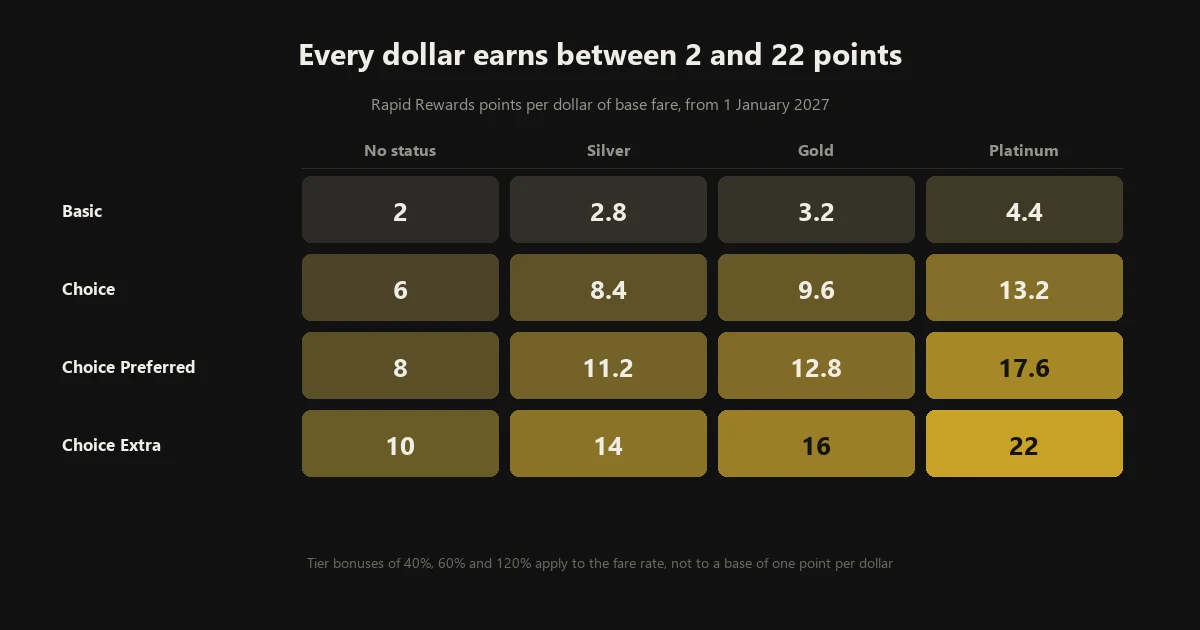
Those figures are points per dollar, and the same multipliers govern Tier Qualifying Points, so a Choice Extra fare earns five times what a Basic fare earns toward both goals. On a $200 one-way, Basic earns 400 points and Choice Extra earns 2,000. The gap is 1,600 points, worth roughly $19 to $27, and the fare difference between the two is usually larger than that.
The matrix says the fare decision should be made on comfort and flexibility, not on points. Buying up two fare classes to earn a few hundred extra points is a losing trade at any tier. The exception is the member already paying for the higher fare to get the seat or the changeability, in which case the points are a by-product rather than a reason.
Several kinds of flying earn nothing at all, and they are worth knowing before you plan around them. Reward flights earn no points and no Tier Qualifying Points. Companion Pass travel earns nothing for either passenger. Charter flights, nonrevenue travel, vacation packages booked through an outside agency, and agency tickets where the operating carrier is not disclosed before purchase are all excluded. On a Cash + Points booking, points accrue only on the portion of the base fare paid in cash, which means a booking paid mostly in points earns almost nothing.
One timing note for anyone reading this before the change takes effect: fares flown before 1 January 2027 earn at the rates in force at the time of travel. The matrix above is the schedule that applies from that date onward.
Credit cards: the welcome bonus is the biggest single hit
A Southwest welcome offer is the largest single addition most members will ever make to a balance. Across 2026 the three personal cards have been offered between roughly 50,000 and 90,000 points, with the top of each range landing in October and November: the Plus between 50,000 and 80,000, the Premier between 55,000 and 85,000, and the Priority between 60,000 and 90,000. A 90,000-point bonus on the Priority card is equivalent to 9,000 dollars of Choice Extra spending, for a 229-dollar annual fee and a spending requirement that most households would meet anyway.
That is why the bonus outranks flying in any honest ranking of earning efficiency. It is points bought with money you were going to spend regardless, at an effective cost near zero. The constraints are what stop it from being repeatable: Chase’s 5/24 rule applies, a member who already holds a Southwest personal card generally cannot earn a bonus on another personal card, and the annual fee never counts toward the spending requirement. Holding only a business card does not block a personal application, which is the route most people miss.
Everyday spending is the slower half of the card story. All three cards earn 1 point per dollar on ordinary purchases, a weak rate next to a 2% cash-back card. The reason to use a Southwest card for groceries is the Tier Qualifying Point that comes with it, plus the free checked bag that comes with holding the card at all. Members who want both usually run a Southwest card for the flight benefits and a Chase Sapphire or Bilt card for the spending, transferring the rewards across at 1 to 1.
Transfers: the cheapest legitimate route
Two programs move points into Rapid Rewards at par. Chase Ultimate Rewards converts 1 to 1 from Sapphire Preferred, Sapphire Reserve and Ink Business cards, and Bilt Rewards does the same from its own card. Both transfers usually post immediately, and neither charges a fee.
The cost is opportunity rather than cash. An Ultimate Rewards point transferred to Southwest arrives as one Rapid Rewards point, so you give up whatever else that point could have bought, and Ultimate Rewards points moved to Hyatt or spent through the Chase portal routinely return more. Run the transfer when you are short of Southwest points for a specific award, not as a standing habit.
Hotel transfers are worse, and the ratios make the case on their own. Marriott Bonvoy sends 3 Bonvoy points per Rapid Rewards point, with a 5,000-point bonus on every 60,000 transferred, so 60,000 Bonvoy points become 25,000 Rapid Rewards points. World of Hyatt moves 5,000 points to 2,400, or 50,000 to 30,000. Best Western sends 5,000 to 1,200, and Choice sends 6,000 to 1,800. Each of these destroys value relative to using the hotel points for a room.
None of these transfers earn Tier Qualifying Points. A member who moves 25,000 points in from Marriott has 25,000 more points to spend and no progress toward Silver at all.
Shopping and dining: free points, no status credit
Rapid Rewards Shopping covers more than 1,100 retailers and pays between 1 and 20 points per dollar depending on the merchant, with periodic merchant bonuses that can run far higher. The mechanics are the same as any shopping portal: click through from the Southwest site or use the browser extension, then complete the purchase as normal. Points usually post within three weeks.
Rapid Rewards Dining pays 3 points per dollar at participating restaurants, but only if you stay opted in to email communications. Opt out and the rate falls to 1 point per 2 dollars, a 6x difference that most members never notice. Both programs are worth the two minutes it takes to enroll, because the spending is already happening and the points are otherwise forfeited.
Neither earns Tier Qualifying Points. That is the trade: a shopping portal can add tens of thousands of redeemable points a year and still leave a member at zero progress toward Silver. Use them to build a balance, not to chase status.
Hotels and car rental: 600 points a booking
Five hotel groups will credit a Southwest stay instead of their own currency: Best Western, Marriott Bonvoy, MGM Resorts, World of Hyatt and Radisson Rewards Americas. The standard rate is 600 Rapid Rewards points per qualifying stay, with Radisson the outlier at 20 Radisson points per dollar converting at 10 to 1. Eight rental companies pay 600 points per qualifying rental: Alamo, Avis, Budget, Dollar, Hertz, National, Payless and Thrifty. Some of them levy a frequent flyer surcharge of about $1 to $1.50 a day, which for a three-day rental is a real cost against 600 points worth roughly $7 to $10.
Six hundred points is a poor return on a hotel stay, and the reason is that you give up the hotel’s own points to get them. A single Marriott night at a mid-range property earns several thousand Bonvoy points, which are worth considerably more than 600 Rapid Rewards points. The trade only makes sense for a member with no use for the hotel currency, or one who needs a small number of Southwest points urgently.
Booking through Southwest Hotels instead is a different calculation. That portal pays at least 1 point per dollar and can pay far more, with some properties offering several thousand points a night and the option to pay a small premium for a larger points payout. The cost is the hotel elite benefits and hotel points you forfeit by booking through an intermediary, so it suits members without hotel status rather than those with it.
Two of these earn status credit and two do not, which is worth stating plainly. Getaways by Southwest packages earn Tier Qualifying Points, at roughly 5 points per dollar. Hotel partner stays, car rentals and the Southwest Hotels portal do not.
Buying points: why it ranks last
Purchased points cost 3 cents each at the standard rate, and 1.5 cents during the frequent buy-points sales, which run roughly every six to eight weeks and cap at 50% off. That ceiling has held all year. At 1.5 cents you are paying the upper middle of what a Rapid Rewards point returns, so the purchase only makes sense when it tops off a specific award you have already found.
The mechanics are worth knowing even if you never use them. Members can buy up to 100,000 points per day with no annual cap, points usually post immediately, purchases are non-refundable, and Points.com processes the transaction, which means it does not code as an airline purchase. Purchased points also carry no qualification value of any kind, so they cannot help with status or with Companion Pass trips.
Transferring points between members is a separate product and a worse one: a minimum of 2,000 points at 5 dollars per 500 points, which works out to 1 cent per point in fees on top of whatever the points are worth. It exists for topping off a family member’s account before a deadline, not as an earning strategy.
The order to do this in
Ranked by what each source actually costs rather than by the rate printed next to it, the sequence is stable for almost every member.
| Priority | Do this | Why it comes here |
|---|---|---|
| 1 | Enroll in Rapid Rewards Shopping and Dining | Zero cost, zero effort, and the spending is already happening |
| 2 | Open a card for the welcome bonus, if you are under 5/24 | The largest single addition available, at near-zero effective cost |
| 3 | Route ordinary spending through a card that earns transferable points | One point per dollar either way, but transferable points are worth more than Southwest points |
| 4 | Fly, and pick the fare for the seat rather than the multiplier | The highest per-dollar rate, on money you were spending anyway |
| 5 | Credit hotel stays and rentals to Southwest only if you have no use for the hotel currency | 600 points is a thin return against forfeited hotel points |
| 6 | Buy points only to complete a specific award | 1.5 to 3 cents each, and no qualification value at all |
The ordering holds because the top three sources cost nothing beyond spending that was going to happen, while the bottom two involve buying points with either cash or forgone value. The middle entry is where most members leave the most on the table: a Southwest card earns 1 point per dollar on groceries, and a Chase or Bilt card earns transferable points on the same purchase that can become Southwest points later or something better instead.
Last updated: 24 November 2026.
Frequently asked questions
How many points do I earn per dollar on a Southwest flight?
It depends on the fare class. From 1 January 2027 the base rates are 2 points per dollar on Basic, 6 on Choice, 8 on Choice Preferred and 10 on Choice Extra, calculated on the base fare before taxes. Tier members add a flat bonus on top: 40% at Silver, 60% at Gold and 120% at Platinum, which takes a Choice Extra fare to between 10 and 22 points per dollar.
Do credit card welcome bonuses count toward Southwest status?
No. Welcome bonuses, referral bonuses, anniversary points, category bonuses and partner earning all buy redeemable points but none of them buy Tier Qualifying Points. From 1 January 2027 the five sources that do count are qualifying flights, credit card spending, debit card spending, Getaways by Southwest packages and Southwest Groups bookings.
Is it better to transfer Chase points or buy Southwest points?
Transfer. Chase Ultimate Rewards and Bilt both convert to Rapid Rewards at 1 to 1 with no fee, so the only cost is the value you give up elsewhere. Buying points costs 1.5 cents each during a 50% sale and 3 cents at the standard rate. Neither transfer nor purchase earns status credit.
Can I earn Southwest points without flying?
Yes, and three of the routes are free. Rapid Rewards Shopping pays 1 to 20 points per dollar at more than 1,100 retailers, Rapid Rewards Dining pays 3 points per dollar at participating restaurants if you stay opted in to email, and a card welcome bonus can add 50,000 to 90,000 points in one hit. Only card spending among those three also earns Tier Qualifying Points.
Do hotel stays earn Southwest points?
Best Western, Marriott Bonvoy, MGM Resorts, World of Hyatt and Radisson Rewards Americas will credit 600 Rapid Rewards points per qualifying stay if you set your earning preference to Southwest, which means giving up the hotel’s own points. Booking through the Southwest Hotels portal pays at least 1 point per dollar and often far more, but forfeits hotel elite benefits. Neither earns Tier Qualifying Points.
What is the fastest way to build a Southwest balance?
A card welcome bonus, by a wide margin: 50,000 to 90,000 points in a single hit against 1 point per dollar on ordinary spending. The catch is that Chase limits approvals under its 5/24 rule and a member who already holds a Southwest personal card generally cannot earn another personal bonus, so the route is available roughly once.
More Southwest Guides
- Southwest Rapid Rewards promotions: every live offer and what it is worth
- Southwest Rapid Rewards elite status: Silver, Gold and Platinum in full
- Southwest Companion Pass: three trips or unlimited, and what each costs
- How much are Southwest Rapid Rewards points worth
- The best way to use Southwest Rapid Rewards points
- Southwest Rapid Rewards credit cards compared
- Southwest Rapid Rewards partners: what each kind of partnership actually gets you
- Buy Southwest Rapid Rewards points — when a sale beats the redemption rate, and when it does not.
- Do Southwest Rapid Rewards points expire — no, and the risk that matters is depreciation, not the calendar.
Next step: if you are working out whether a balance is better spent or topped up, the valuation behind every Southwest redemption sets the number the rest of these decisions hang on. What a point is worth is the figure to settle before buying any.