The Companion Pass survived the 2027 rebuild, but it changed shape. It is no longer a separate currency you can chase with a credit card bonus; from 1 January 2027 it is a tier benefit, reachable two ways, and both of them cost far more than the free flights are worth if you go looking for them deliberately.
The short version: 95,000 Tier Qualifying Points (TQPs) or 75 qualifying one-way flights buy three Companion Pass trips. 140,000 TQPs or 100 flights buy Platinum, which comes with unlimited trips. Three trips are worth roughly $600 to $1,800 depending on where you fly; the 95,000 TQPs behind them cost about $9,500 in Choice Extra fares or $95,000 of card spending. That gap is the whole story: the pass is a rebate on flying you were doing anyway, not a purchase. Anyone treating it as a target will spend three to ten times what the companion seats return.
At a glance
| What you get | TQPs | Or one-way flights | Companion travel | Valid until |
|---|---|---|---|---|
| Three trips (Milestone Reward) | 95,000 | 75 | Three trips, each one-way or round trip | 31 December of the following year |
| Unlimited trips (Platinum tier) | 140,000 | 100 | Unlimited, one companion at a time | 31 December of the following year |
Both routes use the same currency that earns status, so the pass is no longer a parallel ladder you can climb with a card bonus. Welcome bonuses, referral bonuses, anniversary points, category bonus points and hotel or car partner earnings all stopped counting on 1 January 2027. Card spending still counts, at one TQP per dollar, with no cap.
The mechanics underneath the pass did not change. One designated companion at a time, taxes and fees from $5.60 one way, no blackout dates, and no points or TQPs earned on the companion’s travel. What changed is the price of entry.
The two ways in
Three trips at 95,000 TQPs. This is the second Milestone Reward, the rung between Gold at 65,000 and Platinum at 140,000. Each trip covers one one-way or one round trip itinerary, and the trip is fully consumed the moment it is redeemed, so a one-way booking throws away half the value. Milestone progress resets every 1 January, and the reward itself stays valid through 31 December of the year after it is earned, which gives you a long window to spend it.
Unlimited trips at 140,000 TQPs. Reaching Platinum converts three trips into unlimited ones. The marginal cost is 45,000 TQPs for the difference between three trips and as many as you can book. At 10 TQPs per dollar on Choice Extra fares that increment is $4,500 of flying, and it only pays if your companion would otherwise have bought more than about thirteen $350 round trips in the same year.
There is no third route. Purchased points do not count, transferred points do not count, and the promotional Companion Pass offers Southwest occasionally runs are separate one-off terms rather than a path you can plan around.
What three trips actually are
A “trip” sounds generous until you read the definition. Southwest counts one trip as either a one-way or a round trip, and using it on a one-way does not leave a balance behind. So three trips means three round trips, and anything else is a 50% haircut on the reward.
The companion also pays taxes and fees on every segment, from $5.60 one way on domestic itineraries. That number rises on international routes, so the pass is not quite free travel even in the unlimited form.
Two things the companion does inherit: the seat selection and checked bag benefits of the better tier on the reservation, and the better boarding group of the two travellers. Southwest says the pair receives the highest applicable boarding benefit based on their individual status, so a Platinum member travelling with a companion without status boards them both in the Platinum group. What is not promised is that you will walk down the jet bridge side by side; the terms require each passenger to board with their assigned group, and sequential boarding is not guaranteed.
What the pass really costs
This is where the arithmetic gets uncomfortable. TQPs earned on flights are multiplied by the fare: 2X on Basic, 6X on Choice, 8X on Choice Preferred and 10X on Choice Extra. TQPs from a co-branded card are multiplied by one. That produces two very different prices for the same reward.
| Route | TQPs needed | Base fare at 10 TQPs per dollar | Card spending at 1 TQP per dollar |
|---|---|---|---|
| Three trips | 95,000 | About $9,500 | $95,000 |
| Unlimited (Platinum) | 140,000 | About $14,000 | $140,000 |
Now price what you get back. Three round trips for a companion, at fares you would otherwise have paid:
| Companion fare you avoid | Three trips | Ten trips (unlimited route) |
|---|---|---|
| $200 round trip, short haul | $600 | $2,000 |
| $350 round trip, domestic transcon | $1,050 | $3,500 |
| $600 round trip, Hawaii or international | $1,800 | $6,000 |
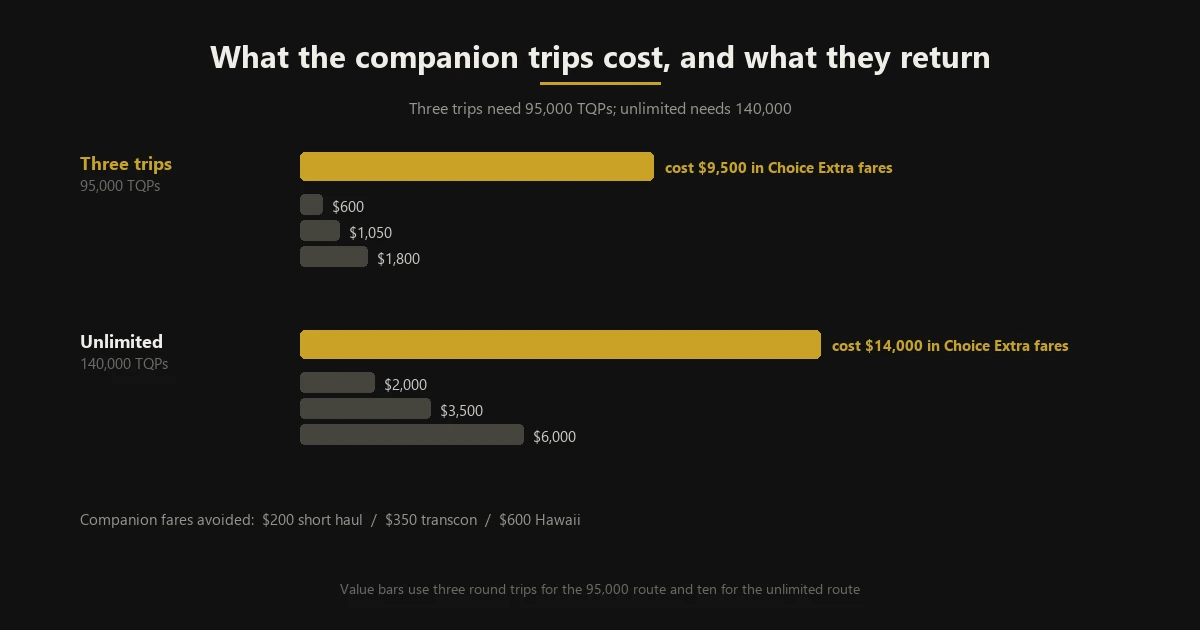
Put the two tables side by side and the conclusion is hard to avoid. For three trips to repay $9,500 of Choice Extra fares, the companion fare would have to be $3,167 per round trip, which no Southwest route reaches. Even the unlimited version needs the companion to fly roughly forty $350 round trips before it beats the $14,000 of flying behind it, and that only happens if they join nearly every trip you take.
Which is not an argument against the pass. It is an argument about who should chase it. If you already fly 75 segments a year, the three trips arrive as a byproduct and cost you nothing extra. If you are 20,000 TQPs short and thinking about manufacturing the difference, the manufactured portion alone will cost several times the companion seats it unlocks.
If you are short of points rather than TQPs, that is a different problem with a different solution — a points purchase during a discount window fills a redemption gap, but it earns no TQPs and moves you no closer to the pass.
Five rules that decide whether it works
1. Your flight has to exist first. The companion reservation is attached to yours, so you book and pay for your own ticket, then add the companion through the My Trips page. You cannot book the companion first and slot yourself in afterwards.
2. Same flights, same dates. No meeting at the connection, no flying a day earlier. If your plans differ, the companion is not on the pass.
3. Your cancellation cancels theirs. If you cancel, change or simply do not travel, the companion’s reservation goes with you. This is the rule that catches people during irregular operations: rebooking yourself does not automatically rebook the companion, and the pass has to be reapplied to the new itinerary.
4. Check in together, with identification. Both travellers check in together at the airport, and Southwest may ask to see Companion Pass documentation at the ticket counter or gate. Photo identification is required for both.
5. Three companion changes a year, and the change is not instant. You may change the designated companion up to three times per calendar year, any existing reservation with the current companion must be cancelled first, and the terms allow 21 business days for the change to process. That last detail almost never appears in summary guides, and it means a companion change planned a week before a trip can fail. Corporations cannot be a companion, and the companion must be a named individual.
What the pass does not cover, including the 2027 gap
The pass is valid on Southwest-operated flights only, and it cannot be added to travel booked through Getaways by Southwest, Group Travel, charter flights, interline itineraries or nonrevenue travel. There are no blackout dates, but a seat has to be available for sale on the flight before the companion can take it.
That list matters more in 2027 than it did before. Southwest begins earning and redeeming points with Icelandair, China Airlines and Etihad Airways from spring 2027, and those bookings are interline itineraries. The pass does not reach them. So the network is expanding in exactly the direction the Companion Pass cannot follow: the more of your travel shifts onto partner airlines, the smaller the share of your flying the pass can pay for.
For the tier side of the same currency, Southwest Rapid Rewards elite status explains how the 95,000 and 140,000 thresholds sit against Silver and Gold. For what is live in the program right now, see Southwest Rapid Rewards promotions.
Verdict
Take the pass if it arrives, do not buy it. The three-trip milestone at 95,000 TQPs is reachable for anyone flying 75 segments a year, and as a byproduct it is one of the better benefits in any US loyalty program. Bought deliberately, it is a poor deal at any companion fare Southwest actually sells. The unlimited version at Platinum is worth the extra 45,000 TQPs only for a household that travels together on nearly every trip, at fares high enough that ten or more companion round trips clear $4,500. Everyone else should treat 95,000 as the ceiling and spend the difference on the trips themselves.
Frequently asked questions
How many Tier Qualifying Points do I need for a Southwest Companion Pass?
95,000 TQPs or 75 qualifying one-way flights earn three Companion Pass trips. 140,000 TQPs or 100 flights earn Platinum status, which includes unlimited Companion Pass trips.
Do credit card welcome bonuses count toward the Companion Pass?
No. From 1 January 2027, welcome bonuses, referral bonuses, anniversary points, category bonus points and partner earnings do not count. Card spending still counts at one TQP per dollar, with no cap.
How much does the companion pay?
Taxes and fees only, from $5.60 one way on domestic itineraries, and more on international routes. The companion earns no Rapid Rewards points or TQPs for the flight.
Can I change my designated companion?
Yes, up to three times per calendar year. Any existing reservation with the current companion must be cancelled first, and Southwest allows 21 business days for the change to process, so do not plan a change close to departure.
Does the Companion Pass work on partner airlines?
No. It applies to Southwest-operated flights and cannot be added to interline itineraries, which includes the Icelandair, China Airlines and Etihad bookings Southwest begins selling from spring 2027.
Can I use a companion trip for a one-way flight?
You can, but a trip is fully consumed when redeemed whether it covers a one-way or a round trip, so a one-way use throws away half the value. Book round trips.
More Southwest Guides
Southwest Rapid Rewards promotions — every live offer and what it is worth.
Southwest Rapid Rewards elite status — Silver, Gold and Platinum, and what each costs.
How to earn Southwest Rapid Rewards points — the five sources and their real rates.
How much are Southwest Rapid Rewards points worth — the valuation behind every redemption.
Best way to spend Southwest Rapid Rewards points — the order to spend in, and what to avoid.
Southwest Rapid Rewards credit cards — which card fits which kind of flying.
Southwest Rapid Rewards partners — interline, loyalty and hotel partners, and why the points only flow one way.
Buy Southwest Rapid Rewards points — when a sale beats the redemption rate, and when it does not.
Do Southwest Rapid Rewards points expire — no, and the risk that matters is depreciation, not the calendar.