Buy Southwest Rapid Rewards points and you are paying 1.5 cents for something that redeems for 1.35 at the very best, and for less than a cent if you hold top-tier status. That is not an opinion about a particular sale. It is what happens when a revenue-based program sells its own currency at a fixed price and then prices awards off the cash fare: the retail price sits permanently above the ceiling of what the currency can buy.
The short version: the standard price is 3 cents a point including the 7.5% federal excise tax, and the recurring sale takes it to 1.5 cents at the top tier, which is where it has landed in seven of the thirteen sales Southwest ran in 2026. The net value of a point, after the taxes you still pay and the points and Tier Qualifying Points a cash fare would have earned, tops out around 1.35 cents. Buying to top off a specific award you have already found is defensible. Buying to hold a balance has never worked, and from 1 January 2027 it also does nothing for status or the Companion Pass.
Three numbers, one conclusion
Everything in this guide reduces to three figures. Two of them are prices Southwest sets. The third is a value the program cannot exceed, no matter which flight you pick or how carefully you book it.
| Number | Figure | What it means |
|---|---|---|
| Standard price | 3.0 cents per point | Inclusive of the 7.5% federal excise tax. This is what the buy page shows when no sale is running. |
| Sale floor | 1.5 cents per point | A 50% discount, targeted, and the best rate Southwest has ever published. Reached in seven of the thirteen 2026 sales. |
| Net value ceiling | 1.35 cents per point | A Basic award on a trip you would have paid for, with no status. Falls to 1.21 cents on Choice Extra and 0.99 cents for a Platinum member. |
The sale floor is above the ceiling. That comparison settles most of the cases people ask about.
What the sale actually charges
Southwest sells points in 1,000-point blocks with a 2,000-point minimum. The daily cap during the current sale, which runs to 11:59 p.m. CT on 31 December 2026, is 100,000 points; outside a sale the buy page has historically shown 60,000. There is no annual cap.
The discounts are targeted, and the tiers are not the same for every account. The pattern in the current sale is no discount at 2,000 points, then 50% from 3,000 points up. Some accounts see the 50% tier start at 5,000, and some see only 45% or 40%.
That structure produces the single most useful oddity on the page. At the no-discount tier, 2,000 points cost $60. At the 50% tier, 3,000 points cost $45. Buying 1,000 more points costs $15 less. Anyone who needs a small top-up and buys the minimum is paying a 33% premium over the buyer who takes one more block.
| Discount shown | Cost per point | Cost of 3,000 points | Cost of 60,000 points |
|---|---|---|---|
| None | 3.0 cents | $90 | $1,800 |
| 35% | 1.95 cents | $58.50 | $1,170 |
| 40% | 1.8 cents | $54 | $1,080 |
| 45% | 1.65 cents | $49.50 | $990 |
| 50% | 1.5 cents | $45 | $900 |
Two mechanical details matter more than they look. Purchases are processed by Points.com, so the charge does not code as airfare: a Southwest co-branded card earns its everyday rate, not its 4X Southwest rate. And the purchase is final. There is no refund, no reversal and no cooling-off period, which is why buying before you have an award priced is a one-way bet.
Points post immediately in practice, though the terms allow up to 72 hours.
Why the ceiling is below the floor
A Rapid Rewards point is worth the cash fare of the seat you book, minus the taxes you still pay on an award, minus the points and Tier Qualifying Points that a cash purchase of the same seat would have earned. That last subtraction is the one published valuations leave out, and it is the one that decides this question.
Run it on a $200 Choice Extra fare. The award costs roughly 15,400 points. The award ticket carries $5.60 in taxes. A cash purchase of the same seat earns 2,000 points at the 10X base rate, plus 2,000 Tier Qualifying Points. So the award is worth $200 minus $5.60 minus the value of 2,000 points and 2,000 TQPs you gave up. At 1.3 cents a point that is about $26, and the net value lands at 1.21 cents per point.
Change one variable and the ceiling drops. Book Basic instead and you forgo only 400 points, so the net rate rises to about 1.35 cents. Hold Platinum and the cash fare earns 22X after the 120% bonus, so 4,400 points and 4,400 TQPs disappear when you redeem, and the net rate falls to 0.99 cents. The better your status, the less each point is worth, because the cash fare you are not buying would have been worth more.
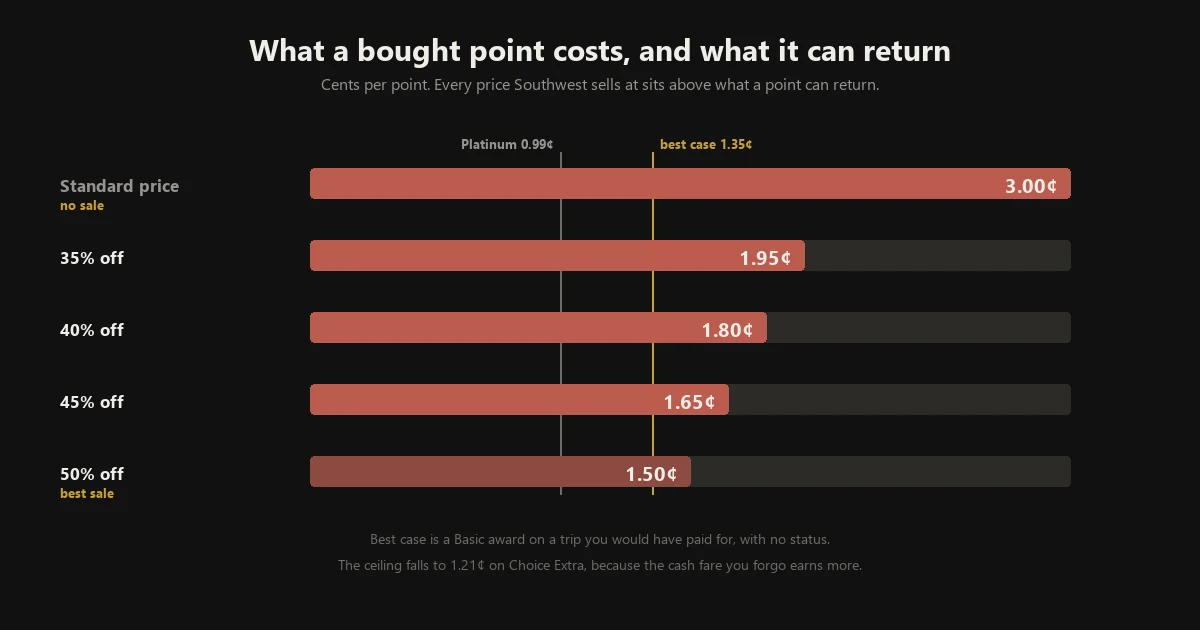
Now place the price against that. Even the best sale, at 1.5 cents, is above the best case of 1.35 cents. The 45% tier at 1.65 cents is above every case. The standard price of 3 cents is more than double the ceiling. This is not a matter of finding a better redemption. There is no redemption in the program that lifts the net rate above the sale price, because the sale price is set independently of what the currency buys.
The comparison nobody runs
Guides that ask whether buying points is worth it usually compare the purchase price to a redemption value. That comparison flatters buying, because it treats the cash fare as a pure cost with no return. It is not. On Southwest, a cash fare earns points and Tier Qualifying Points at the same multiple, and from 2027 that multiple runs from 2X on Basic to 10X on Choice Extra, with a 40%, 60% or 120% elite bonus on the points.
So the honest comparison is between the all-in cost of buying points to book an award and the net cost of simply paying cash for the same seat. On a $200 Choice Extra fare, three routes:
| Route | Cash out | Points and TQPs earned | Net cost |
|---|---|---|---|
| Buy 15,400 points at 50% off, book the award | $231 plus $5.60 taxes | 0 points, 0 TQPs | $237 |
| Pay cash, no elite status | $200 | 2,000 points, 2,000 TQPs | $174 |
| Pay cash as a Platinum member | $200 | 4,400 points, 4,400 TQPs | $143 |
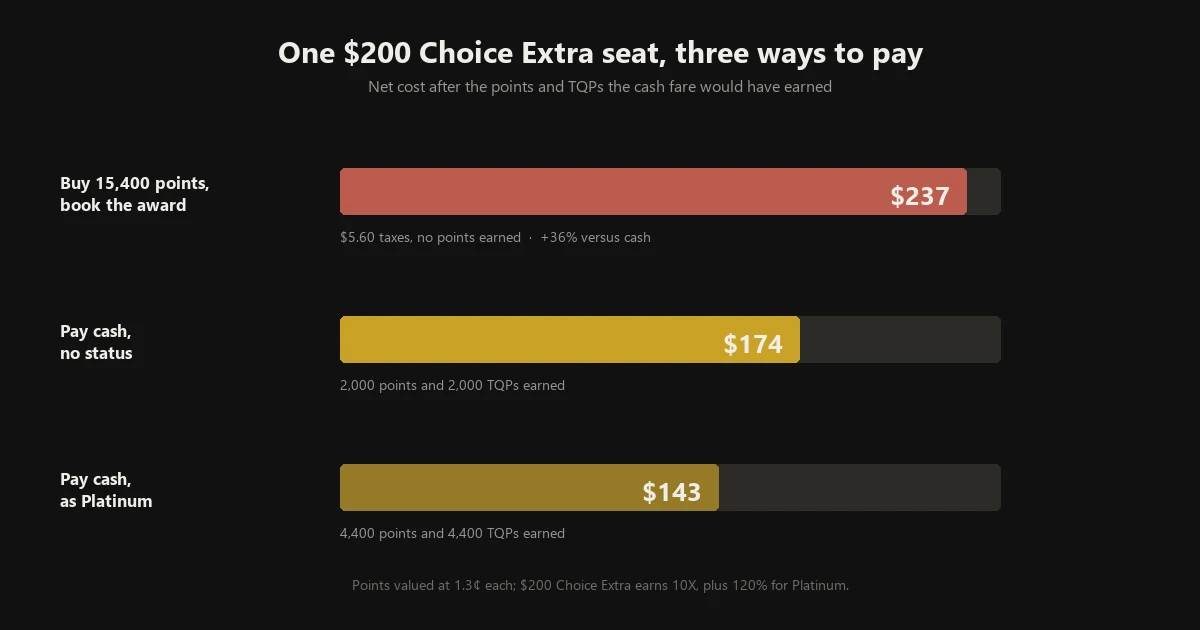
Buying the points costs 36% more than paying cash without status and 66% more than paying cash with it. The gap does not come from the discount being small. It comes from the award earning nothing: no points, no Tier Qualifying Points, and no progress toward the 35,000 TQPs that Silver now requires.
There is a second-order effect too. Award prices track the cash fare, so the fare you are topping up for can move before you buy, and the purchase neither holds the seat nor comes back. Buying to reach an award is a bet on a price Southwest can change until the booking is confirmed.
The Companion Pass case, which also fails
The strongest argument for buying points is the Companion Pass. One award, two passengers, and the effective value of every point doubles. At 1.21 cents net for a single seat, a companion turns the same redemption into roughly 2.4 cents, which finally clears the 1.5-cent sale price.
The argument collapses on the same subtraction. A cash fare with a Companion Pass also seats two people. The companion flies free on a paid ticket exactly as they do on an award. So the choice is not between buying points and paying for two seats. It is between buying points and paying for one, and paying for one still earns points and TQPs.
On the same $200 fare: buying 15,400 points costs $237 for two seats. Paying cash as a Platinum member costs $200, earns 4,400 points worth about $57, and seats the companion for the price of the taxes. The net cost is $143 for the same two seats. The Companion Pass doubles the value of whatever you spend. It does not make a bad currency purchase good.
The Companion Pass is also no longer reachable this way. Purchased points have never counted toward Companion Pass qualification, and from 1 January 2027 the pass is earned through 95,000 Tier Qualifying Points for three trips or Platinum status for unlimited ones. There is no purchase route at all.
The only three conditions for buying
Buying is defensible in exactly one shape: a small top-up against an award you have already found. Three conditions should all hold before you enter a card number.
- You have the award in front of you, priced and available. Not a route you might fly. A specific flight, a specific date, and a points price you can book the moment the points land.
- The gap is small. Under about 5,000 points, buying costs $75 or less at the sale price and closes a gap that would otherwise cost a whole cash fare. Above that, the cash fare is cheaper once you count what it earns.
- Neither 1:1 transfer route is open to you. If you hold a Chase Sapphire or a Bilt card, transferring costs nothing and beats buying every time.
If those three conditions hold and you have decided to buy, the purchase runs through Southwest’s buy page, which is operated by Points.com: buy Rapid Rewards points here. Use a card you are trying to put spending on, not a Southwest card, because the charge will not code as airfare.
The free routes in
Two programs move points into Rapid Rewards at par, and both cost nothing beyond the value of the currency you send.
| From | Ratio | What 60,000 becomes | Cash cost |
|---|---|---|---|
| Chase Ultimate Rewards | 1:1 | 60,000 points | $0 |
| Bilt Rewards | 1:1 | 60,000 points | $0 |
| Marriott Bonvoy | 3:1, plus 5,000 per 60,000 | 25,000 points | $0, but about 2 cents of Bonvoy value per point received |
| Buying points | — | 60,000 for $900 | 1.5 cents per point |
A Chase point that moves here is worth about 1.25 to 1.35 cents as a Southwest point, which is less than the same point is worth at Hyatt or United. That is a real cost, just not a cash one, and it is still smaller than paying 1.5 cents in cash for the same result. Transfers require a Sapphire Preferred, Sapphire Reserve, Sapphire Reserve for Business or Ink Business Preferred; a Freedom card cannot transfer on its own. Bilt requires nothing beyond the card.
Marriott is the one route that can cost more than buying. Sixty thousand Bonvoy points turned into 25,000 Rapid Rewards points destroy roughly $500 of Bonvoy value to create about $310 of Southwest value. It is a route for a stranded balance, not a strategy.
Gifting and transferring, priced
Southwest also lets you gift points to another member and transfer points between accounts, and neither is a way around the arithmetic.
Gifting uses the same purchase mechanism at the same price, so it is buying points for someone else. Gifts count against the same daily ceiling as purchases, which means a gift is not a way to buy past the cap.
Transferring is cheaper and less useful. It costs $5 per 500 points, which is 1 cent per point, with a 2,000-point minimum and a 60,000-point cap per transaction, and points take up to 72 hours to move. At 1 cent it is below the 1.5-cent sale price and below the 1.35-cent ceiling, so transferring is the cheapest paid route into a specific account. It still loses to the free option, which costs nothing at all: book the award from the account that holds the points and put the other person on the itinerary. Southwest does not require the passenger to be the account holder.
How often the sale runs
Southwest ran thirteen buy-points promotions in 2026, roughly one every four weeks, and seven of them reached the 50% tier. That cadence is the strongest argument against stocking up: the deal you are looking at will come back, and the only thing buying early guarantees is that you hold points you have not found a use for.
| Sale ended | Top discount | Best cost per point |
|---|---|---|
| 23 February 2026 | 50% | 1.5 cents |
| 2 March 2026 | 35% | 1.95 cents |
| 4 April 2026 | 50% | 1.5 cents |
| 13 April 2026 | 40% | 1.8 cents |
| 30 May 2026 | 45% | 1.65 cents |
| 8 June 2026 | 45% | 1.65 cents |
| 2 August 2026 | 45% | 1.65 cents |
| 26 August 2026 | 50% | 1.5 cents |
| 31 August 2026 | 45% | 1.65 cents |
| 2 October 2026 | 50% | 1.5 cents |
| 29 October 2026 | 50% | 1.5 cents |
| 17 November 2026 | 45% | 1.65 cents |
| 31 December 2026 | 50% | 1.5 cents |
Two practical conclusions follow. If your account shows 45% or 40%, wait: the next 50% sale is weeks away, not months. And because offers are targeted, the tier you see is not the tier everyone sees, so a report of a 1.5-cent sale does not mean your account has it.
What changes on 1 January 2027
Three changes matter here, and all three push in the same direction.
Purchased points never counted toward elite status or the Companion Pass, and the terms still say so. From 2027 that exclusion is written into a program where the Companion Pass is earned only through Tier Qualifying Points or qualifying segments, so there is no longer any ambiguity to exploit: buying points cannot move you toward status, toward the three-trip pass at 95,000 TQPs, or toward unlimited companion travel at Platinum.
Cash fares keep earning both points and TQPs at the same multiple, from 2X on Basic to 10X on Choice Extra, with card spending adding 1 TQP per dollar. Every one of those paths is closed to a purchased point. The gap in the table above therefore widens with each tier you climb, because the cash alternative gets better while the purchase price does not move.
The third change is the one that removes the last argument. Award tickets do not earn points or TQPs, and from 2027 they do not earn Companion Pass progress either. A purchase that funds an award now forgoes three things instead of two.
Verdict
Buy Southwest points only to close a small gap on an award you have already found, and only if you cannot transfer from Chase or Bilt. Under those conditions the purchase is a convenience fee, not a saving.
Everything else fails on the same arithmetic. The 1.5-cent floor sits above the 1.35-cent ceiling, the cash fare you are not buying would have earned points and TQPs, and the Companion Pass doubles the value of a purchase without making it cheaper than cash. A program that prices awards off the cash fare cannot sell its own currency below the value of that fare, and it does not try.
If you are deciding between spending and buying, price the trip twice and start from what a Rapid Rewards point is actually worth. If you already hold a balance you cannot use well, the answer is usually where to spend it, not how to add to it.
Last updated: 25 November 2026. Sale terms and prices reflect the promotion running to 31 December 2026.
Frequently asked questions
Is it worth buying Southwest points at 50% off?
Usually not. At 1.5 cents a point you are paying more than the 1.35 cents a point is worth on a Basic award with no status, and more than the 0.99 cents it is worth to a Platinum member booking Choice Extra. The exception is a small top-up on an award you have already priced and can book immediately.
How much do Southwest Rapid Rewards points cost?
Three cents each at the standard price, including the 7.5% federal excise tax. Sales take it as low as 1.5 cents at the 50% tier, which is the best rate Southwest has published and the tier reached in seven of the thirteen 2026 sales.
How many Southwest points can I buy at once?
The minimum is 2,000 points, sold in 1,000-point blocks. The daily cap during the sale running to 31 December 2026 is 100,000 points, and there is no annual limit. Purchases, gifts and transfers are measured against the same daily ceiling.
Do purchased points count toward the Companion Pass?
No. Purchased points have never counted toward elite status or the Companion Pass, and from 1 January 2027 the pass is earned only through Tier Qualifying Points or qualifying segments: 95,000 TQPs for three companion trips, or Platinum status at 140,000 TQPs for unlimited ones.
Do Southwest Rapid Rewards points expire?
No. Rapid Rewards points do not expire while the account remains open, which removes any deadline pressure to buy points you have no immediate use for. Closing the account forfeits the balance.
Can I transfer points to another member instead of buying?
Yes, at $5 per 500 points, which is 1 cent per point, with a 2,000-point minimum and a 60,000-point cap per transaction. It is cheaper than buying at 1.5 cents, but the free alternative is better: book the award from the account that holds the points and name the other person as the passenger.
More Southwest Guides
- Southwest Rapid Rewards promotions: every live offer and what it is worth
- Southwest Rapid Rewards elite status: Silver, Gold and Platinum in full
- Southwest Companion Pass: three trips or unlimited, and what each costs
- How to earn Southwest Rapid Rewards points
- How much are Southwest Rapid Rewards points worth
- The best way to use Southwest Rapid Rewards points
- Southwest Rapid Rewards credit cards compared
- Southwest Rapid Rewards partners: what each kind of partnership gets you
- Do Southwest Rapid Rewards points expire — no, and the risk that matters is depreciation, not the calendar.
Next step: if you are short of an award, check the Chase and Bilt transfer routes before you open the buy page. Both move points at 1:1 for nothing, and a transfer that arrives instantly is worth more than a purchase that saves $15 on a block.