Southwest Rapid Rewards credit cards all do the same three things: they kill the checked-bag fee, they put you in Group 5, and they hand you a seat. What changes as the annual fee climbs from $99 to $299 is how good that seat is and how many points come with it. That is the whole product. So the question is not which card is best, it is how many bags you check and how badly you want legroom.
The short version: the Plus card pays for itself on one round trip with a checked bag, and the Priority card does not pay for itself at all on the benefits you can count. From 1 January 2027 every one of these cards also earns 1 Tier Qualifying Point per dollar spent, uncapped, which is the first time the cheapest card has counted toward status. It is still the slowest way to earn status in the program, roughly half the rate of the worst fare, so the card is a place to park spending you were already doing, not a reason to spend more.
The five cards, side by side
Three personal cards and two business cards, all issued by Chase on the same skeleton. Every one returns the first checked bag free for the cardholder and up to eight passengers on the same reservation, boards no later than Group 5, and carries no foreign transaction fee. What differs is the fee, the earn rate, the anniversary points and the seat you can claim.
| Card | Annual fee | Points per $1 | Anniversary points | Seat benefit |
|---|---|---|---|---|
| Rapid Rewards Plus | $99 | 2X Southwest; 2X gas and grocery on the first $5,000 a year; 1X elsewhere | 3,000 | Standard seat within 48 hours of departure |
| Rapid Rewards Premier | $149 | 3X Southwest; 2X grocery and dining on the first $8,000 a year; 1X elsewhere | 6,000 | Standard or Preferred seat within 48 hours |
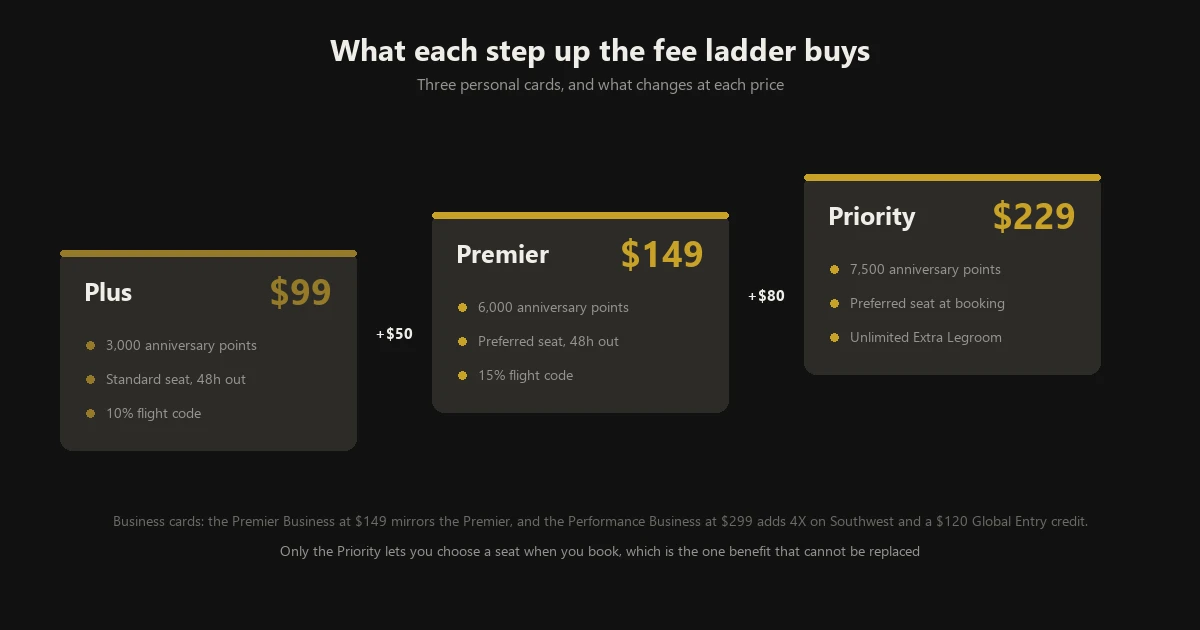
| Rapid Rewards Priority | $229 | 4X Southwest; 2X gas and dining; 1X elsewhere | 7,500 | Preferred seat at booking; unlimited Extra Legroom upgrades within 48 hours |
| Premier Business | $149 | 3X Southwest; 2X gas and dining on the first $8,000 a year; 1X elsewhere | 6,000 | Standard or Preferred seat within 48 hours |
| Performance Business | $299 | 4X Southwest; 2X hotels booked direct, gas, dining and transit; 1X elsewhere | 9,000 | Standard or Preferred seat within 48 hours |
Two cards stand out. The Priority is the only one that lets you pick a seat when you book, and the only one that hands out Extra Legroom upgrades. The Performance Business is the only one that pays a Global Entry, TSA PreCheck or NEXUS application, up to $120 once every four years. Everything else is a variation on a bag waiver and a pile of anniversary points. Welcome offers move monthly and are not worth planning around: at the time of writing the personal cards advertised 80,000, 85,000 and 90,000 points, the business cards 60,000 and 80,000.
What the annual fee actually buys
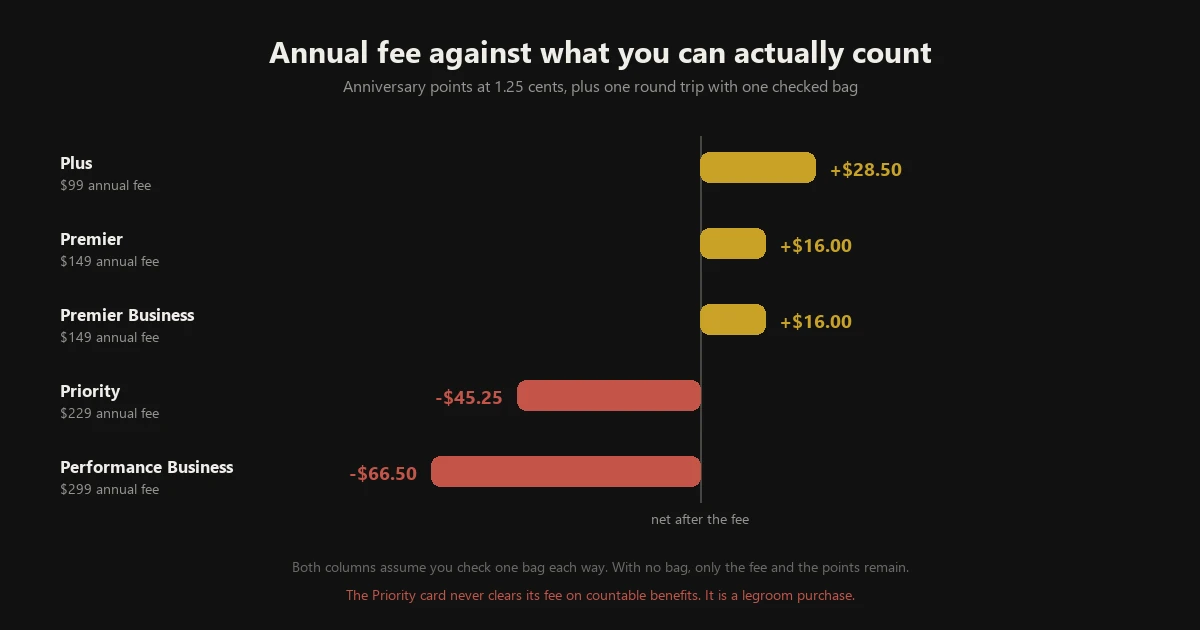
Strip out the soft benefits and each card pays back in two currencies: anniversary points, worth about 1.25 cents each on the valuation this cluster uses, and the bag waiver, worth $45 per bag per trip. One round trip with one checked bag is $90 of avoided fees, and that number alone decides whether the cheap cards are free.
| Card | Fee | Anniversary points | One round trip, one bag | Net in year one |
|---|---|---|---|---|
| Plus | $99 | $37.50 | $90 | +$28.50 |
| Premier | $149 | $75.00 | $90 | +$16.00 |
| Premier Business | $149 | $75.00 | $90 | +$16.00 |
| Priority | $229 | $93.75 | $90 | −$45.25 |
| Performance Business | $299 | $112.50 | $90 | −$66.50 |
Read that with one bag and one round trip, which is the floor rather than the average. Fly twice with a bag and the Premier is $106 ahead. The Priority stays negative however many bags you check, because its fee is $80 above the Premier and its extra anniversary points are worth $18.75. The Priority card is not a value purchase. It is a legroom purchase.
The check nobody runs before applying is the counterfactual: if you would not check a bag, the waiver is worth nothing and the Plus card is a $99 subscription to 3,000 points, or $37.50. Both cards that clear their fee only do so for people already paying bag fees.
The seat ladder is the only real difference
Southwest moved to assigned seating on 27 January 2026, which turned the old boarding-position perks into something you can price. The cards now buy seat access instead of boarding order, on three rungs. Plus gets a Standard seat inside 48 hours. Premier and Premier Business get Standard or Preferred inside 48 hours. Priority gets Preferred at booking, plus unlimited Extra Legroom upgrades inside 48 hours.
The 48-hour clock is the part the marketing glosses over: on a full flight the Preferred seats worth having are gone before the window opens. A benefit you can only use on empty flights is a discount, not a guarantee. Preferred at booking is therefore the only genuinely scarce thing in this lineup, and Extra Legroom on a four-hour segment is the only card benefit with a cash price that is not a bag fee. Fly two long segments a year and would otherwise pay for the legroom seat, and $229 is cheaper than buying it twice.
2027: every card becomes a status card
Until 31 December 2026 the status side of these cards is a patchwork: the Plus earns nothing, the Premier Business 2,000 TQPs per $5,000 spent, the Priority and Performance Business 2,500 per $5,000, and the Premier on a rate that makes no sense next to its own sibling. From 1 January 2027 the whole structure collapses into one line: 1 Tier Qualifying Point for every $1 spent, on every card, with no cap. The Plus going from zero to the same rate as the $299 card is the real change. TQPs count toward Silver, Gold and Platinum, and toward the Milestone Rewards between them, including the 95,000-TQP tier that grants three Companion Pass trips.
| How the TQPs arrive | Spend for Silver (35,000) | Spend for Gold (65,000) | Spend for Platinum (140,000) |
|---|---|---|---|
| Credit card, 1 TQP per $1 | $35,000 | $65,000 | $140,000 |
| Flying, Basic fare, 2X | $17,500 | $32,500 | $70,000 |
| Flying, Choice fare, 6X | $5,833 | $10,833 | $23,333 |
| Flying, Choice Preferred, 8X | $4,375 | $8,125 | $17,500 |
| Flying, Choice Extra, 10X | $3,500 | $6,500 | $14,000 |
So the card is the most expensive way to buy a TQP in the program, by a factor of two against the worst fare and ten against the best. The dollars are not equivalent, though: the card spends money you were going to spend on groceries, the flying route spends money on flights you have to take. The card is not a worse deal, it is a different deal, and it only works when the spending already exists.
Two mechanics decide whether the points land in the year you expect. Card TQPs post after each billing cycle closes, and the earning year runs from your account open date to your December statement, so spending in the final week of December can fall into the next year’s total. And the welcome bonus no longer helps: from 2027 sign-up points carry no TQPs, because TQPs are earned on dollars spent, not points awarded. There is also a one-off 2027 boost of 10,000 TQPs after you reach 130,000, valid through 31 December 2028 — a bridge for people already at the top, not a shortcut.
The math that says don’t spend for status
Run the Silver threshold through the card. $35,000 of spending earns 35,000 TQPs and 35,000 points. If that $35,000 had gone on a flat 2% cashback card it would have returned $700, so the true price of Silver this way is $700 of forgone cash. The question is whether Silver returns $700 to somebody who already holds one of these cards.
It largely does not. Silver brings a Preferred or Standard seat at booking, an Extra Legroom upgrade inside 48 hours, Group 1 boarding, a free bag and a 40% earning bonus. A cardholder arrives with the bag, Group 5 and a seat. What Silver adds is Group 1 over Group 5, and the 40% bonus. On Choice Preferred fares at 8X, that bonus is worth 56,000 extra points after $17,500 of flying, which is $700. You spend $35,000 on the card to reach a tier whose bonus only repays the outlay after another $17,500 of flying.
The card is not bad, it is just narrow. It converts spending you were already making into a slow trickle of TQPs, at no marginal cost beyond the fee and the cashback you gave up. The moment you increase spending to chase a tier the trade inverts, because you are paying 2% of every dollar for the least efficient TQP in the market.
Who the new rule actually rewards
One group comes out clearly ahead, and it is the group the change was aimed at. A small business already pushing $140,000 a year through cards reaches Platinum and unlimited Companion Pass trips as a by-product of paying suppliers, with no flying involved. Before 2027 that business could not buy status with spending at any price, because the rates were too low and the caps too tight. Now the rate is flat and the ceiling is gone.
The mirror image is the churner, who loses the mechanism entirely. A Companion Pass used to mean a sign-up bonus plus a 10,000-point card boost plus some top-up spending. From 2027 the bonus contributes nothing, the boost is gone, and three Companion Pass trips cost 95,000 TQPs — $95,000 of card spending or $9,500 of Choice Extra flying. That is not a game, it is a budget line.
Which card for which traveller
Check a bag once a year and nothing else: the Plus. It is the only card that pays for itself on a single round trip, and 3,000 anniversary points cover a third of the fee on top. You give up Preferred seats and Extra Legroom, which on short flights you were not going to get anyway.
Fly four to eight times a year, often with family: the Premier. The bag waiver extends to eight companions, the anniversary points are double the Plus, the 15% anniversary promo code covers most of the fee gap on one $300 fare, and Preferred seats inside 48 hours are a real upgrade on longer routes.
Fly long segments and care where you sit: the Priority, with your eyes open about the $45 it costs above. Preferred at booking and unlimited Extra Legroom are worth more than that to anyone who would otherwise pay for those seats, and worth nothing to anyone who would not.
Run a business with real card volume: the Premier Business for the 15% code and the lower fee, the Performance Business if the 4X on Southwest and the $120 Global Entry credit clear the extra $150. Neither is worth carrying for the anniversary points.
The application rules you cannot design around
One personal card at a time. You cannot open a second Southwest personal card while one is open, so the ladder is a product change or a cancellation, not a collection. A personal and a business card can coexist.
One bonus every 24 months. You are ineligible for a personal card bonus if you have received one from any Southwest personal card in the previous 24 months. The business cards run the same rule separately against business cards, which is why the two lines can be worked in parallel.
Chase 5/24. Five or more new cards from any issuer in 24 months and the application is likely to be declined regardless of your history with Chase. Business cards usually do not add to that count once open, which is why they are attractive to anyone close to the line.
The annual fee is not waived. It lands on the first billing statement on every card in the lineup, so there is no free first year to test the benefits against.
What is still unannounced
Southwest has confirmed two things about 2027 with no terms attached: a new premium credit card, and Southwest Icon Lounges at select airports with lounge access included as a card benefit. No fee, no earn rate, no date. Do not wait for it. If you hold the Priority, it is the card most exposed when the premium product lands, and repositioning usually moves benefits up a tier rather than leaving them in place.
Verdict
The Southwest Rapid Rewards lineup is a bag waiver with a seat attached, sold at five prices. The Plus wins on arithmetic, the Premier wins on arithmetic plus a promo code, and the Priority is the only one bought for a reason other than money. That is not a criticism of the Priority card, it is a warning about how it gets sold.
The 2027 change is bigger than the fee table suggests. Once every card earns 1 TQP per dollar with no cap, the card stops being a perk and becomes a status instrument, and the cheapest card matches the most expensive one for that purpose. The travellers who gain have spending that already exists. The ones who lose used to buy a Companion Pass with a sign-up bonus, and that door closes on 1 January 2027.
What changed, and when
| Date | Change | Effect on the cards |
|---|---|---|
| 27 January 2026 | Assigned seating and four named fares | Boarding position replaced by seat access as the card benefit |
| November 2026 | Personal offers raised to 80,000–90,000 points | Bigger bonuses, but they no longer buy status from 2027 |
| 31 December 2026 | Card TQPs at the old patchwork rates end | The Plus card earns nothing toward status until this date |
| 1 January 2027 | 1 TQP per $1 on every card, uncapped | Cheapest card becomes a status card; Companion Pass boosts removed |
| 2027 | 10,000 TQP boost after 130,000 TQPs | One-off bridge to Platinum, valid through 2028 |
| 2027, undated | Premium card and Icon Lounges announced | Priority card most exposed to repositioning |
Last updated 25 November 2026. Annual fees, earn rates and card benefits checked against the Chase card pages for each product; 2027 Tier Qualifying Point rules checked against Southwest’s Rapid Rewards 2027 pages.
FAQ
Do Southwest credit cards earn Tier Qualifying Points?
From 1 January 2027, yes, on every card including the Plus. You earn 1 Tier Qualifying Point per $1 of eligible purchases with no annual cap, and the points post after each billing cycle closes. Before that date the rates vary by card and the Plus earns none.
Which Southwest card is worth the annual fee?
The Plus, if you check a bag: one round trip with one bag avoids $90 against a $99 fee, and 3,000 anniversary points add about $37.50. The Premier is worth it if you fly four or more times a year or can use the 15% promo code. The Priority is worth it only if you will use Preferred seat selection at booking or the Extra Legroom upgrades.
Do credit card points count toward the Companion Pass in 2027?
Spending does, bonus points do not. Card purchases earn TQPs at 1 per $1, and TQPs count toward the 95,000 that grants three Companion Pass trips and the 140,000 for unlimited trips at Platinum. Points from a welcome offer carry no TQPs, so a sign-up bonus no longer shortens the path.
Can I hold more than one Southwest personal card?
No. Chase issues one Southwest personal card at a time, and you are ineligible for a new personal bonus if you received one in the previous 24 months. A personal and a business card can be held together, and the business cards run their own 24-month clock.
Does the welcome bonus count toward elite status?
No, not from 2027. TQPs are earned on dollars spent, so bonus points awarded for hitting a spending threshold produce no TQPs of their own. The spending that triggers the bonus does earn them, at 1 per $1.
What is the 10,000 TQP boost in 2027?
A one-off award for cardholders who reach 130,000 TQPs between 1 January and 31 December 2027. It adds 10,000 TQPs, enough to cross the 140,000 Platinum threshold, and the status is valid through 31 December 2028. It does nothing for anyone who does not reach 130,000 first.
More Southwest Guides
Southwest Rapid Rewards promotions — every live offer and what it is worth.
Southwest Rapid Rewards elite status — Silver, Gold and Platinum, and what each costs.
Southwest Companion Pass — three trips or unlimited, and what each costs.
How to earn Southwest Rapid Rewards points — the twelve sources and their real rates.
How much are Southwest Rapid Rewards points worth — the net rate after what you forgo.
The best way to use Southwest Rapid Rewards points — three rules instead of three routes.
Southwest Rapid Rewards partners — interline, loyalty and hotel partners, and why the points only flow one way.
Buy Southwest Rapid Rewards points — when a sale beats the redemption rate, and when it does not.
Do Southwest Rapid Rewards points expire — no, and the risk that matters is depreciation, not the calendar.