Ask what the best way to use Southwest points is and most guides answer with a route: Hawaii from the West Coast, a cheap Tuesday hop, a Caribbean fare in shoulder season. That answer stopped working the moment Southwest priced awards off the cash fare. There is no award chart, so there is no sweet spot to hunt. A seat quoted at 20,000 points is quoted that way because the cash fare is around $260, and a seat quoted at 4,000 points is a $52 fare wearing a different label. The cents-per-point number barely moves from one to the other.
The short version: the best way to use Southwest points is not a destination, it is three conditions. Spend them only on a trip you would have paid cash for anyway. Pay cash instead when your tier is high enough that the forgone earning is large. And prefer the award ticket precisely because it refunds to points even on a Basic fare, which the cash version never does. Everything else in this program, including the More Rewards catalogue and the points-for-seats feature arriving in late 2027, is a worse exchange than a flight.

Every way out of your balance, ranked
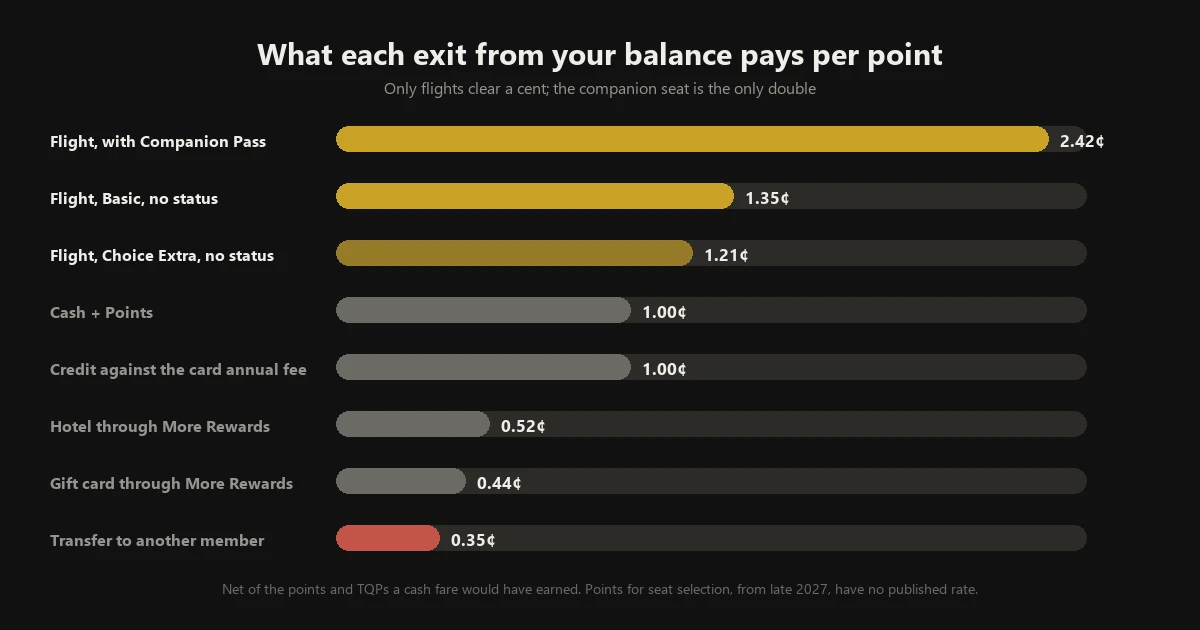
Nine exits exist today, and one more arrives late in 2027. They are not close to each other in value. The figures below are net of the points and Tier Qualifying Points you give up by not paying cash, which is the correction most published valuations skip.
| Where the points go | Value per point | When it makes sense |
|---|---|---|
| Companion Pass second seat | 2.2 to 2.7 cents | You were flying anyway and the companion was going anyway |
| Flights, Basic fare, no status | 1.35 cents | Trip is firm and a carry-on is enough |
| Flights, Choice Extra fare | 1.21 cents | You need the extra legroom seat and two checked bags |
| Flights, Choice Extra, Platinum member | 0.99 cents | Almost never: paying cash earns 10X and a 120% bonus |
| Cash + Points | 1.00 cent on the points used | You are a few thousand points short, and the cash portion earns TQPs |
| Transfer to another member | 0.35 cents | Never, when booking a ticket in their name is free |
| More Rewards hotels | About 0.52 cents | Only if a specific hotel is the whole point of the trip |
| Gift cards and merchandise | 0.27 to 0.53 cents | Never |
| Seat selection, from late 2027 | Priced at the seat, not published | Only when the fare you booked already includes the seat |
Why there are no sweet spots left
A sweet spot in a traditional program is a redemption priced below what the airline would charge in cash, found by comparing an award chart against fares. Southwest deleted half of that comparison. Award prices track the cash fare, so the ratio is roughly constant across routes and dates: a $99 Basic fare and a $249 Choice Extra fare on the same flight return almost the same cents per point.
That removes two habits that still dominate Southwest advice. The first is route hunting: there is no Hawaii exception, because a Hawaii award costs more points for exactly the reason the cash fare costs more. The second is fare-class arbitrage, the claim that a cheap fare returns 1.5 cents and a flexible one 1.1 cents. Since 27 January 2026 the fare you pick changes what the trip includes, not what a point is worth.
What is left is a decision about currency: on this trip, do you want to spend dollars or points? That is a better question, and it has an answer.
The three rules that decide the outcome
Three conditions separate a redemption that saves real money from one that quietly costs it. They are independent of route, season and fare class.
| Rule | What it means in practice | Why it changes the math |
|---|---|---|
| Only spend points on a trip you would have paid for | If the trip exists because the balance exists, the saving is imaginary | Points are near-cash; a trip you would not have bought converts 1.35 cents into a $0 saving |
| Pay cash when your tier is high | At Platinum, cash earns 10X plus a 120% bonus; an award earns nothing | The forgone earning drags net value from 1.35 cents to 0.99 |
| Buy flexibility, not luxury | An award ticket refunds to points even on a Basic fare | Cash Basic fares are non-refundable outside the 24-hour window |
Rule one: the companion seat
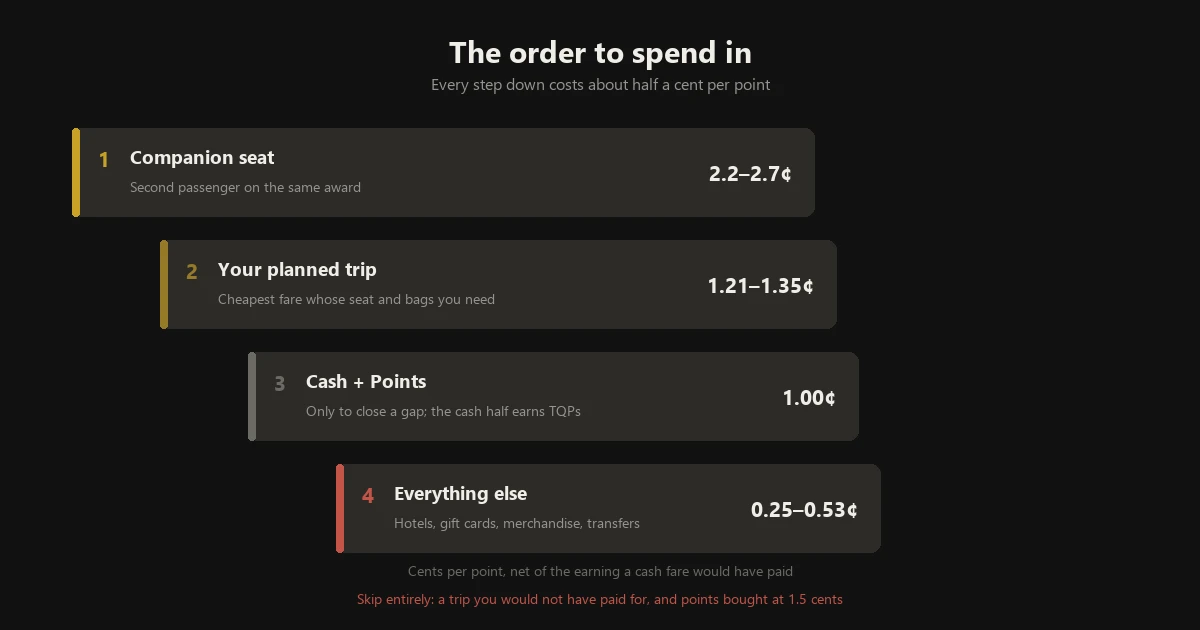
Companion Pass is the only mechanism in Rapid Rewards that genuinely doubles the return on a point, because it puts a second passenger on the same award without a second award. A $260 fare booked for 20,000 points returns 1.3 cents on its own. The same booking carrying a companion returns 2.6 cents per point, since the points bought two seats.
The companion pays their own taxes and fees, from $5.60 each way domestic, on award and cash bookings alike. A companion trip therefore costs $11.20 round trip plus the points you spent to fly yourself.
Two limits keep this honest. From 1 January 2027 three trips arrive as a Milestone Reward at 95,000 Tier Qualifying Points or 75 qualifying flights, and unlimited trips require Platinum at 140,000 TQPs or 100 flights. The pass also applies to Southwest-operated flights only, not to the interline partners Southwest begins selling in spring 2027. Earning it is a separate calculation, covered in the Companion Pass guide, which concludes that you should take the trips if they come, not add flying to reach the threshold.
The spending rule is simple: with a Companion Pass active, a points booking is worth roughly twice what it is worth without one. That is the only place on this page where a good redemption stops being a judgement call.
Rule two: your own trip, priced twice
For the ordinary case, a ticket for one person with no companion, the right method is to price the same trip twice and compare the two totals honestly. Take the cash fare, subtract the $5.60 you pay either way, and divide by the points the same seat costs. On a $260 fare quoted at 20,000 points that is 1.27 cents; on the same route a month later at $520 and 40,000 points it is about the same, because both numbers moved together.
That is why the answer rarely changes with the route, and why the two levers that do change it are timing and rebooking.
Timing: the Low Fare Calendar is a points tool.
Southwest’s calendar shows the lowest fare for each day of a month, and the points price moves with it. Shifting a trip from a Friday to a Tuesday commonly cuts the cash fare by a third, and the points required by the same third. The rate does not improve, but the number of points you spend does, and points you do not spend stay available for the next trip.
Rebooking: the price drop is recoverable.
Southwest lets you change a Choice, Choice Preferred or Choice Extra booking without a change fee, and when the new itinerary costs fewer points the difference returns to your account. A Basic award cannot be changed directly, but it can be cancelled and rebooked, which returns all the points and creates a new booking at the lower price. The practical tactic is to book early, keep checking the same flight in the points view, and rebook when the number falls. This works because award inventory is not capacity controlled: every seat is an award seat, so the only variable is price.
The refund path is worth naming: points go back to the account that booked, not into a travel credit with an expiry date. A cash Basic fare returns a non-transferable credit that expires six months after ticketing.
Which of the four fares to book with points
All four fares can be bought with points, and the points price scales with the fare. The choice is therefore not about cents per point, it is about what happens when plans change. The table reflects Southwest’s published fare rules as of November 2026.
| Fare | Seat at booking | Bags | Change a points booking | Cancelled in time | No-show |
|---|---|---|---|---|---|
| Basic | Assigned at check-in | Fee on first bag | Upgrade to Choice first, or cancel and rebook | Points returned | Points and taxes can be forfeited |
| Choice | Standard seat, your pick | Fee on first bag | Free, pay the points difference | Points returned | Points and taxes can be forfeited |
| Choice Preferred | Preferred or Standard | Fee on first bag | Free, pay the points difference | Points returned | Points redeposited, taxes as a flight credit |
| Choice Extra | Any seat, including Extra Legroom | Two free | Free, pay the points difference | Points returned | Points redeposited, taxes as a flight credit |
Read the last column before you choose. On Basic and Choice, failing to cancel ten minutes before departure can forfeit the points. On Choice Preferred and Choice Extra the points come back and the taxes become a transferable flight credit. For a member who books speculative trips, that difference is worth more than the seat and the bags.
The corollary is counter-intuitive: when paying with points, the cash-refundability of the higher fares stops being a reason to pay more, because a timely award cancellation already returns everything. Book the cheapest fare whose seat and bags you actually need.
Cash + Points, and what it is really for
Cash + Points is the one exit where a point is worth a flat one cent, and the one exit where spending points still earns status credit. Since 1 January 2026 the dollar portion earns Rapid Rewards points and Tier Qualifying Points at the normal rate; the points portion earns nothing. Southwest offers up to five preset mixes per flight, minimum 1,000 points.
That gives the feature a narrow job. It is not a way to stretch a balance, since 1.00 cent is the worst rate on the flight side of this page. It is a way to close a gap without buying points at 1.5 cents, while keeping the cash you do spend counting toward Silver. A member 8,000 points short of a 20,000-point award should split the fare rather than buy the difference, and should not use it to pay down a fare their balance already covers.
Two limits: the feature is offered in the dollar booking flow, not the points flow, and it cannot cover a fare increase after ticketing, a vacation package, or an ancillary such as a bag.
Transferring points, and the free alternative
Southwest is unusual in letting one member move points to another member’s account directly, and the price is a flat one cent per point: $5 for every 500 points, minimum 2,000, up to 60,000 in a single transfer, with the points arriving within about 72 hours. Transferred points do not earn Tier Qualifying Points for the recipient, so the move buys spending power and nothing else.
Against a point worth 1.35 cents in a flight redemption, a 1 cent transfer fee leaves 0.35 cents of net value. Unless the recipient’s account is the only way to reach a booking, that is a bad trade, and there is a free route that most people miss: log into your own account and book the flight with your points, entering the other person’s name as the passenger. The points leave your balance, the ticket is issued in their name, and the fee is zero. The only thing the paid transfer buys is control, since a passenger travelling on someone else’s points cannot change the itinerary themselves.
The same logic applies to buying Rapid Rewards points to top up a balance. At 1.5 cents during a 50% sale, a bought point costs more than the 1.35 cents it can return, and the purchase earns no status credit. Buying is defensible only to close a small gap on a specific booking, which Cash + Points does at a lower effective price. The valuation behind every Southwest redemption sets out the arithmetic in full.
The four worst things to do with points
Gift cards and merchandise. The More Rewards catalogue prices these at 0.27 to 0.53 cents. A $25 gift card costing 5,000 points is a 0.5 cent redemption, and no scenario makes that beat a flight.
Hotels through More Rewards. Roughly 0.52 cents, and the booking usually forfeits hotel elite benefits and hotel points on the same stay. Paying cash and earning both is better on nearly every trip.
Points for seat selection, from late 2027. Southwest has confirmed the feature but not the exchange rate. Whatever it turns out to be, the product has a flaw for points: a separately purchased seat cannot be cancelled unless the whole flight is, and is only refundable against a higher-priced seat. Spending a refundable currency on a non-refundable add-on is the wrong direction, and a $40 to $90 Extra Legroom seat is small enough to pay in cash.
Buying points to fund a redemption. Covered above, and worth repeating because it is the most common version of the mistake: 1.5 cents in, 1.35 cents out.
Verdict
The best use of Southwest points is a flight you were going to take, booked with points you did not buy, on a fare whose seat and bags you need, with a Companion Pass attached if you hold one. That narrow sentence covers most of the value in the program.
Three numbers summarise the page. A companion seat returns 2.2 to 2.7 cents. An ordinary award returns 1.35 cents at Basic and 0.99 at Platinum on Choice Extra. Every non-flight exit returns 1.00 cent or less. The tier effect surprises people: the higher your status, the more a points booking costs in forgone earning, the opposite of how loyalty is usually sold.
What changed, and when
| Date | Change | Effect on redemptions |
|---|---|---|
| 27 January 2026 | Assigned seating; four fares replace the old names | Fare choice now buys seats and bags, not a better rate |
| 1 January 2026 | Dollar portion of Cash + Points earns points and TQPs | Cash + Points became a status tool as well as a gap-filler |
| November 2026 | Points redeemable for rental cars via cars.southwest.com | New exit, priced near the bottom of the range |
| 1 January 2027 | Silver, Gold, Platinum; TQPs become the single currency | Tier effect on net value widens at the top |
| Spring 2027 | Earn and redeem with Icelandair, China Airlines, Etihad | First partner redemptions; Companion Pass does not apply |
| Late 2027 | Points for seat selection, including Extra Legroom | New exit at or below the flight rate, non-refundable add-on |
Last updated 24 November 2026. Fare rules and redemption paths checked against Southwest’s published fare terms and the 2027 program pages.
FAQ
Is it better to book a Southwest award on a Basic or a Choice fare?
Basic, unless you need the seat choice or the transferable credit. The points price scales with the fare, so a higher fare does not return more per point, and a timely award cancellation returns all the points on every fare type. The one exception is a member who books trips that sometimes go unused: on Basic and Choice a no-show can forfeit the points, while on Choice Preferred and Choice Extra the points are redeposited.
Can I cancel a Southwest award ticket and get my points back?
Yes, if you cancel at least ten minutes before the original scheduled departure. The points return to the account that made the booking, and the taxes are refunded to the original form of payment. There is no redeposit fee. This holds even on a Basic award, which is the fare where a cash ticket would only return an expiring credit.
What happens if I no-show a Southwest award flight?
It depends on the fare. On Basic and Choice, the points and the taxes can be forfeited. On Choice Preferred and Choice Extra, the points are redeposited and the taxes become a transferable flight credit. The difference is not advertised prominently, and it is the main argument for paying a little more with points on a trip you might abandon.
Is Cash + Points worth using?
Only to close a gap. The points portion is valued at a flat one cent, which is below every flight redemption on this page, so converting a large balance this way gives up value. The reason to use it is that the dollar portion earns Rapid Rewards points and Tier Qualifying Points, which a pure award booking does not.
Should I transfer points to a family member?
Rarely. Southwest charges one cent per point to transfer, against a redemption value of about 1.35 cents, so the net is roughly a third of a cent. Booking the flight in the other person’s name from your own account costs nothing and achieves the same result, unless that person needs control of the reservation.
Are Southwest points worth more on expensive flights?
No. Award prices track the cash fare, so a $520 fare costs about twice the points of a $260 fare and returns the same cents per point. Expensive flights do not improve the rate, they only make the redemption larger. The rate is set by your tier and by whether you would have paid cash at all.
More Southwest Guides
- Southwest Rapid Rewards promotions: every live offer and what it is worth
- Southwest Rapid Rewards elite status: Silver, Gold and Platinum in full
- Southwest Companion Pass: three trips or unlimited, and what each costs
- How to earn Southwest Rapid Rewards points
- How much are Southwest Rapid Rewards points worth
- Southwest Rapid Rewards partners: what each kind of partnership actually gets you
- Buy Southwest Rapid Rewards points — when a sale beats the redemption rate, and when it does not.
- Do Southwest Rapid Rewards points expire — no, and the risk that matters is depreciation, not the calendar.
Next step: before spending a balance, price the trip twice — once in dollars, once in points — and check which fare you would actually buy with cash. If the cash answer is Basic, the award answer is Basic too, and the points are worth 1.35 cents rather than the 1.3 cents the headline quotes.