Choice Privileges is one of the few hotel programmes that still advertises points which never expire, and for a growing share of its members that is now literally true. Since the 2026 refresh, anyone holding elite status keeps their balance indefinitely. Everyone else does not, and the difference between the two groups is a single line in the rules that most members read as marketing rather than as a deadline.
The short version: points are forfeited when an account has no qualifying activity for 18 consecutive calendar months, and the forfeiture takes the whole balance rather than the oldest points in it. Gold, Platinum, Diamond and Titanium members are exempt for as long as they hold the tier. The cheapest way to reset the clock is to buy 1,000 points for about $12.80, which is less than the value of almost any balance worth protecting. Expiry is one of the six parts of how loyalty points work.

At a glance
| Question | Answer |
|---|---|
| Do Choice points expire? | Yes, for members without elite status: after 18 consecutive calendar months with no qualifying activity. |
| Do they expire for elite members? | No. Points never expire while you hold Gold, Platinum, Diamond or Titanium. |
| What does forfeiture take? | The whole balance, at account level. There is no partial loss and no queue where the oldest points leave first. |
| When does the clock start? | The first day of the month after your activity posts, not the day you stayed. |
| When does it stop? | The last day of the 18th month, at 12:00 am Pacific time. |
| Cheapest way to reset it | Buy the 1,000-point minimum: $12.80 at list price, less in a bonus round. |
| What does not count | Third-party bookings, rooms under $40, complimentary and convention rooms, registering for a promotion, and sending points to another member. |
| Where to see your date | My Account, then My Statements, or the mobile app. The date is calculated for you and is the one that matters. |
The rest of this guide is about the gap between the two halves of that table. The programme is generous to members who stay, and unforgiving to members who stop, and the difference is not the number of nights: it is whether anything at all touched the account in the last year and a half.
The 18-month rule, exactly
Choice Privileges points are forfeited in accounts with no qualifying activity during the previous 18 consecutive calendar months. That sentence is the whole policy, and the mechanics underneath it are where members get caught out, because the clock does not start on the day you earn.
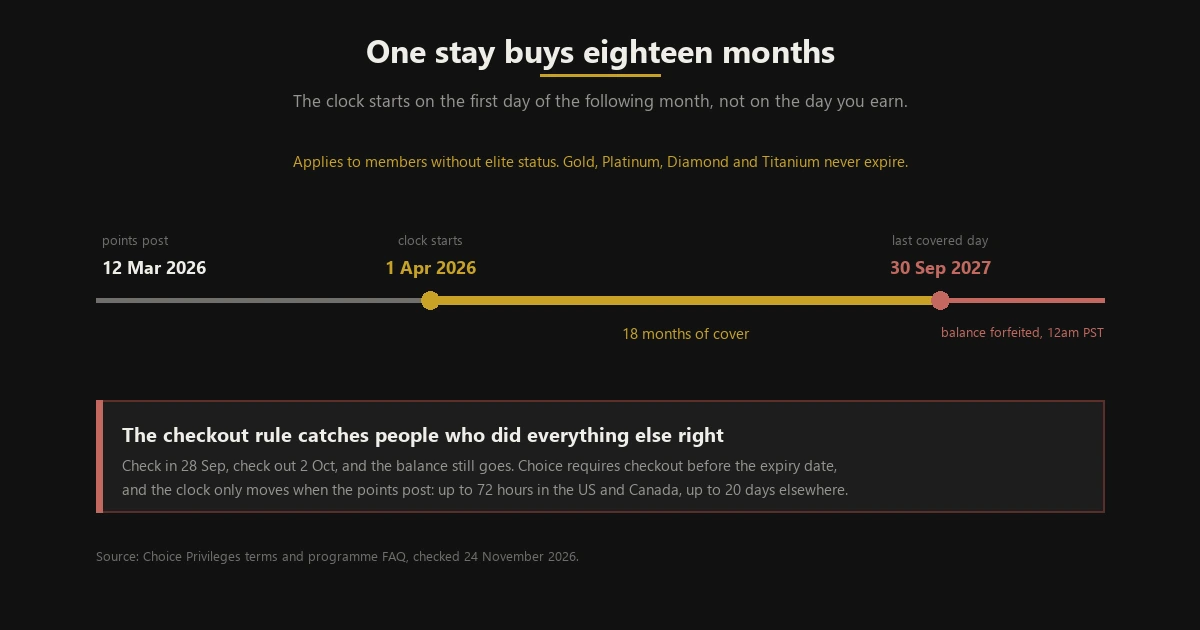
Activity keeps your points alive for 18 additional months, counted from the first day of the month after the activity posts through the last day of the 18th month, stopping at 12:00 am Pacific time. A stay whose points post on 12 March 2026 therefore protects the balance through 30 September 2027, not through 12 September 2027. The rule buys you the remainder of the month you were active plus eighteen full months, which is slightly better than a naive eighteen-month count and considerably easier to remember.
| Event | Date |
|---|---|
| Stay points post to the account | 12 March 2026 |
| Clock starts | 1 April 2026 |
| Eighteenth month of inactivity ends | 30 September 2027, 12:00 am Pacific |
| Balance forfeited if nothing else happened | 1 October 2027 |
Note the shape of the penalty. The rule is written against the account, not against individual points, so there is no queue in which the earliest points leave first. When the deadline passes with no activity, the balance goes. A member holding 40,000 points from a single large purchase two years earlier has exactly the same outcome as a member holding 40,000 points from twenty small stays.
Two details make the deadline harder to police yourself. The first is that qualifying activity is judged by when points post, not by when you travelled, and posting takes up to 72 hours for hotels in the US and Canada and up to 20 days for Europe, the Middle East, Asia-Pacific, Mexico, Central America and the Caribbean. The second is that the deadline is set in Pacific time, which is a day earlier than most of the world experiences it. Both are reasons to check the date the site gives you rather than the one you calculate.
Choice states the policy in the programme FAQ and repeats the substance in the terms, so there is no ambiguity to argue over later. The programme calls a member with recent activity an active member, and defines active entirely by the activity list in the next section.
Why elite status is the real protection
The 2026 refresh changed the answer for anyone with status. Choice now says it plainly: points never expire for elite members, and as long as you hold Gold, Platinum, Diamond or Titanium, the balance is safe. That is a stronger promise than most programmes make, and it reframes status as something closer to insurance than to a set of perks.
| Tier | Nights | Or qualifying credits | What happens to your points |
|---|---|---|---|
| Member | — | — | Forfeited after 18 months with no qualifying activity |
| Gold | 5 | 10,000 | Never expire while the tier is held |
| Platinum | 15 | 30,000 | Never expire while the tier is held |
| Diamond | 35 | 70,000 | Never expire while the tier is held |
| Titanium | 55 | 110,000 | Never expire while the tier is held |
The cheapest tier is also the one that does the expiry work. Gold comes free with the no-annual-fee Choice Privileges Mastercard, and every month that card posts points it also counts as qualifying activity. A member who carries it has two independent reasons never to see a forfeiture: the exempt status, and a monthly drip of activity that would reset the clock even if the exemption disappeared.
What the exemption does not do is survive losing the tier. Status in this programme is earned for a calendar year against nights or qualifying credits, and a member who stops travelling long enough to drop back to the base tier falls back to the standard rule. The clock in that case is measured from the last qualifying activity, not restarted from the day status lapses, which can leave a shorter runway than expected. The safe reading is that status buys time, not immunity from arithmetic.
That matters most for the members who accumulated points during a heavy travel year and then changed jobs, retired or moved to a city with no Choice properties. Their balances are usually the largest, and their activity is usually the thinnest. If that describes you and you are one tier away from Gold, the calculation in whether Choice elite status is worth chasing now has a second input: the value of the balance the tier protects, not just the bonus points it pays.
What counts, and what quietly does not
Qualifying activity is a closed list, and it is shorter than most members assume. Anything that earns, spends or moves points through an approved channel counts. Anything that merely demonstrates interest in the programme does not.
| Counts as qualifying activity | Does not count |
|---|---|
| A point-eligible stay, whether you take points or airline miles | Stays booked through online travel agencies, wholesale packages or group tours |
| Redeeming points: reward nights, Points Plus Cash, gift cards | Complimentary rooms, convention or meeting rooms, rooms booked under $40 a night, senior tours |
| Buying points, including a 1,000-point top-up | Registering for a promotion, however early you register |
| Earning on the co-branded card, for US cardholders | Sending points to another member: only the recipient is credited |
| Partner activity: Avis or Budget rentals, cruise packages, Golf by Choice tee times, e-Rewards surveys | Checking your balance, updating your profile, downloading the app |
| Transferring American Express Membership Rewards in, or exchanging points out to airline miles | Points Sharing transfers, which are not qualifying activity |
Two exclusions are responsible for most of the losses. The first is the third-party booking: a member who stays three nights a year through an online agency travels plenty and earns nothing, and the account looks dormant from the programme’s side. The second is the under-$40 rate, which is easy to hit at Econo Lodge and Rodeway Inn during a quiet week and disqualifies the stay even though the guest paid, checked in and checked out.
The partner list is the useful half of the table for anyone with a small balance and no travel planned. A rental car booked through Avis or Budget counts. So does a cruise package, a set of Golf by Choice tee times, an e-Rewards survey, and a transfer of American Express Membership Rewards into Choice. None of them requires a hotel night, and one of them can be done from a laptop in ten minutes.
Buying points is on the list, which is what makes the reset so cheap: the smallest purchase the programme allows is 1,000 points, and that single transaction is enough. For the full price ladder at every tier, see what Choice points cost at every bonus tier, because the per-point price swings by almost a factor of two between the top and bottom bands.
Three traps that cost people whole balances
1. The checkout that crosses the deadline. A member whose points expire on 30 September checks in on the 28th and checks out on 2 October. The stay is real, the folio is paid, and the balance is still forfeited, because Choice requires checkout before the expiration date for the stay to protect the points. The same trap exists in miniature whenever a stay posts late: Asia-Pacific hotels take up to 20 days to report, which turns a mid-September checkout into an October posting and a lost balance.
2. A stay that earns nothing. The rule measures activity, not travel. Four nights booked through an online agency, one night at a $38 rate, a complimentary upgrade stay, or a room settled on a group master bill all look like loyalty from the member’s side and look like nothing from the programme’s side. The member finds out at the deadline, by which point the stay cannot be re-credited in time to matter.
3. The promotion registration. Registering for a double-points offer feels like engagement and counts as nothing at all. Only the stay inside the window counts, and only when the bonus posts. Members who register for every promotion and then travel once a year on a third-party rate are the most common profile behind a forfeiture.
There is a fourth, softer trap: assuming the deadline is later than it is because the balance has been sitting quietly for years. Choice does not send a warning that resets anything. The date is in My Statements, it moves only when activity posts, and it is the only figure worth planning around.
The cheapest ways to reset the clock
Resetting the clock is a transaction, not a travel decision, and the options vary by more than an order of magnitude in cost. The table below prices each one against its real cash outlay, not against points.
| Method | Cash cost | What you get | Verdict |
|---|---|---|---|
| Buy 1,000 points at the list price | $12.80 | 1,000 points and 18 more months | The default. Buy the minimum, buy once. |
| Buy 6,000 points in a 30% bonus round | $52.80 at 0.88 cents | 6,000 points and 18 more months | Only if you have an award in mind. Otherwise the minimum is enough. |
| Transfer 1,000 American Express Membership Rewards points in | About $20 of Amex value | 1,000 points and 18 more months | Worse value than buying, but rational if the Amex points are stranded. |
| Redeem 8,000 points for a gift card | No cash, $59 of points | A gift card and 18 more months | Only sensible when you were going to redeem anyway. |
| One paid night at a budget property | $45 and up | About 450 points and 18 more months | Worth it if you needed the room. Never worth a trip on its own. |
| An e-Rewards survey or a rental car you were booking | $0 incremental | Points and 18 more months | The best version of this: activity you already had planned. |
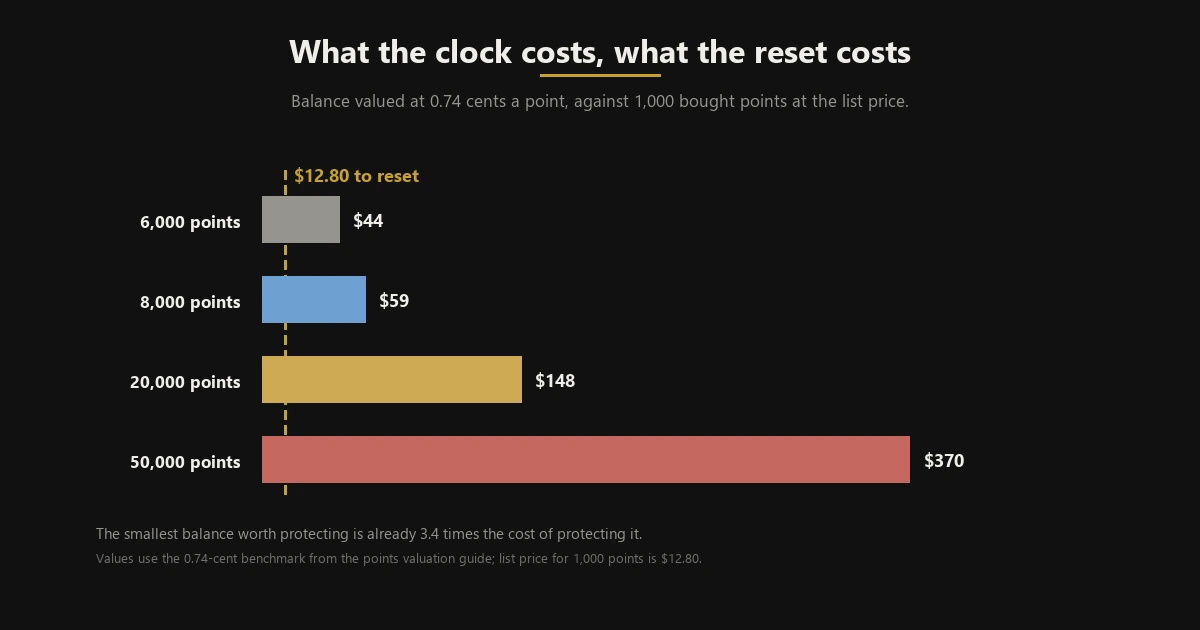
The arithmetic is lopsided in a way that makes the decision easy. At the 0.74-cent benchmark used for valuation across this cluster, 6,000 points are worth $44 and 50,000 points are worth $370. Spending $12.80 to protect either is a return of roughly three and a half times on the smallest balance and twenty-nine times on the largest, and it happens on the day you click, not on some future stay.
Which is not the same as saying always buy. A member with 1,200 points and no plans should let them go: the points are worth about $9 and the reset costs more than they are worth. The line sits around 2,000 points, where the balance starts to exceed the cost of keeping it alive, and it moves with your intentions rather than with the programme’s rules.
If you are buying, buy against the date rather than the calendar. The per-point price moves by up to 45% across a year of promotion rounds, so a member whose deadline falls inside a bonus window can reset for well under the list price; the current price of Choice points is the number to check before you decide between the minimum purchase and a larger one that also serves a future award.
How to find your exact date
Choice calculates the deadline for you and shows it in the account, which is the only source worth trusting. Sign in on the website, open My Account, and look under My Statements: the point expiration date sits alongside the statement periods. In the app the same figure appears under Stays and Activity. Nothing in the emailed statements substitutes for it, because the date shifts every time activity posts.
Two habits make the date usable rather than decorative. The first is to check it when you plan a stay, not when you think about the balance, since that is the moment when a late-posting stay can still be replaced by a purchase. The second is to set a reminder for the first day of the month before the expiry month, which gives you the whole month to act and covers the 20-day posting lag outside the US and Canada.
If the figure looks wrong, the activity history on the same screen is the evidence. Missing stays, a card statement cycle that posted late and a purchase that never credited are all visible there, and all of them are fixable before the deadline rather than after.
If your points have already gone
The rules do not promise reinstatement. There is no clause saying expired points can be restored, and customer care works with discretion rather than obligation, so the honest expectation is that an expired balance stays expired. That said, two situations are worth a call rather than an email, and both rest on the programme’s own wording.
The first is a missing transaction inside the window. If you stayed, redeemed or bought points and the activity never posted, the account was not inactive, the system simply did not see the activity, and the activity history in My Statements is the proof. The second is a forfeiture that happened while you held elite status, because the exemption for Gold and above is explicit in the FAQ and leaves no room for interpretation.
Bring specifics: the date the balance expired, the transactions you believe should have counted, and the confirmation numbers. A request framed as “my 34,000 points expired on 1 October, but the Radisson stay from August never posted, here is the folio” is a different conversation from a request to be given points back because the deadline was missed.
For anyone who does get them back, the fix is immediate rather than reflective: one small transaction on the same day, so the clock resets before anything else happens. Buying the shortfall is usually the fastest option and the one that also serves the next award, which is why buying the points you are short of during a bonus round is the standard advice in this programme rather than a last resort.
Verdict
Expiry is the least interesting rule in Choice Privileges and the most expensive one to ignore, because it is the only rule in the programme that can take a balance to zero without a decision being made. It also has the simplest possible defence, which is why there is no reason to be caught by it.
Three sentences cover every case. If you hold Gold status or above, do nothing: the balance is exempt and the card that gave you the tier is probably posting points anyway. If you do not, put one qualifying activity in every 18-month window, and treat the date in My Statements as the deadline rather than a suggestion. If the balance is small enough that the reset costs more than the points are worth, let it go without guilt.
Everything else in this cluster is about getting value out of the balance while it exists: what a point is worth on a given night, which redemptions return the most, and how to earn faster. Keeping the balance alive is the precondition for all of it, and the cheapest version costs about $12.80 once every year and a half. Compared with the $370 sitting in a mid-sized account, that is not a budget line; it is a rounding error with a deadline. The purchase page, with the tier prices and any live bonus, is Choice’s own points purchase page.
Last updated: 24 November 2026. Expiry rules and qualifying activity checked against the Choice Privileges terms and programme FAQ on the same date.
Choice is unusual in exempting elites outright, which matters more than the 18 months themselves. The full comparison across thirteen programmes ranks each window against its exemptions and shows that the shortest clock is not always the one that costs you the balance.
Frequently asked questions
Do Choice Privileges points expire?
Yes, for members without elite status. Points are forfeited when an account has no qualifying activity for 18 consecutive calendar months, counted from the first day of the month after the activity posts through the last day of the 18th month. The whole balance goes rather than the oldest points, so the deadline is worth tracking before it arrives.
Do points expire if I hold elite status?
No. Choice states that points never expire for elite members, and that the balance is safe for as long as you hold Gold, Platinum, Diamond or Titanium. The protection lasts only while the tier does: if you fail to requalify, the standard 18-month rule applies from your last qualifying activity, which may leave less time than expected.
Does buying 1,000 points reset the clock?
Yes. Purchasing points is on the programme’s list of qualifying activity, and the minimum purchase is 1,000 points, which costs $12.80 at the list price and less during a bonus or discount round. One transaction is enough to protect the balance for a further 18 months, whatever the size of the balance.
Does registering for a promotion count as activity?
No. Registering for a double-points promotion is explicitly listed as a non-qualifying activity, along with gifting points to another member. Only the stay inside the promotion window counts, and only once the points or bonus post to the account.
How do I check when my Choice points expire?
Sign in, open My Account and look under My Statements, or open Stays and Activity in the mobile app. The expiration date is calculated from your last qualifying activity and moves whenever new activity posts. It is the only figure worth relying on, because posting delays of up to 20 days outside the US and Canada shift dates that you calculate yourself.
Can I get expired Choice points back?
The rules do not provide for reinstatement, so treat a restored balance as goodwill rather than a right. Two cases are worth raising: activity inside the window that never posted, and a forfeiture that happened while you held elite status, since the exemption is explicit. Bring dates, confirmation numbers and the folio, and ask for a specific transaction to be credited rather than for the points to be returned.
More Choice Privileges Guides
- Every Choice Privileges promotion live in 2026, with the registration deadline for each one.
- What Choice points cost at every bonus tier, and the price at which buying stops working.
- What a Choice point is worth on a specific night, rather than the industry average that answers nothing.
- Where Choice points return the most on a single night, and the four redemptions that quietly destroy value.
- Whether Choice elite status is worth chasing, tier by tier, with the bonus priced in dollars per night.
- How a single $100 night becomes 3,500 points, and the four layers that stack on the base rate.
- the free partner activity that resets the clock, without booking a room.
- the card that stops the clock permanently, for $0 a year.