The best way to use Choice points is not to hunt the most expensive hotel on the list. It is to find the nights where the cash rate has jumped and the points price has not caught up yet — a mispricing that Choice’s own structure keeps producing, because every property sets its own award level by date range rather than tracking the live cash rate.
The short version: standard award nights start at 8,000 points with no blackout dates, RewardSaver drops the floor to 6,000 at select properties, and you can book 50 weeks out. That combination means points are worth most on peak dates at mid-tier hotels and worth least on a random Tuesday at a roadside motel. Below, the breakeven maths, the two strategies that actually work, and the four redemptions that quietly destroy value. For the cross-programme baseline, see how much hotel points are worth in 2026.

At a glance
| Question | Answer |
|---|---|
| Cheapest award night | 6,000 points (RewardSaver, select properties and dates). Standard floor is 8,000. |
| Blackout dates | None advertised. Reward inventory can still sell out, which is different from a blackout. |
| Booking window | 50 weeks before the end of your stay, not the start. |
| Cash you still pay | Resort fees, mandatory fees and incidentals. Choice does not waive them on award stays. |
| Points value at a good redemption | 1.5 cents or better. A weak redemption lands under 0.74 cents, which is below what you can buy points for. |
| Best single use | Peak-date mid-tier hotels in expensive markets — regional Japan, Scandinavia, Australia, US event weekends. |
| Worst single use | Transferring points to airline miles, and gift cards. |
If your balance is short of the night you want, topping up during a bonus window is the cheap route. You can buy Choice Privileges points at the current bonus rate and pay somewhere between 0.57 and 0.76 cents each, which sets the floor for every comparison in this guide.
How Choice actually prices an award night
Most hotel programmes either publish a fixed award chart or run fully dynamic pricing that tracks the cash rate. Choice does neither, and that gap is where the value lives.
Each property sets its own reward level for date ranges, often with a weekday rate and a weekend rate that differ. The programme publishes a floor rather than a table: reward nights start at 8,000 points at participating hotels with no blackout date, and RewardSaver — reintroduced in January 2025 — lets select properties open inventory from 6,000 points. There is no published ceiling either. The old 35,000-point cap was removed in 2024, and properties such as Cambria Hotel Nashville Downtown and several New York hotels moved past it, with Asia-Pacific rates reaching considerably higher.
Three consequences follow, and all three shape how you should spend:
- The award price lags the cash price. A hotel that doubles its cash rate for a festival or a graduation weekend does not necessarily double its points price on the same date. Search both and you will find nights where the effective value runs to two or three cents per point.
- No blackout is not the same as available. Choice does not block dates, but it does not guarantee a set number of reward rooms either. Popular properties clear their reward inventory long before arrival, which is why the 50-week window matters.
- The same hotel is worth different amounts on different nights. That is the whole argument against a single “points are worth X” number, which is why we price Choice points against the specific night rather than an industry average.
The breakeven grid: which redemptions clear the bar
Two thresholds matter. The first is 0.74 cents, roughly what points cost when you buy them during a 40% bonus. Any redemption below that line is worse than simply buying the points you need, so it fails on its own terms. The second is 0.85 cents, the top of the published 2026 valuation range and the number to beat if you want to argue you did better than the consensus.
The grid below shows the effective value of a single night at common award levels. Read across a row to see how the same cash rate changes meaning as the points price rises.
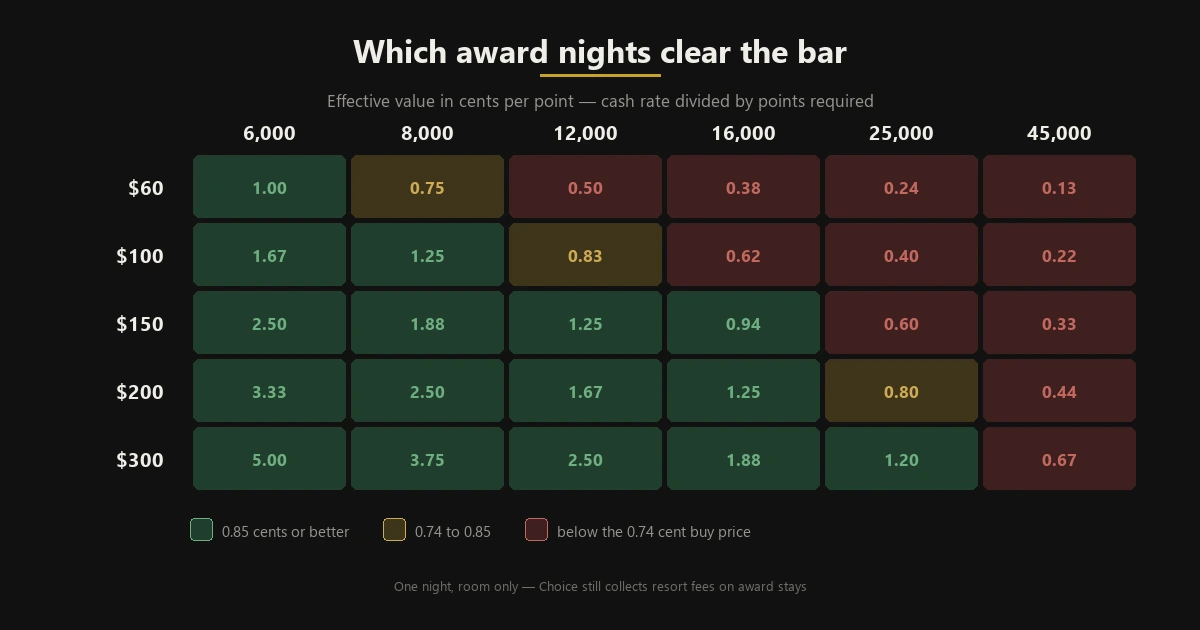
Two things jump out. An 8,000-point night at a $60 motel returns 0.75 cents — technically above the purchase price, but nowhere near enough to justify holding a balance for. An 8,000-point night at a $150 hotel returns 1.88 cents, which is a genuine win. The points price did not change. The night did.
Budget for one thing the grid does not show: award stays still carry resort fees and mandatory charges. A Preferred Hotels redemption documented in March 2026 ran 50,000 points plus $48 in resort fees, and that $48 has to be subtracted from the cash rate before you divide. On a $250 night, the fee alone cuts the return from 0.50 to 0.40 cents per point — enough to turn a marginal redemption into a bad one.
Two paths that work: structure and timing
There are exactly two ways to beat 0.85 cents, and they are not the same strategy.
Structure is the everyday version. Analysis of roughly 980,000 award searches across nearly 5,000 properties found the budget brands quietly delivering the best per-point return on ordinary stays: Suburban Extended Stay around 0.91 cents, Econo Lodge 0.87, Rodeway Inn 0.85, Radisson 0.81. Quality Inn, Clarion, Ascend Collection and Comfort Inn all cluster near a 0.75-cent median. The logic is unglamorous — cash rates at economy and midscale hotels have risen faster than award prices, so the gap widened in your favour.
Timing is the version worth planning a trip around. Same properties, peak dates, cash rate inflated by demand, award level unchanged. That is how an 8,000-point Comfort Hotel night in regional Japan during autumn foliage, or a 12,000-point Quality property outside Rome, returns well over 1.5 cents.
The window does close, though, and 2026 proved it. Choice repriced 101 Japan hotels across three separate rounds between June and August, moving the Tokyo, Osaka, Kyoto and Sapporo Comfort properties from 10,000–15,000 points to 20,000–30,000. Nothing about those hotels changed. The cash rate did not fall. Only the award level moved, and the arbitrage that made them famous evaporated between one booking window and the next. Timing works precisely because award levels lag cash rates. It stops working the week the programme reprices, so book the night you have identified instead of holding the points until the maths gets fixed for you.
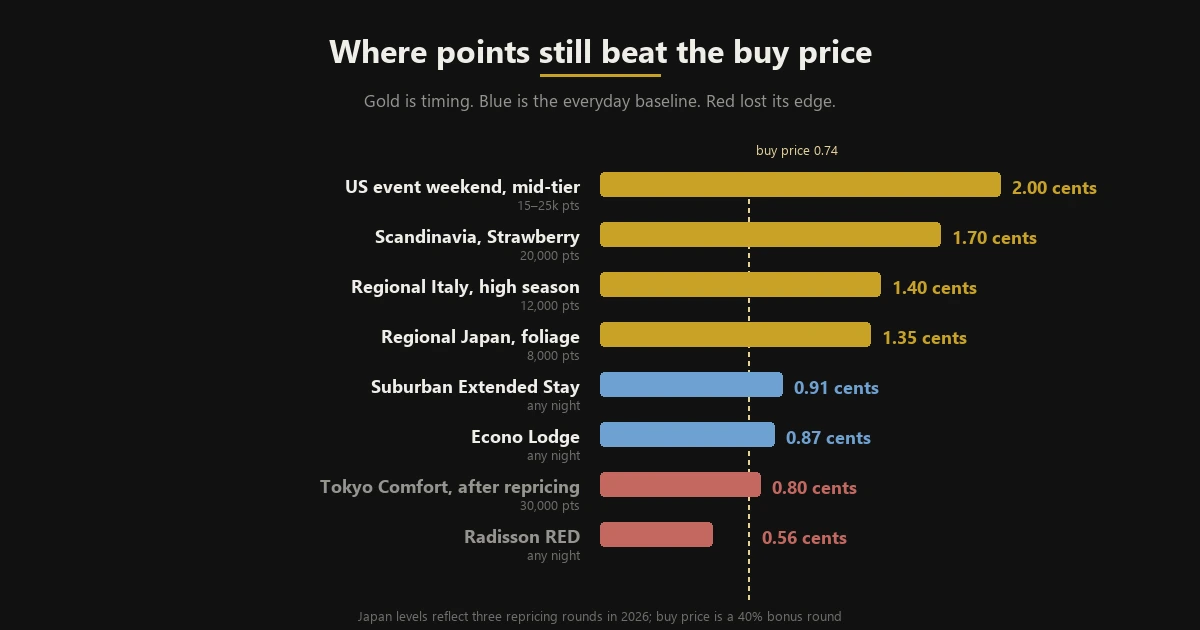
The mistake is treating these as competing theories. Structure is the baseline you should expect from any competent redemption. Timing is the reason to hold the points rather than cash them out, and it is entirely dependent on searching a year ahead while inventory lasts.
Six situations where points genuinely win
These are the cases where the cash alternative is high enough that the maths works without stretching.
| Situation | Typical award | Why it works |
|---|---|---|
| Regional Japan, cherry blossom or foliage season | 8,000–15,000 | After three repricing rounds in 2026 the city Comfort hotels sit at 20,000–30,000 points. Regional properties such as Yamanashi still start at 8,000, with Chitose and Hakodate at 10,000–15,000, and peak cash rates there still clear $150 a night. |
| Scandinavia and Finland | 20,000+ | Strawberry (formerly Nordic Choice) hotels start around 20,000 points against cash rates that routinely clear $150 in Helsinki and Stockholm. |
| Regional Italy | 12,000–20,000 | Quality Hotel Nova Domus near Rome runs about 12,000 points, Comfort Hotel Bolivar about 20,000. Both beat the cash rate in high season. |
| Australia outside the capitals | 8,000–16,000 | Cash rates above A$100–150 are common; the award floor is not adjusted for the market. |
| US event weekends | 15,000–25,000 | Graduation, football and festival weekends at Comfort and Cambria properties where the cash rate triples but the award level moves one tier. |
| Preferred Hotels off-peak | 35,000–50,000+ | 300-plus luxury properties, taxes included in the redemption. Only worth it when the cash rate is high, because resort fees stay with you. |
Note what these have in common: none of them are the cheapest night available, and none are the most expensive hotel on the programme. They are all cases where cash and points diverged.
Four redemptions that look smart and are not
1. Roadside budget motels at 8,000 points. A $60 Econo Lodge night returns 0.75 cents. It clears the purchase price by a hair and loses to almost any other use. Pay cash and keep the points.
2. Transferring Choice points to airline miles. The ratios are punitive compared with transferring in the other direction, and the effective value lands near 0.2 cents. If you want miles, earn miles.
3. Gift cards and merchandise. Redemption values sit well under a cent and there is no upside case. This is where a balance goes to die.
4. Premium rooms at premium prices. Choice now lets you book upgraded room types with points, which sounds like progress until you price it. Paying 45,000 points for a suite that sells for $220 is 0.49 cents — worse than the standard room at the same hotel. The feature is useful only when the premium room’s cash premium exceeds the points premium, which is rare.
One more trap worth naming: stretching a trip to use a balance. Adding a night you did not need at 0.8 cents does not improve the value of the points you already spent well. It just adds a night.
The booking mechanics that decide the outcome
The strategy is only half the job. These rules decide whether you actually get the night.
- Fifty weeks, counted from checkout. The window runs from the planned end of your stay. On a five-night booking at the edge of the window, that shifts your earliest bookable date by nearly a week. There is no minimum advance purchase — same-day awards work — so the 50 weeks is a ceiling, not a target.
- RewardSaver inventory is finite. The 6,000-point tier is a limited allocation at participating properties, not a permanent price. It disappears when it is taken.
- Cancellation follows the hotel, not the programme. Cancel by the deadline on your confirmation and points return to your account. Miss it, or no-show, and the points are gone. The hotel holds the room until 7:00 AM the day after arrival before treating it as a no-show.
- Preferred Hotels cannot be modified. You cancel using the link in the confirmation email and rebook from scratch, with points redeposited after 72 hours. If the rate moved in the meantime, you absorb it. Get those dates right the first time.
- Points plus cash is not refundable in cash. The cash portion stays with Choice on cancellation; the points come back. Use it to top up a short balance, not as a flexible booking.
- Eighteen months of inactivity forfeits the balance. Any qualifying earn or redemption resets the clock, and current elite members are exempt. A far-out award booking is the simplest way to keep a dormant account alive.
If you are buying to reach a specific night, buy after you have confirmed the award is bookable, not before. Points purchases are non-refundable and post within 24 hours, and the official Choice points purchase page applies whatever bonus your account is targeted for, which varies by member.
Partners, transfers and the alternatives
Choice points arrive from four bank programmes: American Express Membership Rewards at 1:1, Capital One miles at 1:1, Wells Fargo Rewards at 1:2, and Citi ThankYou at a ratio that varies by card and reaches 1:1.5 on the best cards. All of them transfer one way, so the decision is final.
| Use | Effective value | Verdict |
|---|---|---|
| Peak-date mid-tier award | 1.5–3.0¢ | Best use of the currency |
| Everyday budget-brand award | 0.75–0.91¢ | Solid baseline, no planning needed |
| Preferred Hotels award | 0.7–1.4¢ | Only at high cash rates, and subtract resort fees first |
| Points plus cash top-up | 0.7–1.0¢ | Convenience, not value |
| Airline miles | ~0.2¢ | Avoid |
| Gift cards | Under 0.5¢ | Avoid |
Partner inventory outside hotels is broader than most members realise — Bluegreen Resorts, PENN Entertainment casino hotels and the Preferred portfolio all take points. The casino and resort options are worth a look only when the cash rate is genuinely high, because the same resort-fee problem applies. Current promotions that stack with an award stay are tracked in our running list of Choice Privileges promotions, and the timeshare package is a separate calculation covered in the 3 nights for $199 offer breakdown.
Verdict
Treat Choice points as a tool for expensive nights, not as a discount on cheap ones. The programme’s structural quirk — property-set award levels by date range, no blackout dates, a floor that has not tracked cash inflation — means the value is concentrated in a small number of high-demand dates at mid-tier hotels in costly markets. Search 40 to 50 weeks ahead, compare the award against the cash rate for the exact dates, subtract any resort fee, and divide.
If the result clears 2 cents, book it and stop reading. If it lands between 0.85 and 1.5, it is a reasonable use and you should not feel bad about it. Under 0.74, pay cash and keep the points — the price of Choice points right now is lower than the value you would be getting.
Next step: check the award price and the cash price for the same dates on the nights you actually want, before you buy anything. Our price ladder for buying Choice points shows what each bonus tier costs per point, so you can tell immediately whether a top-up makes sense.
Frequently asked questions
How many Choice points do I need for a free night?
Reward nights start at 8,000 points at participating hotels, and RewardSaver drops the floor to 6,000 at select properties and dates. There is no published ceiling; premium properties and peak dates can run past 45,000 points, and Asia-Pacific rates go higher.
Can I book a Choice award night a year in advance?
You can book up to 50 weeks before the planned end of your stay, which is roughly 350 days. The window is measured from checkout rather than check-in, so multi-night bookings at the edge of the window start slightly later than you might expect.
Do Choice points expire?
Points are forfeited after 18 consecutive calendar months with no qualifying activity. Earning or redeeming points resets the clock, and members who currently hold elite status are exempt while that status lasts.
Are resort fees charged on Choice award stays?
Yes. Points cover the room only. Resort fees, mandatory fees and incidentals are paid at the property, which differs from programmes such as World of Hyatt that waive resort fees on award stays. Subtract those charges before you calculate value.
Is it better to use Choice points or pay cash?
Divide the cash rate by the points required, after subtracting fees you would still pay. A result above one cent favours points. Below 0.74 cents, buying points during a bonus window would be cheaper than redeeming them, so pay cash instead.
Can I cancel a Choice award night and get my points back?
Yes, if you cancel by the deadline shown on your confirmation. Miss it or fail to claim the room and the points are forfeited. Preferred Hotels awards cannot be modified at all — you must cancel and rebook, with points redeposited after 72 hours.
More Choice Privileges Guides
- The earning side that decides how much there is to redeem, and the three multipliers that stack.
- Whether elite status changes the redemption maths, or just adds a few cents to each night.
- Every Choice Privileges promotion live in 2026, with what each one is actually worth.
- What Choice points cost at every bonus tier, and the price at which buying stops making sense.
- What a Choice point is worth on a specific night, rather than the industry average that answers nothing.
- the 18-month deadline on the balance, which runs whether or not you redeem.
- whether a partner award beats a hotel night, with the transfer ratios priced in.
- which card makes a night cheaper, if the points were earned on plastic.