How much are AAdvantage miles worth? On average, about 1.45 cents each — but that headline number is the least useful thing in this guide. The same mile is worth under 1 cent when you burn it on a lounge pass and 15 cents or more in a Japan Airlines first-class seat. American Airlines’ AAdvantage miles do not have one value. They have a value for each way you redeem, and the spread between them is wider than in almost any other US program.
The short version: treat 1.45 cents as a planning average, not a promise. American prices its own flights dynamically with no published chart, so what you get on AA metal swings with demand. Flights on oneworld partners still price off a fixed chart, and that fixed pricing is where the value lives — JAL business to Tokyo near 60,000 miles, Cathay business to Hong Kong near 70,000, Qatar Qsuite to Doha near 70,000, all while the cash fares sit in the thousands.
The 1.45-cent benchmark
Most published 2026 valuations cluster around 1.4 to 1.5 cents per AAdvantage mile. The Points Guy puts it at 1.45 cents. NerdWallet sits slightly higher in the 1.4 to 1.7 range. These are not measurements — they are blended averages, and they mix a $15,000 first-class award with a gift card redeemed at 0.7 cents.
That blending is why the average is a starting point rather than an answer. An average sits in the middle of a wide distribution. If your actual redemptions live in the top of that distribution, the 1.45-cent figure understates what your balance can do. If they live at the bottom, it flatters you.
What makes AAdvantage unusual is where the distribution comes from. Delta and United have moved almost entirely to dynamic pricing, which compresses the range. American runs a dual system: dynamic on its own flights, a published fixed chart on partner flights. That split is the single most important fact about the program’s value, and it is the next section.
Why partner awards carry the value
American has not published an award chart for its own flights since 2019. A domestic seat can price at 7,500 miles on a web special or 25,000 at peak, and there is no way to know which until you search your dates. On a $250 cash fare, the low end returns about 3.3 cents and the high end about 1 cent. Same route, same seat, value everywhere.
Partner flights work the opposite way. AAdvantage keeps a published chart for oneworld and a few other partners, so the mileage price is fixed by region and cabin rather than by demand. That is what protects the high-value redemptions:
| Route (one way) | Partner | Miles | Typical cash fare |
|---|---|---|---|
| US to Tokyo, business | Japan Airlines | ~60,000 | $3,000 – $4,500 |
| US to Hong Kong, business | Cathay Pacific | ~70,000 | $3,500 – $5,000 |
| US to Doha, business | Qatar Airways (Qsuite) | ~70,000 | $4,500 – $5,500 |
| US to Europe, business | British Airways, Iberia, Finnair | ~57,500 | $2,500 – $4,000 |
| US to Australia, business | Qantas | ~80,000 | $6,000 – $7,500 |
| US to Tokyo, first | Japan Airlines | ~80,000 | $12,000 – $15,000 |
Two structural details push these numbers further than the chart alone suggests. American does not pass on partner fuel surcharges the way it does with British Airways and Iberia, so a JAL or Cathay award carries taxes in the low hundreds rather than the several hundred a BA award attracts. And because the chart price does not move with the cash fare, a partner award gets more valuable precisely when cash prices spike — peak season, holidays, last-minute business travel.
That is the asymmetry worth internalising. On AA metal you are competing with everyone else’s demand. On partner metal you are paying a fixed price set before the demand arrived. If AAdvantage miles have a job, it is this one.
Value by redemption type
The chart below prices six common redemptions on one consistent basis, so the bars are comparable rather than a mix of methods. The figure for each is the cash fare you avoid, minus the award taxes you still pay, divided by the miles spent. Treat the bands as directional: the exact value is always your own fare divided by your own miles.
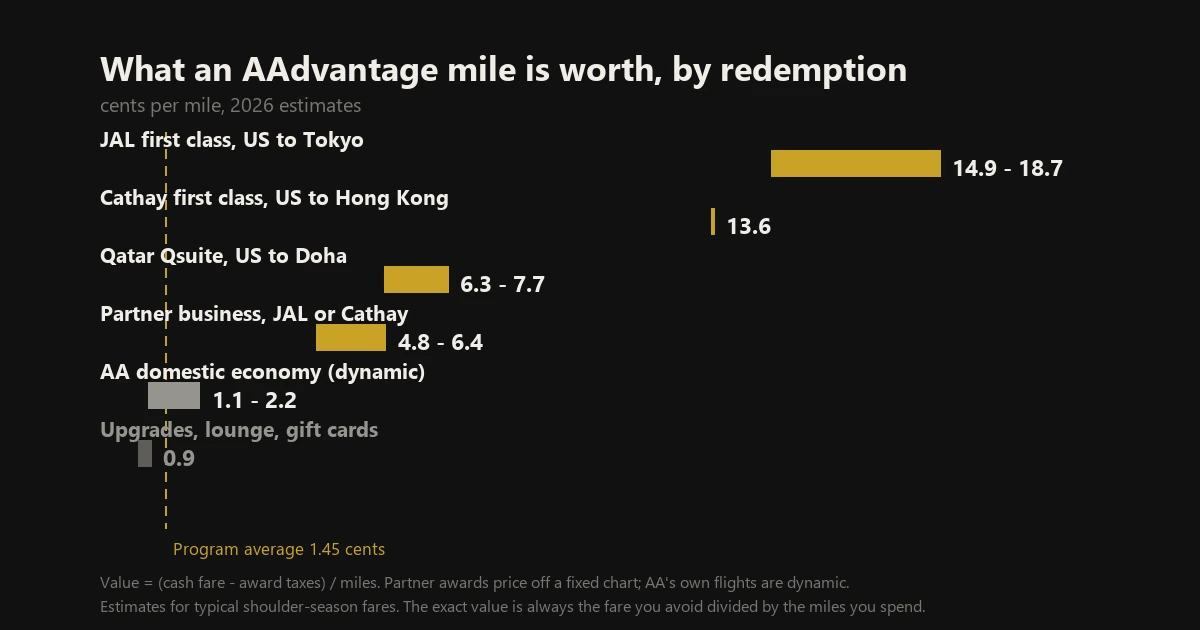
Four things stand out.
Partner first class is a different sport. A JAL first-class seat to Tokyo prices around 80,000 miles against a cash fare that routinely runs $12,000 to $15,000. Even after taxes, that is 15 to 18 cents per mile. Cathay first to Hong Kong lands in the same neighbourhood. These redemptions are scarce, they require booking roughly 330 days out, and they are the entire reason a large AAdvantage balance can be worth more than its 1.45-cent label.
Partner business is the realistic target. Qsuite and JAL business clear 6 to 8 cents against typical fares, and ordinary partner business — the JAL and Cathay seats that actually have saver space — sits around 5 to 6.5 cents. This is the band most people should plan around, because it is attainable without waiting for a unicorn.
AA’s own domestic economy is barely above the average. Dynamic pricing means the cents-per-mile figure depends entirely on the cash fare on the day. On a cheap $200 fare, 17,500 miles returns about 1.1 cents. On a $400 fare at the same price, it returns 2.2. Same number of miles, double the value — which is why domestic awards should follow the fare, not lead it.
Everything non-flight collapses. Upgrades, lounge passes, seat selection and gift cards all settle near 1 cent or below, because American prices those at a straight cash equivalence. You are not unlocking value; you are converting miles into cash at a bad rate.
How to price your own award
Every figure on this page comes from one line of arithmetic, and you can run it yourself for any award in about thirty seconds:
(cash fare − award taxes) ÷ miles required × 100 = cents per mile
Worked example. A Qatar Qsuite from JFK to Doha at 70,000 miles plus $80 in taxes, where the same seat sells for $5,500:
- ($5,500 − $80) ÷ 70,000 = $0.0774 per mile
- × 100 = 7.7 cents per mile
Three rules keep the number honest. Use the fare you would actually have paid, not the most expensive fare you can find on the route — pricing a $400 economy seat against a $9,000 fully flexible business fare tells you nothing useful. Subtract the award taxes, because you pay those in cash either way. And use the miles the booking screen quotes you, not the chart minimum, since partner space often only exists at a higher level.
Run that comparison before you transfer anything in. Points transfers are one-way and irreversible, and award space can vanish while the transfer settles. If a Marriott balance is the intended source, the arithmetic matters even more, because the ratio is unkind: the Marriott to AAdvantage conversion runs 3 to 1, and AAdvantage is one of three programs excluded from Marriott’s usual 5,000-mile transfer bonus. Sixty thousand Bonvoy points become 20,000 AAdvantage miles — not 25,000. At Bonvoy’s own valuation, that is roughly 2 cents per AAdvantage mile created, which only makes sense against a partner premium-cabin redemption.
Where the value disappears
Five redemptions consistently return 1 cent per mile or less. All of them are cash-equivalent purchases dressed up as redemptions, and all of them convert a flight currency into a weak discount.
| Redemption | Typical return | Why it fails |
|---|---|---|
| Mileage upgrades on paid tickets | ~0.9 cents | Priced dynamically, often with a cash co-pay on top |
| Admirals Club day pass or membership | ~1 cent | Priced at a straight cash equivalence |
| Main Cabin Extra seat selection | ~1 cent | A $70 seat for 7,300 miles is a cash swap |
| Gift cards and merchandise | 0.5 – 0.8 cents | Discount applied on top of an already-poor rate |
| Hotels, cars and vacations via AAdvantage | ~1 cent or less | Those platforms are built for earning, not redeeming |
The pattern is consistent: whenever American quotes you a fixed miles-for-dollars rate, the rate is about 1 cent. There is no arbitrage in it. The only reason to take one of these is to stop miles from expiring — and there are cheaper ways to do that, since any earning activity resets the 24-month clock.
One partial exception is worth knowing. AAdvantage miles expire after 24 months without activity, but the primary cardholder on a Citi AAdvantage card is exempt from expiry entirely. If you hold one of those cards, the expiry argument for a bad redemption disappears, and the case for holding miles until a partner award appears gets stronger.
British Airways awards deserve a separate warning. The chart price looks reasonable, but BA passes on carrier surcharges, and a transatlantic BA business award can carry $600 or more in cash fees. On a $3,000 fare, that turns an apparent 4-cent redemption into something closer to 3. It is not a bad redemption — it is just worse than the chart implies, and worse than the same miles spent on JAL or Cathay.
Does the value justify buying miles?
This is where valuation meets price, and the answer depends on which side of the ladder you are on.
American sells miles at a standard 3.5 cents each, plus a 7.5% federal excise tax — 3.76 cents all-in. A standing tiered discount cuts that, and the deepest tier takes 40% off on a single purchase of 151,000 to 300,000 miles, bringing the effective cost to about 2.26 cents. Three numbers matter: the 151,000-mile threshold that unlocks the 40% tier, the 300,000-mile annual cap on buying and gifting combined, and the fact that purchased miles earn no Loyalty Points.
Set 2.26 cents against the bands above and the conclusion is narrow but clear:
| Your plan | Worth it? | Why |
|---|---|---|
| Partner business or first class | Yes | 5 – 18 cents of value against a 2.26-cent cost |
| Topping up a specific award you have found | Yes | The cheapest way to close a small gap |
| AA domestic economy | Usually no | Returns 1 – 2 cents against a 2.26-cent cost |
| Holding miles for later | No | You pay 2.26 cents per mile for a value that may fall |
| Buying before you have an award in mind | No | Purchases are non-refundable and non-reversible |
The threshold matters more than it looks. Crossing from 150,000 to 151,000 miles does not cost you more — it costs less, because the 40% tier reprices the whole transaction. At 30% off, 150,000 miles runs about $3,951. At 40% off, 151,000 miles runs about $3,409. You get a thousand more miles and pay roughly $542 less. If you are buying at all, buy to that line.
The live tier table sits behind the sign-in on American’s Buy, Gift & Transfer portal: the discount is applied at checkout rather than published on the landing page, so sign in and price your own quantity before comparing it against a transfer.
For most readers the better answer is not to buy. AAdvantage has exactly one mainstream bank transfer partner — Citi ThankYou at 1:1 on premium cards, at 1:0.7 on the no-fee ones — plus Marriott at 3:1 and, since June 2024, nothing from Bilt. Chase, Amex and Capital One do not transfer to American at all, which is the program’s real weakness. If you already hold Citi points, transferring beats buying. If you hold Marriott points, price the 3:1 conversion before you commit, and check whether a transfer bonus is running first — a bonus changes the arithmetic completely.
If buying is the only path, buy the shortfall, not the balance. The one honest use case is having a specific partner award priced, confirmed, and a few thousand miles out of reach. Anything else is speculation on a currency that has lost value before and will again.
Frequently Asked Questions
How much are AAdvantage miles worth?
Most 2026 valuations put them at 1.4 to 1.5 cents each, with The Points Guy at 1.45 cents. That is a blended average across all redemption types. Individual redemptions range from under 1 cent for gift cards to 15 cents or more for partner first class.
Why are AAdvantage miles worth more on partner flights?
American prices its own flights dynamically with no published chart, so the mileage cost moves with demand. Partner awards still use a fixed chart, priced by region and cabin. When cash fares spike, the fixed mileage price gets more valuable rather than less, which is what protects the high-end redemptions.
Are AAdvantage miles worth more than Delta or United miles?
On average, slightly. AAdvantage valuations sit at 1.4 to 1.5 cents against roughly 1.1 to 1.3 for Delta SkyMiles and 1.2 to 1.4 for United MileagePlus. The gap comes from American keeping a fixed partner chart while the other two lean further into dynamic pricing.
Can I transfer credit card points to AAdvantage?
Only from Citi ThankYou at 1:1 on premium cards, and from Marriott Bonvoy at 3:1. AAdvantage is excluded from Marriott’s 5,000-mile transfer bonus, so 60,000 Bonvoy points become 20,000 miles rather than 25,000. Chase Ultimate Rewards, Amex Membership Rewards and Capital One Miles do not transfer to American.
Do AAdvantage miles expire?
They expire after 24 months without any earning or redemption activity. Any qualifying activity resets the clock. The primary cardholder on a Citi AAdvantage card is exempt from expiry, which removes the main reason people make poor-value redemptions just to keep a balance alive.
Is it worth buying AAdvantage miles at 2.26 cents?
Only against a specific premium redemption. Partner business and first class return 5 to 18 cents per mile, so buying there is clearly profitable. AA domestic economy returns 1 to 2 cents, so buying at 2.26 cents loses money. Buy the shortfall for a booked award, not a balance for later.
What is the best use of AAdvantage miles?
Partner first and business class on the fixed chart — Japan Airlines to Tokyo, Cathay Pacific to Hong Kong, Qatar Qsuite to Doha. These return 5 cents per mile and up, well clear of the program average, while American’s own domestic awards sit closest to it.
More American Airlines Guides
- Buy AAdvantage miles, the full discount ladder, the 151,000-mile threshold and the annual caps.
- The best way to use AAdvantage miles, every sweet spot ranked by what it actually returns.
- How much Alaska miles are worth, for a direct comparison against a rival fixed-chart program.
- How much Marriott Bonvoy points are worth, the other half of the 3:1 conversion maths.
- AAdvantage partner airlines, the full oneworld list and what you can earn versus redeem.
- AAdvantage promotions, the offers that are live and which ones actually pay.
If you are short of a partner award, price the transfer before you pay for miles. Compare what Marriott points cost against the miles they become, because 3 to 1 with no bonus is a worse deal than most guides admit.