The best way to use AAdvantage miles is a partner premium cabin on the fixed award chart — and it is not close. Qatar Qsuite to Doha for 70,000 miles one way, Cathay Pacific business to Hong Kong for 70,000, Japan Airlines business to Tokyo for 60,000. Those seats sell for thousands of dollars in cash, and the mileage price does not move when the cash fare does.
That is the whole answer in one line, but it leaves the hard part untouched: which specific awards are actually worth chasing, what each one costs, how to find space when American Airlines’ own website will not show it, and which partners quietly add hundreds of dollars in surcharges. This guide works through all four.
The short version: concentrate on partner business class between 57,500 and 70,000 miles, avoid British Airways metal across the Atlantic, use Asia as a free stopover, and search on a partner’s site before you call American. Everything else in the program is a worse deal than those four habits.
The one rule that decides everything
American runs two pricing systems at once, and which one applies to your flight determines whether the redemption is good or ordinary.
Flights American operates are priced dynamically. There is no chart, the mileage cost tracks the cash fare, and a domestic seat can be 12,500 miles on a Tuesday or 40,000 on the Friday before a holiday. Nothing about that is a sweet spot; it is just a second price tag that moves.
Flights a partner operates price off a published chart, fixed by region and cabin. A business seat from the US to Japan costs the same 60,000 miles whether the cash fare is $3,000 or $7,000. That fixed number is the entire source of value in this program, and every recommendation below comes from it.
So the operating rule is simple. Spend AAdvantage miles on partner metal, in premium cabins, on long routes. Everything that follows is the detail behind that sentence.
One qualifier worth stating up front, because it changes how you read the rest of this page. The chart is a floor, not a guarantee. Partner saver space is released in limited quantities, often a year out, and the price you see is the price for the seats that exist. A 60,000-mile JAL seat is only 60,000 miles if there is one available on a date you can fly.
The seven sweet spots
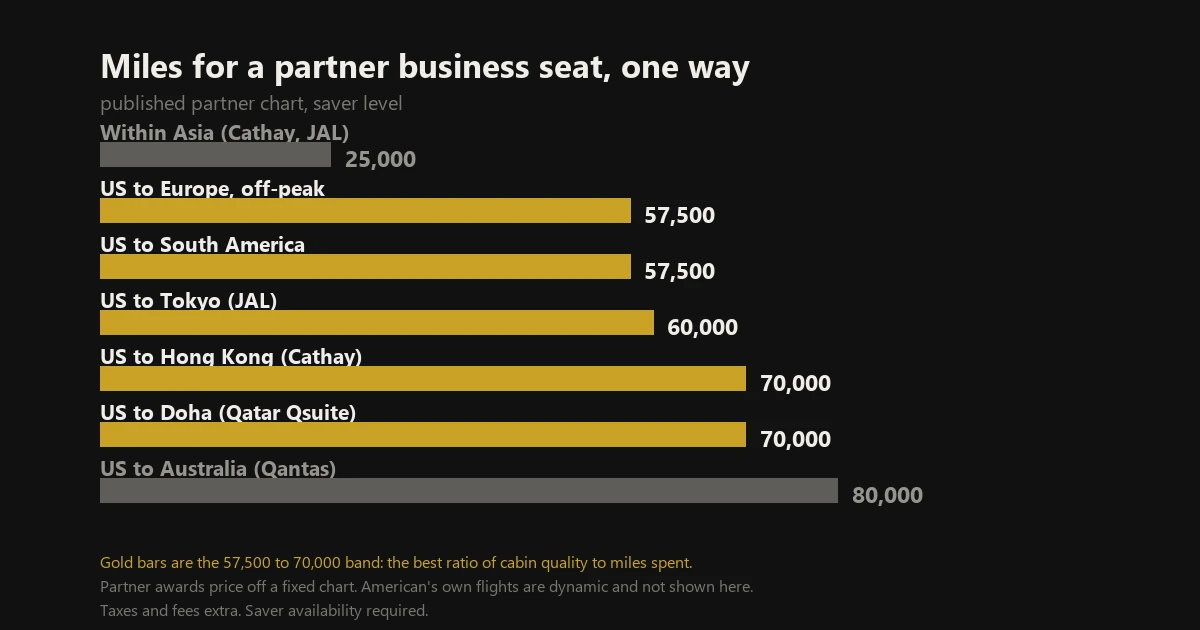
The chart below prices the partner business awards that consistently deliver, ordered by what they cost. The gold bars are the band worth planning around: between 57,500 and 70,000 miles you are buying a long-haul flat bed on an airline that does this well, and the mileage difference between them is small enough that cabin quality — not price — should decide.
Qatar Qsuite to Doha — 70,000 miles
Qsuite is the best business class product flying, and 70,000 miles one way is the least you will pay for it in any program. The seats are enclosed suites with double beds in the middle pair, the service is a genuine step above every US carrier, and Doha connects onward to Africa, India and Southeast Asia on the same award if you route it well. Saver space is scarce and disappears fast — this is the one award worth booking the day you find it rather than the day you decide.
Roughly 70,000 miles reaches Europe on Qatar metal, and about 75,000 reaches South Asia. Taxes run in the region of $80 one way, which is the cleanest cash component of any premium award in the program.
Cathay Pacific to Hong Kong — 70,000 miles
Cathay business is the workhorse of this list: widely available, bookable directly on aa.com, and priced at 70,000 miles to Hong Kong with onward connections into Southeast Asia and mainland China that often add little or nothing to the total. First class on the 777-300ER is 110,000 miles and mostly appears on the JFK–Hong Kong route.
The reason to pick Cathay over a cheaper economy award is not the seat. It is that Hong Kong is a hub, so one award can carry you from the US to Bangkok or Singapore through a city worth a stopover, at a price set for the long-haul sector.
Japan Airlines to Tokyo — 60,000 miles
JAL business is the best value on this page measured against the cash fare, because JAL’s US–Japan fares run high while the award price sits at 60,000 miles. JAL first class on the 777 is 80,000 miles and is a genuinely different product — suites, a la carte dining, and award space that appears more reliably than most first-class cabins.
The complication is finding it. JAL inventory frequently does not surface on aa.com even when seats exist. Search British Airways Executive Club or Qantas instead, note the flight numbers, then call American to ticket. Details are in the searching section below.
Qantas to Australia — 80,000 miles
Australia is the longest partner redemption on the chart and the one where the cash fare comparison is most lopsided: 80,000 miles against fares that routinely clear $6,000 in business. Gateways are Los Angeles, Dallas and New York. Qantas first class, where the A380 still flies with it, runs 110,000 miles.
The three shorter sweet spots
Europe off-peak at 57,500 miles is the cheapest way to cross the Atlantic in a flat bed. Off-peak runs 10 January to 14 March and 1 November to 14 December; outside those windows the same seat is around 62,500. Fly Iberia, Finnair or Aer Lingus metal and the cash taxes stay low — fly British Airways and they do not, which is the next section.
South America at 57,500 miles reaches Santiago, Buenos Aires and São Paulo. It is the least discussed award on the page and one of the better ones, because cash fares to deep South America are expensive relative to the mileage cost.
Within Asia at 25,000 miles is the add-on that turns a long-haul award into a trip. Cathay and JAL both price regional business seats inside Asia at 25,000 one way, so a Tokyo or Hong Kong stop becomes a second destination rather than a connection.
Where the surcharges bite
AAdvantage does not add fuel surcharges to its own flights, and most partners are clean: JAL, Cathay, Qatar, Qantas and Finnair awards carry taxes and little else. Two partners are the exception, and the difference is large enough to change which airline you book.
| Partner metal | Cash surcharges on a transatlantic business award | Verdict |
|---|---|---|
| British Airways | Can reach $700 one way in premium cabins | Avoid unless nothing else exists |
| Iberia | Low, typically a fraction of BA’s | Use instead of BA to Madrid |
| Finnair, Aer Lingus | Usually $100 – $200 | Clean routes into Europe |
| JAL, Cathay, Qatar, Qantas | Taxes only, roughly $50 – $150 | No surcharge problem at all |
British Airways is the trap. The chart price for a BA transatlantic business award looks identical to Iberia’s, but BA passes its carrier surcharges through to the award, and in a premium cabin that can add several hundred dollars per person each way. On a $3,000 fare, $700 of surcharge takes a 4-cent-per-mile redemption and drags it toward 3 — still not terrible, but no longer the bargain the mileage number implied.
There are two clean workarounds. Fly Iberia to Madrid instead of BA to London; the same alliance, a fraction of the cash. Or route through continental Europe on Finnair or Aer Lingus and pay taxes in the low hundreds. If you must fly BA, departing from a continental city rather than London avoids the UK departure tax on top of the surcharge, which is a separate cost from the carrier surcharge and compounds it.
Worth noting how this interacts with earning. If you are short of miles and considering a transfer, price the surcharge before you move anything: the Marriott conversion into AAdvantage runs at 3 to 1 with no transfer bonus, so creating 70,000 AAdvantage miles costs 210,000 Bonvoy points — a steep price to pay for an award that then charges $700 in cash.
How to find space
This is where most people give up, and where the awards are actually won. The short version: American’s own search tool does not reliably show every partner, so you search elsewhere and then call.
What aa.com shows well: American’s own flights, Cathay Pacific, Qatar, British Airways, Iberia, Qantas, Finnair, Malaysia Airlines, Royal Jordanian, Fiji Airways, Air Tahiti Nui, Alaska and Hawaiian. For those, searching and booking on aa.com is fine.
What it does not: Japan Airlines is the big one — inventory often fails to appear even when seats exist. Etihad, China Southern, Aer Lingus and IndiGo are also unreliable or absent. For these you need a partner’s own search tool.
| Search here | To find space on |
|---|---|
| British Airways Executive Club | BA, Iberia, Cathay, JAL, Qatar, Qantas |
| Qantas Frequent Flyer | Qantas, JAL, Cathay |
| Alaska Airlines | JAL, Qantas |
| Qatar Airways Privilege Club | Qatar, and onward connections |
The inventory is the same inventory. A seat that shows on British Airways’ site is a seat American can sell you, because both programs draw on the same partner allocation. What differs is which website is willing to display it.
Three habits make the search faster. Search one segment at a time rather than a full itinerary — American’s engine is fussy about complex routings and will report nothing when a simple leg-by-leg search finds space. Use the calendar view to see three days either side, because partner space clusters on specific dates. And search one passenger first; adding travelers after you confirm space avoids the phantom results that appear when the engine cannot seat a group.
When you find it, note the exact date, flight number and cabin before you do anything else. Award space can vanish while you are on hold, and the agent cannot find it for you if you cannot tell them what to look for.
Booking, changes and holds
If the award is bookable online, book it online. If it is not — JAL is the usual case — call American and read the agent the flights you found. A service fee may apply when you book by phone something that was bookable on the website, but tickets that genuinely cannot be booked online are generally handled without one. The distinction is worth knowing before you call, not after.
Two rules are more generous than most programs. American opens awards around 331 days before departure, though many partners release space earlier through their own programs — British Airways at roughly 355 days, JAL and Qatar similarly early. And award tickets can be held for up to 24 hours on eligible reservations booked at least seven days out, which gives you a day to confirm hotels or a companion’s plans without committing miles.
Changes and cancellations are unusually forgiving. You can change the date before departure without a change fee, and cancel to have the miles redeposited at no charge. Compare that with programs that charge $150 or more to redeposit, and it changes how aggressively you should book: a speculative Qsuite seat you are not sure about is a much cheaper mistake here than in most other currencies.
One structural limit to plan around. A single award allows one stopover, and enforcement has tightened — a stop in Tokyo on the way to Bangkok may or may not be permitted depending on how the agent reads the routing. If the stopover matters to the trip, confirm it on the phone before you count on it, or split the journey into two one-way awards, which is often cleaner and sometimes barely more expensive.
What to skip
Five redemptions are consistently worse than the alternatives, and all five are avoidable.
AA domestic economy on miles. Dynamic pricing means you are paying whatever the fare says, and on a cheap route that is close to 1 cent per mile. Pay cash, or use a card that earns transferable points.
British Airways transatlantic in business. Not because the product is bad — it is fine — but because $700 of surcharge converts a good mileage price into a mediocre one, and Iberia or Finnair flies the same direction with a fraction of the cash.
Miles plus cash at checkout. The fixed conversion rate is poor and it consumes miles you could have spent on a partner award. It exists to make a cash fare feel cheaper, not to deliver value.
Upgrades on paid tickets. Priced dynamically with a cash co-pay on top, these routinely return under 1 cent per mile.
Speculative booking without a date. Miles expire after 24 months without activity, and awards cannot be held indefinitely. Book when you have dates, not when you have a hunch — though note that the primary cardholder on a Citi AAdvantage card is exempt from expiry, which removes the pressure to spend miles just to keep them alive.
The alternative to all of this, if you have not yet built a balance, is not to buy miles at the standard rate. The cheapest legitimate route in is a transfer from a program you already hold. Check what a points transfer would cost before paying cash for miles, because buying at the 40% tier still costs about 2.26 cents per mile against a 1.45-cent average valuation, and that only makes sense against the premium awards on this page.
Frequently Asked Questions
What is the best way to use AAdvantage miles?
Partner business class on the fixed award chart: Qatar Qsuite to Doha at 70,000 miles, Cathay Pacific to Hong Kong at 70,000, Japan Airlines to Tokyo at 60,000. These seats sell for thousands in cash while the mileage price stays fixed, which is where the program’s value comes from.
Is it better to book partner awards on aa.com or by phone?
Book online when the award appears there — Cathay, Qatar, Qantas and most partners do. Call American for Japan Airlines and several others, whose inventory often fails to show on aa.com. Searching one segment at a time and using the calendar view finds space the default search misses.
Which partners add fuel surcharges to AAdvantage awards?
British Airways is the significant one, with surcharges that can reach $700 one way in a premium cabin. Iberia adds far less. JAL, Cathay, Qatar, Qantas and Finnair carry taxes only, typically $50 to $150.
How far in advance can I book an AAdvantage award?
American opens awards about 331 days before departure, but partners often release space earlier through their own programs — British Airways around 355 days, with JAL and Qatar similarly early. Searching a partner’s site can surface seats before they appear on aa.com.
Can I put an AAdvantage award on hold?
Yes, eligible reservations can be held for up to 24 hours when booked at least seven days before departure. That gives you time to confirm the rest of a trip before committing miles.
Can I add a stopover to an AAdvantage award?
One stopover is permitted per award, though enforcement has tightened and it depends on the routing and the agent. Confirm it by phone before relying on it, or book two one-way awards, which is often simpler.
Do award flights earn AAdvantage miles or Loyalty Points?
No. Award tickets do not earn redeemable miles or Loyalty Points, so a premium award does not advance your elite status. It is a spending decision, not an earning one.
More American Airlines Guides
- How much are AAdvantage miles worth, the per-redemption value behind every number on this page.
- Buy AAdvantage miles, the discount ladder, the 151,000-mile threshold and the annual caps.
- The best way to use Alaska miles, a direct comparison on the same oneworld partners.
- How much are Marriott Bonvoy points worth, for pricing the 3 to 1 transfer before you make it.
- AAdvantage partner airlines, how the partner network is structured and the surcharges to watch.
- AAdvantage promotions, the offers running now and whether any of them is worth taking.
Find the seat first, then fund it. Search British Airways or Qantas for JAL space, price the partner award, and only then work out whether a transfer closes the gap — and what that transfer actually costs you.