Buy United miles only when you know exactly what you will spend them on. United sells MileagePlus miles directly at a standard price of 3.76 cents each, and it runs a sale almost every month. The top tier is usually a 100% bonus — or the equivalent 50% discount — bringing the price to about 1.88 cents per mile; some accounts see a 90% bonus at about 1.98 cents. That is a real discount, but the decision still comes down to one question: is the award you want worth more than the cash you are paying? This guide answers that with the typical price bands, the two purchase caps and the break-even maths.
Before you buy, check the price shown on your own account. The offer is targeted, so some members see a 100% bonus, others 90%, 75% or a straight discount, and the tier on your account fixes the price you pay. If your account shows the top tier and an award is already priced, you can check the current United miles price here — just remember that bonus miles eat into the purchase caps, which is where most people get the numbers wrong.
At a glance
| Question | Short answer |
|---|---|
| Standard price | 3.76 cents per mile, with no bonus |
| Typical sale price | About 1.88 cents at a 100% bonus, or 1.98 cents at 90%; higher at lower tiers. Sales run almost monthly. |
| Rolling cap | 50,000 miles per rolling 90 days, Buy / Gift / Multiply combined, bonus miles included |
| Annual cap | 200,000 miles per calendar year, bonus miles included |
| Minimum purchase | 2,000 miles; 5,000 to trigger a bonus, 10,000 for a discount offer |
| Do purchased miles earn status? | No — not Premier Qualifying Points, and usually not an airline spend on a general card |
| Do United miles expire? | No. There is no activity requirement. |
What a mile actually costs
United prices bought miles in bands, and the price per mile falls as the bonus rises. The standard rate, with no promotion, is 3.76 cents for a purchase of 2,000 to 50,000 miles. During a sale the effective price depends mainly on the bonus tier, and that top tier has sat at a 100% bonus through most of 2026.
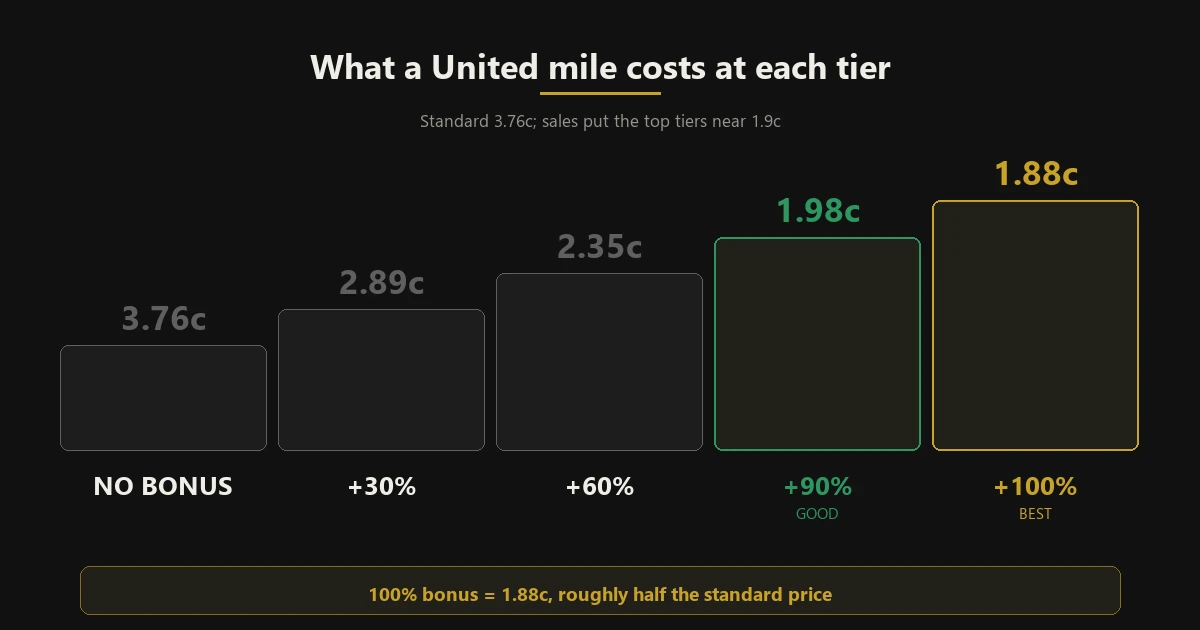
The top tier is the one that changes the maths. A 100% bonus — or its equivalent, a 50% discount — takes the effective cost to roughly 1.88 cents per mile, about half the standard price. A 90% bonus lands near 1.98 cents, and some accounts have seen 95% at about 1.93 cents. Treat 1.88–1.98 cents as the good-price band and check the exact figure at checkout.
The lower tiers are less compelling. A 75% bonus prices at about 2.15 cents and a 45% discount at about 2.07 cents, depending on the purchase band. Both are above what an independent analysis puts on a United mile, roughly 1.3 cents, so they only work when a specific award makes the miles worth more than that.
The percentage is not the price. A 50% discount and a 100% bonus produce the same 1.88-cent cost, and a 45% discount can sound bigger than a 30% bonus while still being dearer. What matters is the cost per mile in your hand after the offer is applied. Compare that single number against the cash price of the award you want — nothing else in the promotion is worth weighing.
The two purchase caps
This is the part of buying United miles that catches people out, and it changed in 2026. United applies two limits, and both count the bonus miles in full, not just the miles you pay for.
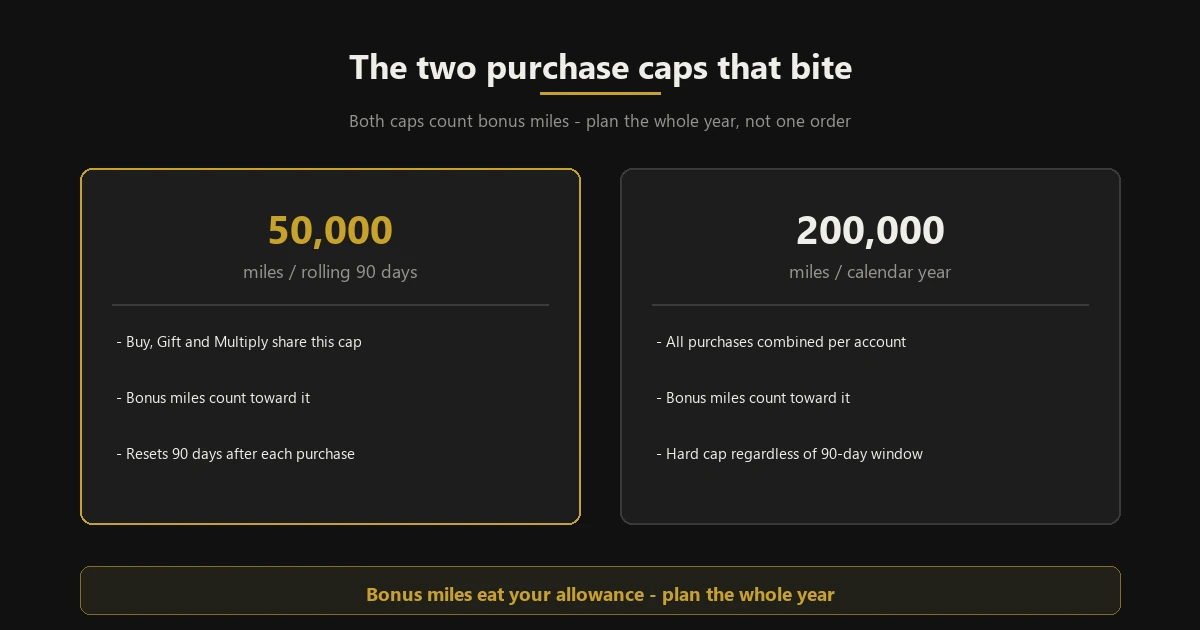
50,000 miles in any rolling 90 days. This is the tight one. Buy, Gift and Multiply are combined, and every bonus mile counts toward the 50,000 — the cap applies after the bonus is added. At a 100% bonus, buying 25,000 miles delivers the full 50,000 and uses your entire 90-day allowance, so a second purchase within three months is effectively blocked. Buying more and treating the bonus as free allowance is the classic mistake here.
200,000 miles per calendar year. The annual ceiling also counts bonus miles and all purchase types together. Historically the per-window limit was 200,000; it is now 50,000 per rolling quarter with a 200,000 annual backstop, so the quarterly number is the one that constrains most buyers.
Plan the whole purchase at once. Because bonuses consume the allowance, there is no advantage to splitting a buy into two smaller transactions — the miles still land in the same 90-day window and the total allowance used is identical. Decide how many miles the award needs, add a small buffer, and make one purchase.
Minimums and other rules
Purchase bands. The minimum buy is 2,000 miles, in increments of 1,000. Reaching 5,000 is what triggers a bonus offer, and a straight discount offer generally needs 10,000. Below those thresholds you pay the standard rate.
Delivery. Purchased miles normally post immediately and, at the outside, within 72 hours. If an award is available now, the miles will almost certainly be there before you need to book it.
No refunds. MileagePlus purchases are final. There is no cooling-off period and no way to return miles once the transaction clears, which is another reason to fix the award first.
No status credit. Bought miles are not Premier Qualifying Points and do not count toward Silver, Gold, Platinum or 1K. The transaction is processed by Points.com, so on a general travel card it does not usually code as an airline purchase either. Buying through a United co-branded card is the exception: that purchase earns MileagePlus miles as a United spend.
No expiry pressure. MileagePlus miles do not expire and there is no activity requirement. That is a genuine difference from hotel programmes, where 24 months of inactivity can empty a balance. It also means there is never a deadline-driven reason to buy — only the price and the award matter.
Break-even maths
Take a top-tier sale at about 1.9 cents — 1.88 cents at a 100% bonus, 1.98 cents at 90%. Reaching the 50,000-mile cap then costs roughly $940 to $990. To break even, the award those miles book has to be worth at least that in cash, and to come out ahead it needs to be worth more.
A domestic economy ticket that sells for $250 is a bad use: 25,000 miles at about 1.9 cents cost roughly $470 to $495 for a $250 seat. A Polaris business-class seat to Europe that sells for $4,000 is the opposite case — 75,000 to 100,000 miles in United’s dynamic pricing cost $1,410 to $1,980, well below the cash fare. Star Alliance partner awards can be better still: a Lufthansa or SWISS transatlantic business seat booked through MileagePlus often prices around 80,000 miles, and ANA or EVA business to Asia around 88,000, for fares that routinely clear $3,000.
The practical rule is to compare two numbers, not percentages. Write down the cash price of the exact flight you want, then the cost of the miles at your account’s per-mile price. If the miles are clearly cheaper, the purchase is rational. If the cash fare is low, pay cash and keep the miles — and if you hold Chase Ultimate Rewards or Bilt, price a 1:1 transfer first, because those miles cost no cash at all.
Who should buy, and who should skip
Buy if all of these are true: your account shows a top-tier offer — a 100% bonus or a 50% discount; you have a specific award already priced and available; the cash fare for that award is several times the cost of the miles; and the purchase fits inside your rolling 90-day allowance. In that situation a top-up of the shortfall is one of the better uses of cash in the points world.
Skip it if any of these apply: you are buying speculatively with no award in mind; your account only shows 75% or 45%; the redemption is a low-value domestic economy seat; you need more miles than the 90-day cap allows; or the cash fare is cheaper than the miles. In all of those cases, waiting costs you nothing, because the miles do not expire and the sale returns almost every month.
How to buy, step by step
1. Find the award first. Search MileagePlus for the exact flight and date you want, and note the miles required and the cash price. An award that is not available is not worth buying for.
2. Check your account’s price. The bonus is targeted. Log in and look at the offer shown to you, then calculate the cost per mile — do not assume you have the top tier because someone else does.
3. Work out the shortfall. Subtract the miles you already hold from the award cost, and add a small buffer for any price change. Buy the shortfall, not a round number that feels better.
4. Check both caps. Confirm the total miles you will receive, bonus included, fits inside 50,000 per rolling 90 days and 200,000 for the year. If it does not, use transfers for the difference.
5. Compare transfers. Chase Ultimate Rewards and Bilt transfer to United at 1:1. If you hold either, transferring is usually cheaper than buying — so check that balance before paying.
6. Complete the purchase and book. Miles usually post immediately. Once they are in the account, book the award before availability changes. If you want a second look at the live price before paying, check the current United miles offer here.
Verdict
Buying United miles in the 1.88–1.98 cent sale band is a good deal only in the narrow sense: it is roughly half the standard price, and it is cheap enough to make a premium award a bargain. It is not a general-purpose discount. At the 75% and 45% tiers the price is above the value most people get from a mile, and at any tier a speculative purchase is a mistake — the miles do not expire, so there is no clock pushing you to decide.
The two caps matter more than the bonus percentage. Because bonus miles count toward the 50,000 per-90-days limit, a single top-tier purchase can use up your allowance for the whole quarter. Work out the exact award first, buy only the shortfall, and leave the rest of the balance for the next sale.
For the full picture of what is live on this account and how it compares with other offers, start with our United MileagePlus promotions tracker. For what a mile is worth before you spend it, see our guide to United miles valuation, and for the wider framework, how loyalty points work.
Frequently Asked Questions
How much does a United mile cost during a sale?
The standard price is 3.76 cents with no promotion. In a sale the top tier usually brings the cost to about 1.88 cents at a 100% bonus, or 1.98 cents at 90%; some accounts see a 50% discount, which is the same 1.88-cent price. Treat 1.88–1.98 cents as the good-price band and check the exact figure at checkout.
Can I buy enough miles for a business-class award in one purchase?
Usually not. The rolling cap is 50,000 miles per 90 days, and bonus miles count toward it in full. Buying 25,000 miles with a 100% bonus delivers 50,000 miles but uses your entire 90-day allowance, effectively blocking a second large purchase. Awards that need more miles are best funded with a mix of purchased and transferred miles.
Do bonus United miles count toward the purchase caps?
Yes, in full. Both the 50,000 per rolling 90 days and the 200,000 per calendar year limits count the miles you receive, including every bonus mile. Buy, Gift and Multiply are combined under both caps. This is the most common reason a planned second purchase fails.
Do purchased United miles count toward Premier status?
No. Bought miles are not Premier Qualifying Points and do not move you toward Silver, Gold, Platinum or 1K. The purchase is processed by Points.com, so on a general travel card it does not usually code as an airline spend. Buying through a United co-branded card is the exception and earns MileagePlus miles on the transaction.
Do United MileagePlus miles expire?
No. MileagePlus miles do not expire and there is no activity requirement to keep them active. That is a fundamental difference from hotel loyalty programmes, where 24 months without activity can wipe a balance. It means there is no deadline forcing a purchase — the only question is the price and the award.
Is buying United miles during a sale a good deal?
Only against a specific, expensive award. A mile is widely valued at about 1.3 cents, so the 1.88–1.98 cent sale band is still a premium — but a Polaris or Star Alliance business-class award can return 3–5 cents, which makes the purchase worthwhile. For a cheap domestic economy ticket, pay cash instead.
What is the minimum number of miles I can buy?
The minimum purchase is 2,000 miles, in increments of 1,000. To receive a bonus you generally need to buy at least 5,000 miles, and a straight discount offer usually requires 10,000. Below those thresholds the standard 3.76-cent rate applies.
Should I buy United miles or transfer from Chase?
Transfer first if you can. Chase Ultimate Rewards and Bilt both transfer to United at 1:1, so miles you already hold cost no cash. Buying is for the gap that transfers cannot close — for example, when you are short of an award and have no transferable balance left.
More United MileagePlus Guides
- United credit cards ranked, the four Chase cards compared on fees, earning and PQP.
- Does United have an award chart, how dynamic pricing works and the partner Saver floor.
- Do United miles expire, why MileagePlus miles never lapse and the six forfeiture exceptions.
- United MileagePlus promotions, every live offer and which accounts should act on it.
- Best way to use United miles, the top redemptions ranked by value, current Saver levels and what to avoid.
- United MileagePlus elite status, all four tiers, 2026 thresholds and what changes in 2027.
- How to earn United miles, flight rates, bank and hotel transfers and the routes to avoid.
- Every official buy-points link in one place, with the current price per 1,000 miles for each programme.
- How loyalty points work, the framework for valuing a balance before you buy into it.
- All United Airlines coverage, every guide and offer we have published.
Price the exact award you want first, then check the per-mile cost on your own account against the 50,000-per-90-days cap. If the numbers work and your account shows the top tier, buy the shortfall here while a bonus is running.