ALL Accor points are worth a fixed 2 euro cents each — about 2.1 to 2.3 US cents — and that number is the same whether you redeem 1,000 points or 100,000.
The short version: this is a cash rebate, not a leveraged award currency. There is no award chart to exploit, no off-peak trick, and no way to turn a cheap point into a luxury-night bargain the way you can with Hyatt. The value is predictable, which is its whole appeal, and it also means the headline 2-cent figure is easy to misread as better than it is.

What an Accor point is actually worth
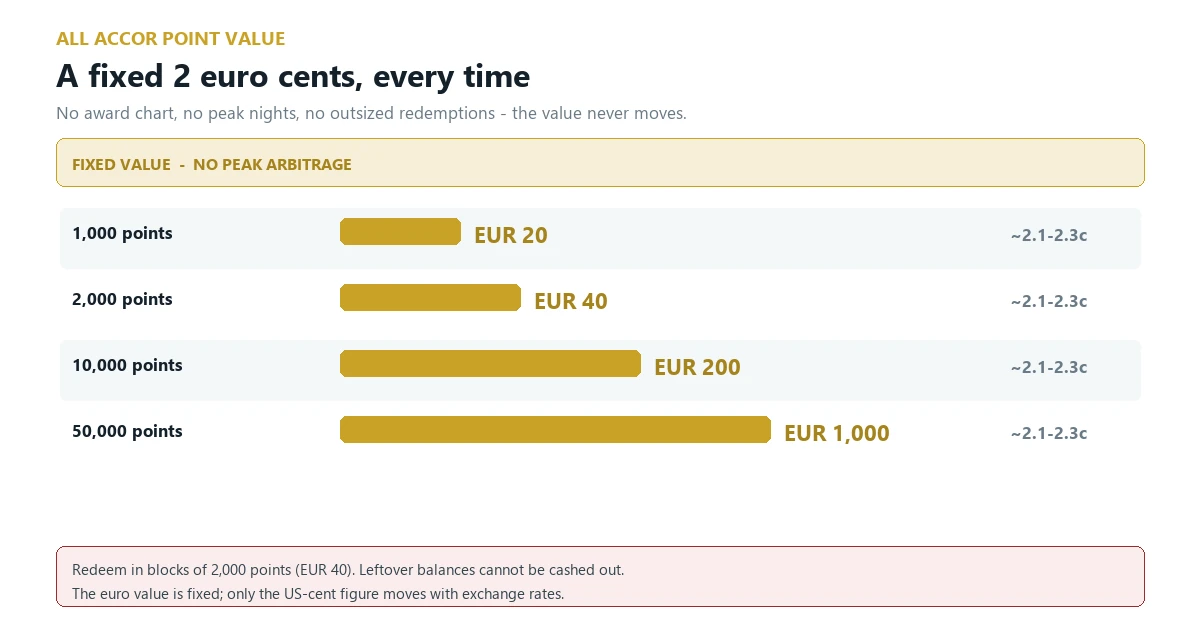
The answer is unusually clean: one ALL Accor Reward point is worth 2 euro cents, fixed by the programme. Redeem 1,000 points and you get EUR20 off an eligible stay; redeem 2,000 and you get EUR40. Because the rate is published and constant, you can work out the exact cash value of any balance before you book — something you cannot do with a dynamic programme where the same point buys a different amount each night.
In US dollars the figure floats with the euro: roughly 2.1 to 2.3 cents per point at recent exchange rates. That is the only moving part. The euro amount is nailed to the floor, so a weak dollar simply makes your Accor points worth a little more in dollars, and a strong dollar the reverse. If you want the cross-program context, our hotel points valuation chart puts this fixed rate alongside the dynamic currencies.
The fixed 2-eurocent rate, explained
Accor prices rewards off the cash cost of the stay rather than off an award chart. Every Reward point carries the same face value, and you apply that value as a credit to the folio. There is no seasonality, no category table and no peak or off-peak pricing to time. A point earned on a EUR90 ibis night is worth exactly the same as one earned on a EUR600 Sofitel night.
This makes planning simple and removes the main skill element in other programmes. With Marriott or Hilton points, a savvy booking on an expensive night can return far more than the average; with Accor, the return is identical everywhere, so the only question is whether you value a fixed EUR40 off more than the alternatives. You can check current Accor rates and see what the credit would actually offset on a real booking.
The trade-off is a hard ceiling. A fixed-value point can never outperform its face value, so there is no upside to hunting for a special property. That is the defining difference from a leveraged award chart, and it is why Accor belongs in the predictable-cash bucket rather than the points-optimisation bucket.
Why redemption blocks matter
Accor applies points in set increments rather than letting you spend an exact balance. The floor is 1,000 points for EUR20 off. Everything above that works in 2,000-point steps, so 2,000 points take EUR40 off and 4,000 take EUR80. A balance of 1,700 points cannot be partly redeemed for EUR34 — you can only apply 1,000 of it, and the rest waits until you top it up.
This creates a small but real waste at the margins. If a stay ends with a balance just below a block, those points have no cash value at that moment, even though the headline valuation says 2 cents. The fix is straightforward: check your balance before redeeming and, if you are close, use a partner earning route or a small qualifying spend to cross the threshold. It is also one of the few cases where topping up makes mathematical sense, because you are unlocking a fixed credit rather than gambling on an award seat.
The earn rate is where the value adds up
Because the redemption side is fixed, the earn side does the heavy lifting. If you want the channel-by-channel breakdown, our Accor points earning guide ranks every route. A Classic member earns roughly 2.5 Reward points per euro of eligible room spend at most brands — Accor markets this as a 5 percent rebate. Elite bonuses stack on that base: Platinum adds about 75 percent and Diamond about 100 percent, taking the effective return toward 10 percent of pre-tax room spend in Accor credit.
That is a strong rebate if your travel already lands in Accor hotels, and it compounds because the credit is worth a known 2 euro cents rather than a speculative amount. Earning rates are lower at ibis, ibis Styles, Mama Shelter and Adagio, and a few brands sit outside ALL altogether, so the effective rebate depends on where you sleep. Accor also lets you earn on up to two rooms on the same night, which is unusually generous for couples and families travelling together.
The practical takeaway: treat Accor points as a rebate you accumulate, not a balance you optimise. Choose the brand and location you actually want, then let the rebate build. Our Accor hotel brands guide maps every brand to its earn rate so you can see what that choice costs in points. For a sense of how other chains reward the same spend, compare the Hilton points valuation and the IHG points valuation, where the earn rates look similar but the redemption value is far lower.
A concrete example shows how quickly the fixed rate adds up. Two nights at EUR220 a night as a Classic member earn roughly 2,200 points — enough for one EUR40 block, an 18 percent rebate on the EUR440 room bill once you factor in the block rounding. Add Platinum status and the same stay earns close to 3,850 points, almost two full blocks worth EUR80. If you are working toward that tier, our Accor Platinum status guide explains the 60-night and 14,000-point routes and what Platinum actually adds. Because you can earn on both rooms when you book two, a family in adjacent rooms can reach a redeemable block in a single weekend. There is no strategy beyond showing up and choosing an eligible rate; the fixed value does the rest.
Accor vs Hyatt, Marriott, IHG and Hilton
On paper, Accor’s 2 cents beats every major US chain. World of Hyatt is often quoted near 1.55 cents, Marriott Bonvoy near 0.8, and IHG and Hilton around 0.5 each. Those numbers are not comparable in the way they look. Accor’s figure is a fixed cash-equivalent rebate; the others are average values of a dynamic award currency that can be beaten — or badly undercut — depending on the night.
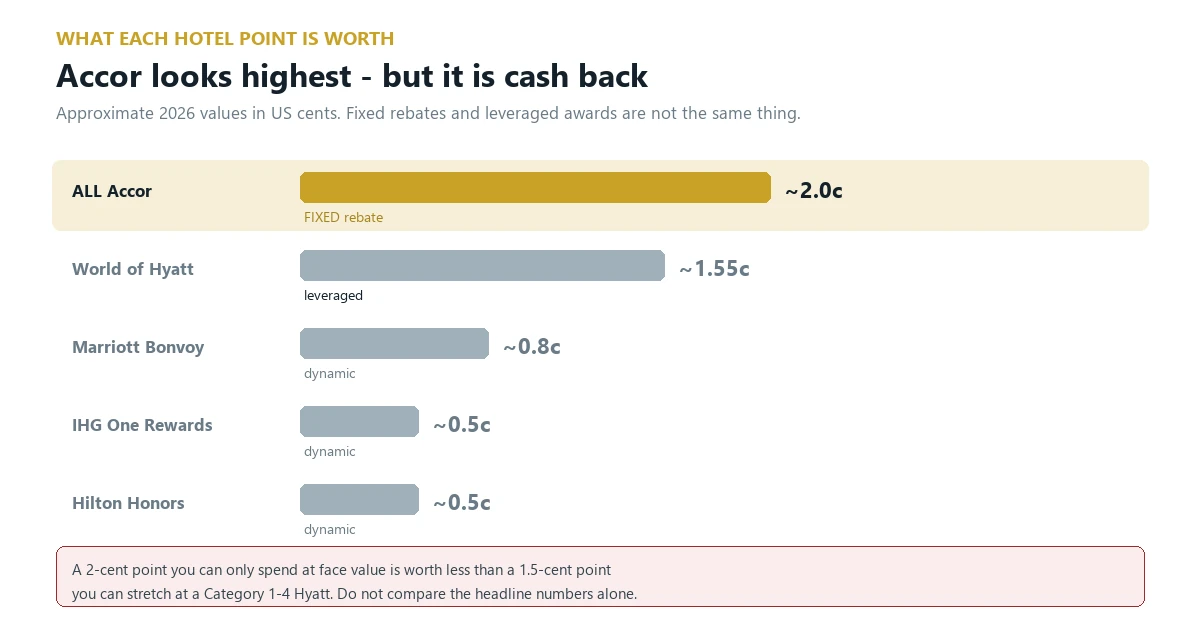
A worked example makes the distinction clear. Spend 15,000 Hyatt points at a Category 4 hotel on a night that costs USD400 in cash and you have extracted about 2.7 cents per point — well above Accor’s fixed rate. Spend the same points at a Category 8 on a slow Tuesday worth USD250 and you have got under 1.7 cents. Accor has no version of this spread: 15,000 points are always EUR300, no matter the hotel or the night.
So the right comparison is not “2 cents versus 1.5 cents”. It is “a guaranteed 2 cents versus a variable average of 1.5 cents with a higher ceiling”. If you are a casual redeemer who values certainty, Accor wins. If you are willing to learn an award chart and book strategically, Hyatt’s leveraged points can beat it. Marriott’s dynamic points sit somewhere in between.
Three value traps to avoid
Trap one: treating 2 cents as a return on spend. The 2-cent figure is what a point is worth when redeemed, not what you earn per euro. At Classic level you earn about 2.5 points per euro, which is the 5 percent rebate. Conflating the two leads people to think a promotion doubling points doubles a 2-cent return — it doubles the number of points, and the cash value follows, but the earn rate and redemption value are separate numbers.
Trap two: transferring points to airlines. Accor transfers to Avios at 1:1, which sounds reasonable until you remember each point is already worth 2 euro cents in cash. That is roughly 2 euro cents per Avios — far above what an Avios is worth as a redemption. Moving points the other way is worse: British Airways Avios routed through Qatar Privilege Club into Accor currently returns well under half a penny per Avios. There are narrow exceptions such as a better Qantas ratio or an Accor Experiences ticket, but the default answer is no. Our guide to the best Accor redemptions prices each exit route in cash. We cover the fuller reasoning in the Accor promotions hub, where transfer bonuses sometimes change the arithmetic.
Trap three: ignoring the 12-month expiry. A fixed-value point that lapses is worth zero. Accor points expire 12 months after the last point-earning activity, and the whole balance goes at once. A single new earning event resets the clock, and ALL Accor+ Signature subscribers are exempt. If you hold a small balance you cannot yet redeem, keeping it active matters more than chasing an extra fraction of a cent in value. The full clock rules, including the checkout-date start, are in our Accor points expiry guide. If you are weighing the subscription purely for this protection, our Accor Plus worth-it guide compares every paid plan, review the current Accor options before deciding.
Is an Accor point worth chasing?
For most travellers, Accor points are worth having but not worth optimising. The fixed 2-eurocent value makes them an honest, predictable rebate on stays you were going to book anyway, and the earn rate at elite levels is genuinely good. What they will not do is deliver the outsized redemption that makes a points balance exciting. If your goal is to stretch a small number of points into a luxury stay, a leveraged programme is a better use of your attention.
The mindset that fits is simple: join for where you sleep, earn at the highest tier you naturally reach, and redeem in clean blocks at 2 euro cents as a rebate. Watch the expiry clock, skip the airline transfers, and do not compare the headline cent figure with Hyatt in isolation. Book eligible Accor stays directly so the points post and the fixed value is actually yours to spend.
Bottom line: an ALL Accor point is worth a dependable 2 euro cents, provided you redeem it before it expires and resist the poor-value transfer options. Predictability is the benefit, and the ceiling is the price of it.
FAQ
How much is an ALL Accor point worth?
An ALL Accor Reward point is worth a fixed 2 euro cents. In practice, 1,000 points take EUR20 off an eligible stay and 2,000 points take EUR40, which works out to roughly 2.1 to 2.3 US cents depending on the exchange rate. The euro value never changes, so you can calculate any redemption exactly before you book.
Why do Accor points look more valuable than Hyatt or Hilton points?
Because the headline number is a fixed cash rebate, not a leveraged award. A 2-eurocent Accor point can only ever be spent at face value against the bill. A Hyatt point worth 1.55 cents on paper can be stretched to 3 cents or more at a low-category hotel on a busy night. The bigger printed number does not mean a bigger possible saving.
Can I redeem Accor points in any amount?
Not exactly. The floor is 1,000 Reward points, worth EUR20 off the folio, and anything above 2,000 must come in 2,000-point multiples. A leftover balance below the floor cannot be cashed out or partly applied — it waits until you earn enough to reach it.
Do Accor points expire, and does that change their value?
Yes, points expire 12 months after your last point-earning activity, so a stale balance is worth zero if you let it lapse. Any new earning activity resets the clock on the whole balance. ALL Accor+ Signature subscribers do not have the 12-month expiry. Because the value is fixed, the only way to protect it is to keep the account active or hold a qualifying subscription.
Is transferring Accor points to airlines good value?
Usually no. Accor transfers to Avios at 1:1, but since your points are already worth 2 euro cents each in cash, that is effectively paying 2 euro cents per Avios — far more than most redemption values justify. Transfers into Accor are worse: converting British Airways Avios through Qatar Privilege Club returns well under half a penny per Avios. There are occasional exceptions such as Qantas, but as a rule airline transfers destroy fixed-value points.
How many points do I earn per euro at Accor?
A Classic member earns about 2.5 Reward points per euro of eligible room spend at most brands, which Accor describes as a 5 percent rebate. Elite bonuses stack on top: Platinum earns about 75 percent more and Diamond about 100 percent more, taking the effective rebate toward 10 percent. Lower-earning brands such as ibis, ibis Styles and Adagio pay less, and some brands sit outside the programme entirely.
Can Accor points cover taxes and incidentals?
Points are applied as a fixed credit against eligible charges on the folio at participating hotels. The exact eligible items vary by property and region, and resort fees, taxes or third-party charges may not always qualify. Since the credit is credited as blocks, you generally use it against the room and qualifying incidentals up to the EUR40 multiples you hold.
Last updated: 18 November 2026. Redemption increments corrected to the published terms: 1,000 points as the floor, then 2,000-point multiples.