Accor Platinum status is reached at 60 qualifying nights or 14,000 status points in a calendar year — and it is the tier most travellers should actually aim for. Diamond looks grander but has no nights route at all.
The short version: ALL Accor has five tiers, Classic through Diamond. Silver, Gold and Platinum each accept either nights or status points, so you can climb by staying or by spending. Diamond breaks the pattern — it needs 26,000 status points, roughly EUR10,400 of eligible spend, and Accor also calls it invitation-only. Unlike Hilton or Marriott, no American Express card hands you Accor status.

The five tiers and how you reach them
ALL Accor runs a simple ladder: Classic, Silver, Gold, Platinum and Diamond. Four of the five can be reached two ways — by nights or by status points — and the lower tier you qualify for arrives automatically once you cross the threshold. Everything is measured within a single calendar year and resets on 31 December. That reset is the defining feature of the programme and the reason a December push counts for far less than the same push in January.
| Tier | Qualify by nights | Qualify by status points | Approx. eligible spend | Point bonus |
|---|---|---|---|---|
| Classic | Join for free | — | — | Base earning |
| Silver | 10 nights | 2,000 | EUR800 | +24% |
| Gold | 30 nights | 7,000 | EUR2,800 | +48% |
| Platinum | 60 nights | 14,000 | EUR5,600 | +76% |
| Diamond | No nights route | 26,000 | EUR10,400 | +100% |
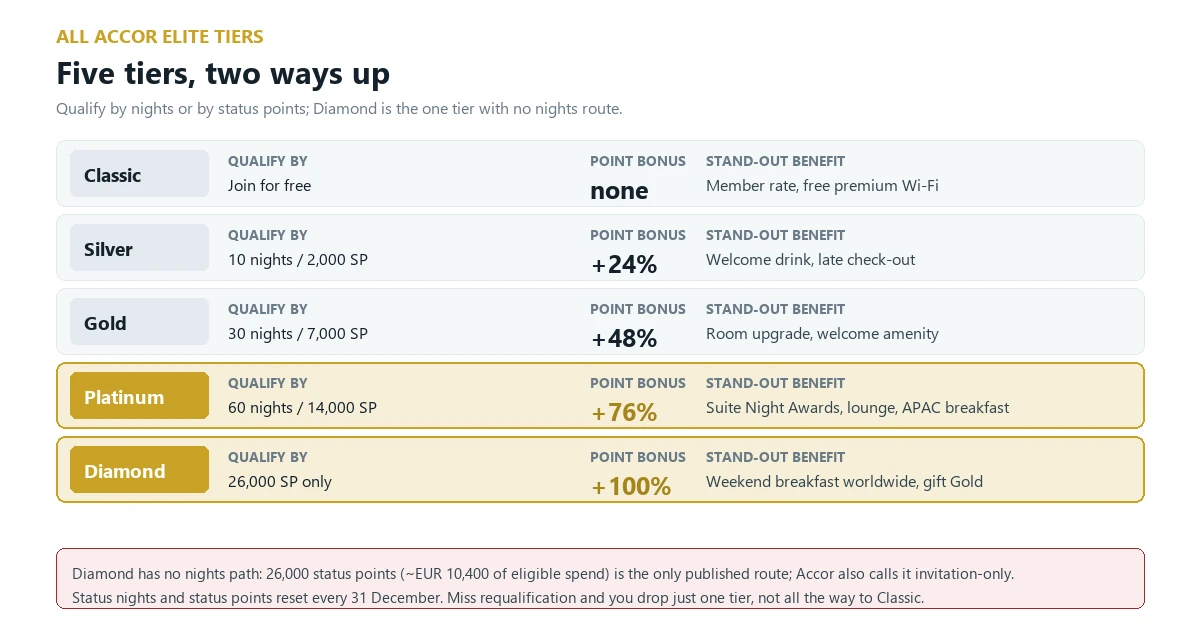
The spend figures are Accor’s own illustration — roughly four status points per euro of eligible spend — not a promise that every euro counts. Room rate, brand and rate type all change how many status points a stay delivers, and our Accor hotel brands guide shows which tier each brand sits in, and charges outside eligible categories do not count at all. Treat the numbers as a scale, then check your own account to see how fast your points actually accumulate.
Notice how the spend route gets progressively steeper. Silver is a modest EUR800 of spend, Gold is EUR2,800, Platinum is EUR5,600. That makes Platinum reachable for a business traveller whose company pays for rooms, while Diamond at EUR10,400 is a genuine commitment. Booking through Accor’s official site is the straightforward way to make sure your stays earn both nights and status points in the first place, since third-party bookings usually credit neither.
Status points vs Reward points
Accor runs two point balances, and mixing them up causes more errors than any other part of the programme. Status points decide your tier and clear every 31 December. Reward points are the spendable currency, worth a fixed 2 euro cents each, and they expire after 12 months of no qualifying activity. Neither can be turned into the other. A six-figure Reward points balance does nothing for your status, and the status points you earned in November vanish weeks later if you do not requalify.
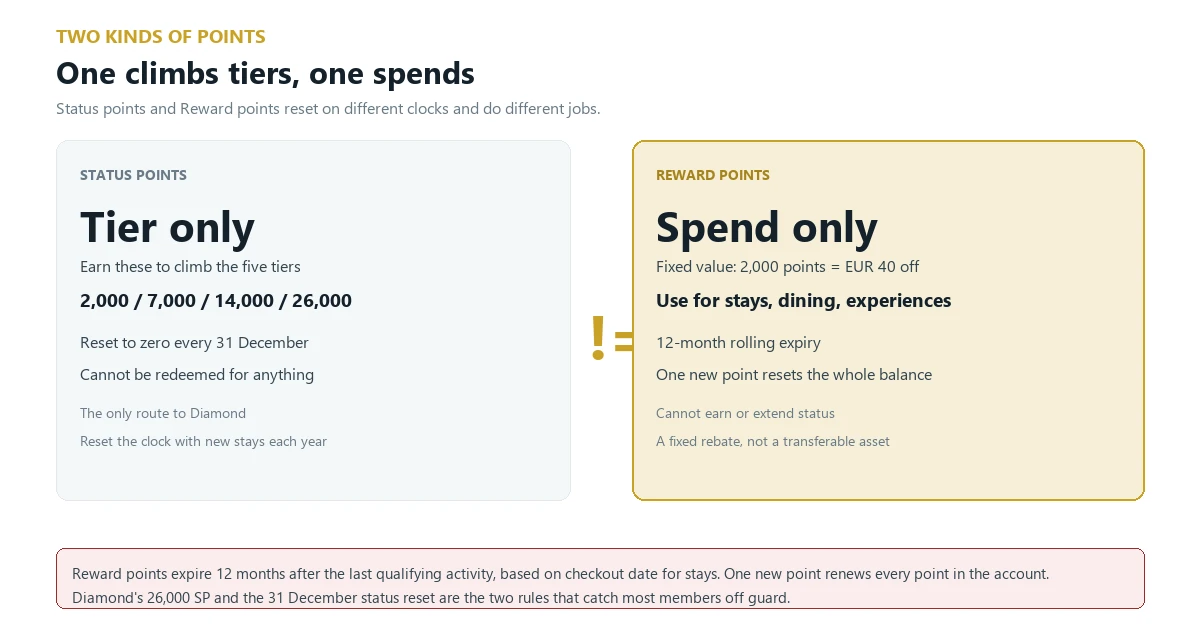
The different clocks matter in practice. A member who earns 7,000 status points in a year has Gold for the following year, but those points do not roll forward — the next year starts from zero again. Reward points work the opposite way: one new point resets the 12-month clock on the entire balance. This split is the reason Accor status requires consistent yearly activity rather than one big splurge you can coast on. For the exact expiry mechanics on the Reward side, see our Accor points expiry guide.
If you want the full detail on the 12-month rule and the exceptions, the Accor promotions hub tracks the offers that can top up a balance, and our Accor points valuation guide explains why the fixed 2-eurocent rate makes Reward points a rebate rather than a leveraged currency. For how this compares across chains, see the cross-programme points value chart.
Why Platinum is the sweet spot
Platinum is where the Accor programme becomes genuinely useful. At 60 nights or 14,000 status points it is easier to reach through spend than top status at most competing chains. The benefits are practical rather than flashy: Suite Night Awards that confirm an upgrade at the time of booking, executive lounge access where a hotel has one, early check-in and late check-out when the property can offer them, a 76 percent bonus on Reward points earned during stays, and complimentary breakfast at Asia-Pacific hotels.
Two of those deserve a closer look. Suite Night Awards are the standout They are also the one benefit no points redemption can replicate, which our Accor redemption guide explains. because they lock in a suite in advance instead of leaving an upgrade to chance at check-in — a real difference on a long stay or a special trip. The breakfast is more complicated. It is an Asia-Pacific benefit, not a global daily one, and Accor lists exclusions by brand and property. A Platinum member in Paris or Chicago should not assume breakfast is included. Wherever you travel, confirm the benefit on the booking page rather than at the front desk.
Lounge access has its own exception: Fairmont properties generally do not participate, so a Platinum member staying at a Fairmont should not expect a club lounge. This matters because Fairmont sits at the luxury end of Accor’s portfolio and is exactly where a traveller might expect the strongest benefits. Reading the brand-specific terms before booking avoids an awkward conversation on arrival.
For a sense of how this compares with a programme where status comes more easily from a card, the Marriott elite status guide shows the contrast: Marriott Gold can arrive through Amex, while every Accor tier has to be earned through actual Accor activity. That difference is the main reason Accor status is underrated — it is harder to fake, so it usually means the member genuinely stays with the chain.
Diamond: the spend-only tier
Diamond is the top of the ALL ladder and the only tier that ignores nights entirely. The published requirement is 26,000 status points in a calendar year — about EUR10,400 of eligible spend — and Accor also labels the tier invitation-only. A member who racks up a large number of cheap nights will not reach it if the status points are not there. Any plan for Diamond has to start with your status-points-per-stay, not a night counter.
The payoff is a 100 percent bonus on Reward points, weekend breakfast worldwide and daily breakfast in Asia-Pacific, ten Dining and Spa Rewards worth around EUR10 each, access to Fairmont Gold lounges, and the unusual ability to gift Gold status to another person. That last perk is genuinely distinctive and has no direct equivalent at Hilton or Marriott. Even so, Diamond only makes sense for someone whose spend already lands near the threshold — buying EUR10,400 of stays you would not otherwise make is not a sensible way to chase a tier.
There is a legitimate shortcut worth knowing. A paid subscription such as ALL Signature Absolute credits 12,000 status points across the year, close to half the Diamond requirement, and Explorer adds 30 status nights for Gold. Our Accor Plus and ALL Signature guide runs the break-even math on those subscriptions. Combining a subscription with normal stays can make Diamond realistic for a high-volume guest, but the subscription alone will not deliver it — status points still have to be earned within the calendar year.
Why no credit card gives Accor status
This is the most common misconception about ALL Accor. American Express Platinum is famous for granting Hilton Gold and Marriott Gold, and a reader moving those habits to Accor expects the same. It does not work. The Amex Platinum card confers no Accor status of any kind. Amex occasionally runs targeted offers that earn extra Accor Reward points, but those are point bonuses, not tier credits, and they never shortcut the path to Platinum or Diamond.
Among the major hotel loyalty programmes this is unusual. Hilton, Marriott and IHG all have co-branded or premium cards that grant status to cardholders. Accor has chosen not to follow that model, which is why the useful comparison is not another hotel chain but the structure of Accor’s own subscriptions. If your status strategy depends on a card, Accor is the wrong programme; if it depends on real stays and spend, the ladder is refreshingly predictable.
The practical consequence is simple: to build Accor status you either stay at Accor hotels, spend at properties that credit status points, or buy a subscription that credits status nights. There is no back door. Booking directly with Accor matters more here than at other chains because a third-party reservation typically earns neither nights nor status points — you pay the same and start from zero.
Legitimate ways to speed up status
Accor does run occasional status fast tracks and promotion windows, usually announced to members by email and listed on the offers hub. These can grant bonus status points or cut the nights needed for a tier over a defined period. They are real, but they are temporary and rarely align perfectly with your travel plans, so they should be treated as a bonus rather than the foundation of a status strategy.
The reliable accelerators are less glamorous. Concentrating stays inside one chain instead of spreading them across several is the biggest lever — a traveller who splits forty nights between three programmes reaches elite status in none of them. Choosing an Accor property over an equivalent independent hotel for a few extra nights each year compounds quickly. And using a subscription that credits status nights can close a small gap: Explorer’s 30 nights deliver Gold outright, which is a reasonable move if you are otherwise stuck below the threshold.
What does not work is buying Reward points and hoping they count. Accor does not sell points directly, and even points earned through partners or dining are Reward points, not status points. The distinction is deliberate. Our Accor points earning guide breaks down which channels pay points, and which of those also pay status points. If you want to see where Accor’s fixed-value points sit against programmes that do sell points, the cross-chain valuation chart makes the difference clear.
Requalification and the soft landing
Every Accor tier is earned for a calendar year and has to be requalified. Miss the threshold and the published approach is a soft landing: you drop one tier rather than falling straight back to Classic. A Platinum member who falls short the following year lands at Gold, retaining upgrades and the higher points bonus instead of starting over. It is a member-friendly rule and one of the quieter reasons the programme is worth consolidating stays into.
The soft landing is not a reason to stop paying attention. Status points reset on 31 December with no rollover, and a late-year gap can cost you a tier even if you were comfortably above it in October. Members whose travel is uneven should check their status-points balance a few months before year-end, when there is still time to shift a planned stay toward an Accor property. A single qualifying stay in December can be the difference between Platinum and Gold.
Before booking year-end travel, it is worth checking the current Accor promotions for bonus status-point offers — these occasionally run in November and December and can close a small shortfall. And if you are comparing how other chains handle status expiration, the Marriott elite guide covers a programme with a very different requalification calendar.
Verdict: is Accor status worth chasing?
For most travellers who stay with Accor at all, Platinum is the target. Sixty nights or 14,000 status points is achievable through ordinary business travel, the Suite Night Awards and lounge access are tangible, and the earn bonus adds value to every stay. Gold is a perfectly respectable stopping point for lighter travellers, especially in Asia-Pacific where breakfast sweetens the tier. Diamond is a niche achievement for high spenders, not a realistic goal for someone counting nights.
The honest caveat is geography. A traveller based in Europe or North America gets less from Accor status than one who travels in Asia-Pacific or the Middle East, because the breakfast and dining benefits are regional and Fairmont excludes lounge access. In those regions the status is still worth having for upgrades and points, but it should not displace a programme whose elite benefits follow you everywhere. Choose the programme that matches where you actually sleep.
Bottom line: Accor Platinum status is worth chasing if your nights or spend already land near 60 nights or 14,000 status points. It cannot be bought with a credit card, Diamond cannot be reached with nights, and both balances reset on a calendar-year clock. Concentrate your stays, watch the status-points column, and book direct through Accor so every eligible night counts.
Last updated: 18 November 2026.
FAQ
How do you get Accor Platinum status?
You reach Platinum by staying 60 qualifying nights in a calendar year or by earning 14,000 status points, whichever comes first. Status points come from eligible spend, so the points route works out at roughly EUR5,600 of qualifying charges at Accor hotels. Most members get there through a mix of nights and spend rather than one route alone. Status nights and status points both reset on 31 December, so everything has to happen inside the same calendar year.
Can you reach Diamond with nights at Accor?
No. Diamond is the only tier with no nights equivalent. It requires 26,000 status points in a calendar year, which is roughly EUR10,400 of eligible spend, and Accor also describes it as invitation-only in its published terms. A member who stays 200 cheap nights but never builds 26,000 status points will not be invited. Planning for Diamond means watching status point velocity, not counting nights.
Do Amex Platinum or other credit cards give Accor status?
No. The American Express Platinum card is famous for handing out Hilton Gold and Marriott Gold, but it confers no ALL Accor status at all. Occasional targeted Amex offers can earn extra Accor points, but they do not grant or accelerate elite tiers. Among the major hotel programmes this is unusual, and it means the only realistic routes to Accor status are staying, spending at Accor properties, or buying a subscription that credits status nights.
What is the difference between status points and Reward points?
Status points decide your tier and are wiped every 31 December. Reward points are the currency you spend, worth a fixed 2 euro cents each, and they expire after 12 months of no qualifying activity. One set can never be converted into the other. Confusing them is the single most common mistake: a large Reward points balance does nothing for your tier, and a pile of status points from December disappears before it can help the following year.
What do you actually get at Accor Platinum?
Platinum adds Suite Night Awards, executive lounge access where the hotel has a lounge, a 76 percent bonus on Reward points earned during stays, early check-in and late check-out subject to availability, and complimentary breakfast at Asia-Pacific hotels. Fairmont is a notable exception to the lounge benefit. The Suite Night Awards are the most valuable item because they confirm an upgrade at booking rather than hoping at check-in.
Is Accor Platinum worth chasing?
For most frequent travellers, yes — Platinum is the sweet spot. It is easier to reach through spend than top status at Hilton, Hyatt, IHG or Marriott, and the suite upgrades and lounges are real benefits. The breakfast, however, is mainly an Asia-Pacific perk and is not a global daily benefit. If your stays are concentrated in Europe or North America and you rarely see a lounge, the value drops to the upgrades and the 76 percent points bonus.
What happens if you do not requalify for Accor status?
Accor writes a soft landing into its terms: miss requalification and you drop just one tier rather than falling all the way back to Classic. A member who finishes the year at Platinum but falls short the next year lands at Gold, not at the bottom. The exact mechanics depend on the programme terms in force, so it is worth checking the current rules before assuming a specific outcome, but the one-tier drop is the published approach.