Accor hotel brands run from Raffles and Orient Express at the top to ibis budget at the bottom, and the tier a brand sits in decides how many ALL points your stay earns. That is the only distinction that matters if you are collecting.
The short version: Accor sorts its core portfolio into four tiers, and the two most expensive tiers pay the same rate. Luxury and Premium both return 25 Reward points per EUR10 of eligible spend, Midscale returns around 15, and Economy falls to between 5 and 12.5. Ennismore sits alongside the ladder as a lifestyle collective spanning all four. Below that structure is a second, less discussed list of brands and countries that earn nothing at all, and it catches out members every month. Every rate on this page assumes you book direct with Accor, because a third-party booking zeroes all of it.
The four tiers, and why the top two tie
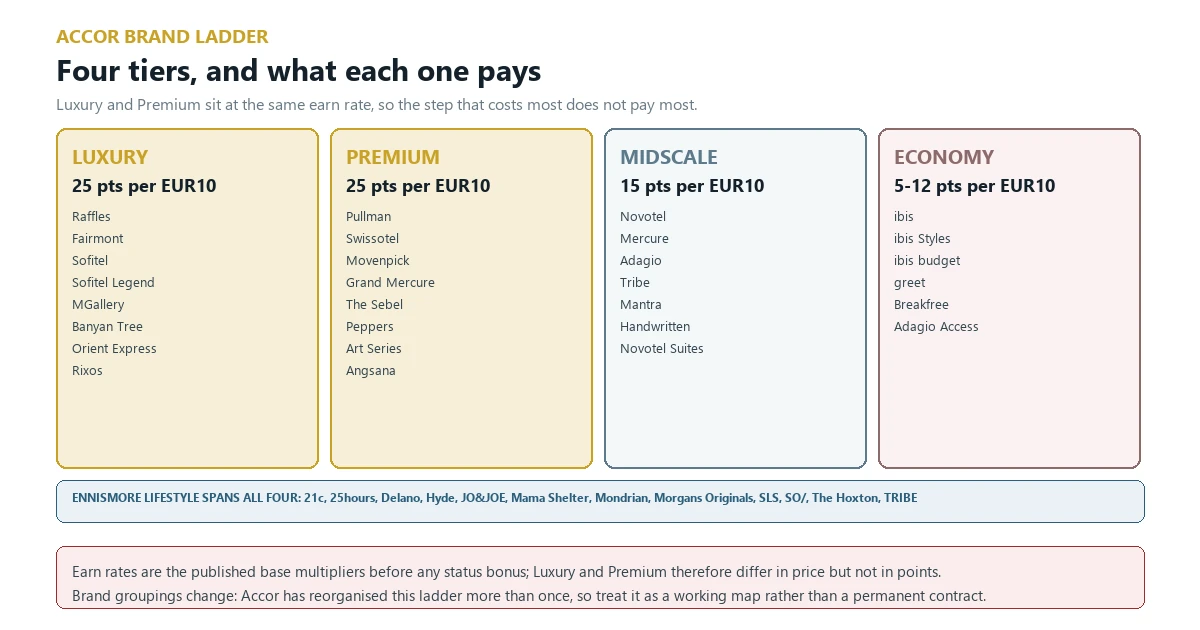
The earn rate is the cleanest way into a portfolio this large. Accor publishes base multipliers by tier rather than by brand, so forty-odd names collapse into four numbers. Luxury and Premium pay 25 points per EUR10. Midscale pays about 15. Economy pays 12.5 for ibis and ibis Styles, and 5 for ibis budget, greet and the other budget labels.
The striking part is the tie at the top. A night at Raffles and a night at Pullman earn identically per euro of eligible spend, even though the cash rates differ by a factor of five. Members routinely assume the luxury tier must pay a premium rate; it does not. The premium is in the status bonus and the benefits, not in the base multiplier, which is why our guide to earning Accor points treats brand choice as a rate decision rather than a prestige decision.
| Tier | Brands | Points per EUR10 | Notes |
|---|---|---|---|
| Luxury | Raffles, Orient Express, Sofitel Legend, Sofitel, Fairmont, MGallery, Banyan Tree, Rixos, Emblems, Faena, onefinestay | 25 | Same rate as Premium |
| Premium | Pullman, Swissotel, Movenpick, Grand Mercure, The Sebel, Peppers, Art Series, Angsana, Mantis | 25 | Best value per euro |
| Midscale | Novotel, Mercure, Adagio, Tribe, Mantra, Handwritten Collection, Novotel Suites, Novotel Living | 15 | Apartment formats included |
| Economy | ibis, ibis Styles, ibis budget, greet, Breakfree, Adagio Access | 12.5 to 5 | budget labels pay least |
| Ennismore | 21c, 25hours, Delano, Hyde, JO&JOE, Mama Shelter, Mondrian, Morgans Originals, SLS, SO/, The Hoxton | Varies by property | Spans all four tiers |
| Excluded | hotelF1, most The Hoxton, most ibis budget outside six countries, ibis and ibis Styles in China | None | Earns nothing at all |
Two caveats keep the table honest. Brand groupings change, because Accor has reorganised this ladder more than once and absorbed whole collections such as Banyan Group and Ennismore along the way. And the rate applies to eligible spend, which is the pre-tax room charge plus qualifying incidentals, not the whole folio. The points calculator inside your ALL account is authoritative for a specific property.
Luxury: Raffles to Rixos
The luxury tier is where Accor’s French inheritance shows most clearly. Sofitel is the flagship and the one most travellers have actually stayed in, with Sofitel Legend reserved for heritage buildings. Raffles brings the colonial-grande-dame format, Orient Express is the revived rail heritage label with a small and growing hotel count, and Fairmont contributes the large resort and city hotels that came across in the 2016 acquisition.
Banyan Tree arrived with the Banyan Group partnership and anchors the resort side, particularly in Asia. MGallery is the soft brand for independent hotels that want distribution without losing their identity, which makes it inconsistent in the way all soft brands are: a superb MGallery and a tired one can carry the same name. Rixos is the all-inclusive and resort-heavy label concentrated in Turkey, the Middle East and Egypt, and Faena is the small Miami and Buenos Aires design collection.
At 25 points per EUR10, luxury stays build a balance quickly. A EUR600 night returns 1,500 points, worth about EUR30 at the fixed rate, and a Platinum member collecting the 76 percent bonus would see roughly 2,640 points from the same stay. That is a real return on a booking someone was making anyway. Our Accor points valuation guide runs the full arithmetic on what those points then buy.
Premium: the sweet spot
Premium is the tier worth understanding best, because it pays the luxury rate at prices most travellers can actually justify. Pullman is the business and conference brand with the largest global footprint of the group’s upscale labels. Swissotel is the quieter, more residential version with Swiss service standards. Movenpick carries the resort and culinary reputation, and Grand Mercure is the one that surprises people by sitting up here rather than beside Mercure.
The rest of the tier is more regional than the headline names suggest. The Sebel and Peppers are apartment and resort labels concentrated in Australia and New Zealand. Art Series is an Australian art-hotel collection. Angsana is the Banyan Group’s mid-luxury resort sibling to Banyan Tree, and Mantis is the boutique and eco collection. If you travel mainly in Europe or North America, Pullman, Swissotel, Movenpick and Grand Mercure are the four you will actually meet.
The value argument is straightforward. Premium gives you the top earn rate without the luxury price, so a Movenpick at EUR180 a night earns proportionally more per euro spent than a Raffles at EUR900. Points per euro is flat across both tiers, but points per night of budget is not, and for anyone building a balance on ordinary travel the Premium tier is where the maths works hardest.
Midscale: Novotel, Mercure and friends
Midscale is the volume tier and the one most members actually stay in. Novotel is the consistent full-service brand with family rooms and pools at many properties. Mercure is the largest and least uniform, ranging from city-centre conversions to roadside motels, and it is the brand most often confused with Grand Mercure one tier above. Tribe is the newer design-led entry aimed at younger travellers.
Adagio is the apartment brand and splits across two tiers: Adagio and Adagio Premium sit in Midscale and Premium respectively, while Adagio Access is the Economy version. Novotel Suites and Novotel Living extend the same apartment logic under the Novotel name. Mantra and Handwritten Collection round out the tier, the first concentrated in Australia and the second a soft brand for independent hotels.
At around 15 points per EUR10, Midscale returns roughly 60 percent of the Premium rate for a stay that often costs half as much. Whether that is better depends on what you are optimising. If the goal is the largest possible balance, Premium wins per euro. If the goal is a comfortable night at a fair price with points as a side effect, Midscale is the realistic answer for most trips, and there is no shame in it.
Economy: the ibis family
The ibis family is the most recognised part of the portfolio and the most misunderstood on rates. ibis is the standardised budget room, ibis Styles is the design-led version that usually includes breakfast, and ibis budget strips the format back further still. All three are Economy, but they do not pay the same: ibis and ibis Styles return around 12.5 points per EUR10, while ibis budget returns about 5.
That gap is larger than it looks. At ibis budget rates, a EUR60 night earns roughly 30 points, worth EUR0.60. The same member spending EUR120 at an ibis earns about 150 points, worth EUR3. Neither is a reason to choose a hotel, but the difference explains why budget stays feel like they earn nothing: they nearly do. greet, Breakfree and Adagio Access sit in the same low-earning group.
The Economy tier also carries most of the programme’s exclusions, which is why the next-but-one section matters more than the rate table. Most ibis budget hotels outside a short list of countries do not participate in ALL at all. All ibis and ibis Styles hotels in mainland China are excluded. hotelF1, the French ultra-budget label, earns nothing anywhere in the world.
Ennismore, the fifth column
Ennismore is not a tier, and treating it as one is where most guides go wrong. It is Accor’s lifestyle collective, formed as a joint venture in 2021 with Accor holding the majority, and it holds brands that deliberately resist tier logic. Mondrian and SLS operate at the luxury end in some cities and mid-market in others. The Hoxton is a design-led city hotel with a co-working lobby. Mama Shelter is playful and mid-priced. 25hours is the German original with themed interiors. SO/ is the avant-garde luxury label, Delano the Miami original, Hyde the younger sibling, and JO&JOE the hostel-adjacent format.
All of them participate in ALL, so stays earn Reward points and status nights like any other Accor booking. What they generally do not participate in is the paid subscription programme: ALL Accor+ Explorer free-night vouchers and the dining discount typically do not apply at Ennismore properties. That distinction matters far more than a few points, and our Accor Plus and ALL Signature guide sets out which benefits travel where.
The practical read is that Ennismore is a design decision rather than a points decision. If you want the lobby, the restaurant and the crowd, book it and collect the points you collect. If you are buying a subscription specifically to use free nights, check the property list before you assume an SLS or a Hoxton will honour a voucher, because several will not.
Brands and countries that earn nothing
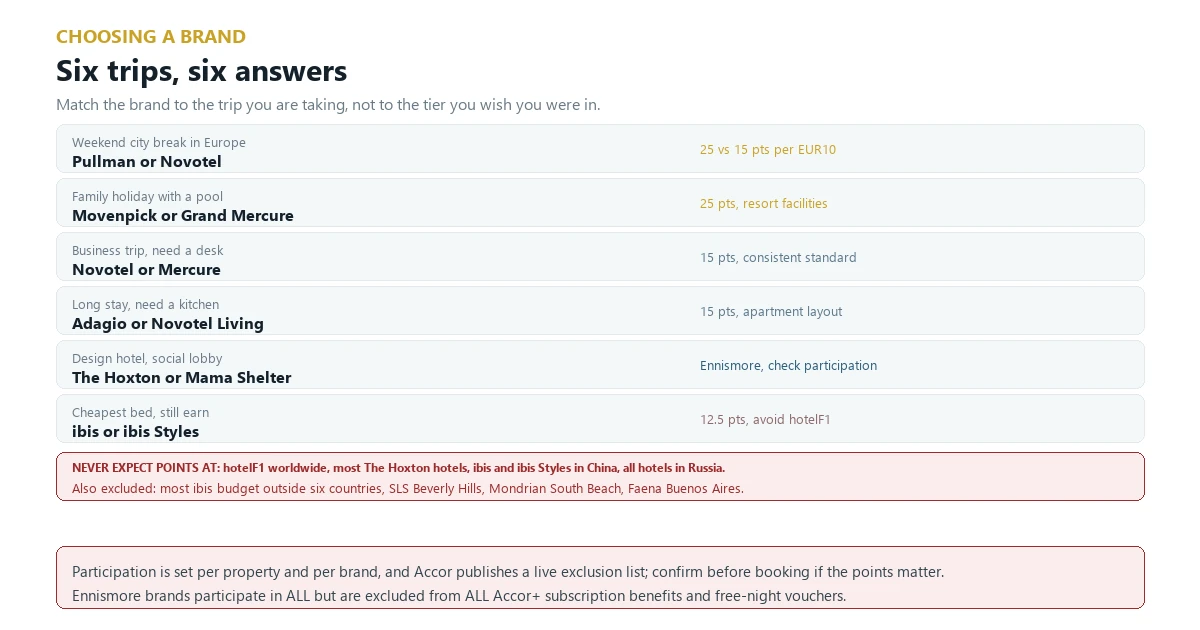
Accor publishes a live exclusion list, and it is longer than most members expect. At a non-participating hotel you cannot earn Reward points, cannot earn status points or status nights, cannot spend Reward points, and do not receive your tier benefits. Being a Platinum member at the door of an excluded property gets you nothing.
The brand-level exclusions are the ones that catch people. hotelF1 is excluded everywhere. Most ibis budget hotels are excluded, with exceptions confined to Cambodia, Georgia, Japan, Mexico, Poland and South Korea. All ibis and ibis Styles properties in mainland China are excluded, which surprises travellers who assume a global brand behaves globally. All hotels in Russia are excluded. The Hoxton is the messiest case: only the properties in Amsterdam Lloyd, Berlin, Edinburgh, Florence, Rome, Vienna, Barcelona Poblenou and London Southwark participate, and the rest of the brand does not.
Individual property exclusions sit underneath the brand rules. Faena Buenos Aires, Banyan Tree Macau, Banyan Tree Seoul, Banyan Tree Krabi, Banyan Tree Samui, SLS Beverly Hills, Mondrian South Beach, Hyde Beach House Hollywood, Hyde Midtown Miami, Fairmont Vier Jahreszeiten Hamburg, Peppers Manor House in Australia and a handful of Adagio and JO&JOE addresses in France all earn nothing despite belonging to participating brands. The list moves, so check the exclusion page before a stay where the points are the reason for choosing the hotel.
One more trap sits outside the exclusion list: booking through an online travel agency. A stay at a fully participating Raffles booked through a third-party site earns no Reward points and no status nights, because the reservation is not an eligible stay. The fix is to book on all.accor.com or the app and keep the member rate, which is usually the same or cheaper anyway.
How to choose by trip type
The tier table answers what a brand pays. It does not answer which brand to book, and the second question is the one most travellers actually have. The useful approach is to start from the trip and let the brand follow, because a tier difference of 10 points per EUR10 rarely justifies a worse location or a room you do not want.
For a weekend city break in Europe, Pullman and Novotel cover most cases at 25 and 15 points respectively, and the price gap usually decides. For a family holiday with a pool, Movenpick and Grand Mercure combine resort facilities with the top earn rate. For business travel where a desk and reliable wifi matter more than the lobby, Novotel and Mercure are the consistent choices. For a stay of a week or more, Adagio and Novotel Living switch to an apartment format without dropping out of Midscale.
The lifestyle end is a different decision. If the design, the restaurant and the social lobby are the reason for the trip, The Hoxton or Mama Shelter deliver something the tier brands do not, and the points are secondary. If the cheapest bed is the goal and you still want the stay to count, ibis and ibis Styles earn 12.5 while hotelF1 earns nothing, so the choice within the budget segment is not neutral. Our guide to the best Accor redemptions covers what to do with the balance once it accumulates.
The short answer
Four tiers, one tie at the top. Luxury and Premium both pay 25 points per EUR10, so if you are choosing between a Sofitel and a Pullman the points are identical and the decision is about the hotel. Midscale pays around 15 and Economy between 12.5 and 5, which means budget stays build a balance slowly by design rather than by accident. Ennismore participates in ALL but not in the subscription benefits, and a specific list of brands and countries earns nothing at all.
For anyone collecting seriously, the practical sequence is: stay in Premium where the trip allows, use Midscale when the price gap is large, avoid hotelF1 and excluded properties entirely, and always book direct so the stay counts. Then let status do the multiplying, which our Accor elite status guide explains tier by tier, and keep an eye on the expiry clock that our points expiry guide sets out. The Accor promotions hub tracks the live offers that stack on top of all of it.
Bottom line: the Accor portfolio is four earn rates, not forty brands. Luxury and Premium tie at 25 points per EUR10, Midscale sits near 15, Economy falls to 12.5 or 5, and a named list of brands and countries including hotelF1, most ibis budget hotels, ibis in China and most The Hoxton properties earns nothing. Choose the brand that fits the trip, book direct, and let the tier the stay sits in do the rest.
Last updated: 18 November 2026.
FAQ
How many Accor hotel brands are there?
More than forty, once the Ennismore lifestyle labels and the Banyan Group are counted. Accor’s own ladder sorts the core portfolio into four tiers called Luxury, Premium, Midscale and Economy, and Ennismore sits alongside those tiers as a separate collective that spans all four. The count changes because Accor keeps absorbing and retiring brands, so the tier a brand belongs to matters more than the total.
Which Accor brands earn the most points?
Luxury and Premium pay the same rate, 25 Reward points per EUR10 of eligible spend, which is the highest in the portfolio. That means Raffles, Fairmont, Sofitel, Banyan Tree, Pullman, Swissotel and Movenpick all earn identically. The step that costs the most does not pay the most, so a Sofitel and a Pullman are worth the same to your balance at the same spend.
Is Mercure a premium brand?
No. Mercure sits in the Midscale tier at around 15 Reward points per EUR10, alongside Novotel, Adagio, Tribe and Mantra. Grand Mercure is the one that moves up to the Premium tier at 25 points. The name similarity causes more confusion than any other pair in the portfolio, so read the first word carefully when booking.
What is Ennismore and does it earn Accor points?
Ennismore is Accor’s lifestyle collective, holding Mondrian, SLS, Delano, Hyde, The Hoxton, Mama Shelter, 25hours, SO/, JO&JOE, 21c Museum Hotels and TRIBE. It participates in ALL, so stays earn Reward points and status nights. What it does not participate in is ALL Accor+ subscription benefits, so Explorer free-night vouchers and the dining discount generally do not apply there.
Which Accor brands do not earn points?
hotelF1 earns nothing anywhere. Most The Hoxton hotels are excluded, with only a handful participating in Amsterdam, Berlin, Edinburgh, Florence, Rome, Vienna, Barcelona and London. Most ibis budget hotels outside Cambodia, Georgia, Japan, Mexico, Poland and South Korea are excluded. All ibis and ibis Styles hotels in China are excluded, as are all hotels in Russia and individual properties such as SLS Beverly Hills, Mondrian South Beach and Faena Buenos Aires.
What is the difference between ibis, ibis Styles and ibis budget?
All three sit in the Economy tier but pay differently. ibis and ibis Styles pay around 12.5 Reward points per EUR10, while ibis budget pays about 5. ibis is the standardised mid-market room, ibis Styles is the design-led version with breakfast usually included, and ibis budget strips the room back further. ibis budget is also the one most often excluded from the programme by country.
Which Accor brand should I book for a family holiday?
Movenpick and Grand Mercure are the usual answers at the Premium rate, because they combine resort facilities with the 25-point earn rate. For longer family stays with a kitchen, Adagio and Novotel Living switch the layout to an apartment while staying in Midscale. The practical rule is to pick the brand whose format fits the trip, since the point difference between tiers is smaller than most people assume.