Do Accor points expire? Yes. Reward points expire 12 months after your last point-earning activity, and the entire balance disappears at once rather than the oldest points first.
The short version: every eligible point-earning activity restarts a 12-month clock on everything you hold, so a single stay a year keeps the account alive. Redeeming points does not count, which is the trap most members fall into. For hotel stays the clock starts at checkout, not at booking, which is why a rescue booking needs to happen well before the deadline. Status points are a completely separate system and are wiped every 1 January regardless of what you do. An active ALL Signature subscription is the only setting where Reward points stop expiring altogether. If you already know you need one qualifying stay, booking it directly with Accor is what makes the activity post correctly.

The 12-month rule in plain terms
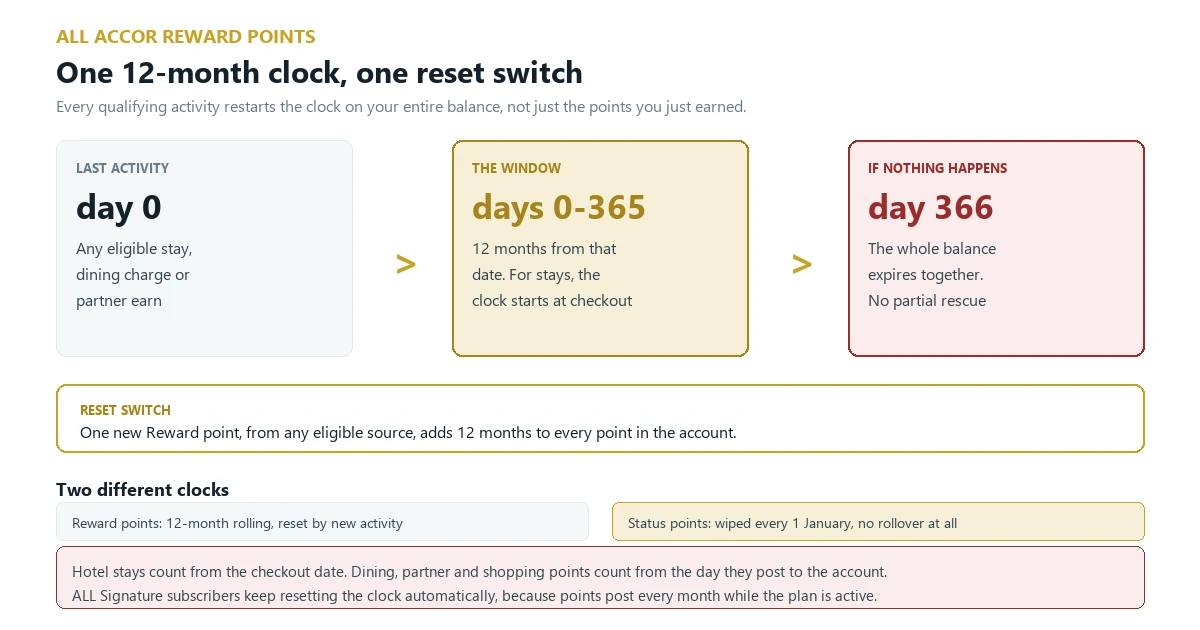
Accor keeps this simple, which is unusual for a hotel programme. Reward points stay alive as long as there is at least one point-earning activity in any rolling 12-month window, and each new activity pushes the deadline out by another 12 months. There is no tiered expiry, no points-by-point aging and no partial loss. You either have activity inside the window or the balance goes.
That design cuts both ways. It is generous to anyone who stays even once a year, because a single night protects a balance of any size. It is unforgiving to anyone who stops travelling, because there is no gradual erosion that gives you warning — the account simply empties on a date. Accor sends expiry reminders, but they are not guaranteed to arrive before the deadline, and the account page is the only authoritative source.
| Situation | What happens to Reward points |
|---|---|
| Any eligible stay, dining or partner earn within 12 months | Entire balance extended by 12 months from that activity |
| Redeeming points | Does not count as activity; the remaining balance still expires |
| Donating points to a partner charity | Not an earning activity; do not rely on it to extend validity |
| No activity for 12 months | Full balance expires, not reinstatable |
| Active ALL Signature subscription | Monthly credit resets the clock automatically |
| Status points, any situation | Wiped every 1 January, no rollover |
When the clock actually starts
The date that matters is when the activity posts, not when you did the thing. For a hotel stay the clock runs from the checkout date, which is the point at which the stay is complete and the points are calculated. A five-night stay that begins in March and ends in April starts the clock in April. For a future booking, nothing counts until you actually stay and check out.
Dining and partner earnings work differently and are the source of most surprises. A restaurant charge billed to your room usually posts with the stay, so it inherits the checkout date. A charge paid directly at a hotel restaurant, an ALL Collections purchase or a partner airline credit can take days or weeks to appear in the account, and the clock starts when it appears rather than when you paid. If you are relying on one of these to keep a balance alive, leave a comfortable margin rather than acting in the final week.
This timing detail is why a last-minute rescue sometimes fails. A member with points expiring on the 20th who books a stay for the 25th has already missed the deadline, because the activity does not post until the stay completes. The safe approach is to act at least a month before the date shown in the account, so posting delays cannot push you over the edge.
Why the whole balance goes at once
Most programmes follow a first-in-first-out model, where the points you earned earliest expire first and newer points survive longer. Accor does not work that way. The balance is treated as a single pool tied to one activity date, so the profile either has recent activity or it does not. When it does not, the whole pool expires on the same day.
For a large balance that is a serious risk. A member who earned 80,000 points over two years and then stopped travelling for a year loses all 80,000, not just the portion from the earliest stays. Because Accor points convert at a fixed rate, the loss is easy to price: at 2,000 points for EUR40, an 80,000-point balance is worth roughly EUR1,600 of hotel credit, and it disappears in one event.
The upside is that protecting it costs almost nothing. One night at an ibis, one dinner billed to a room, one small partner earn — any of these resets the entire balance for another year. Set against the value of the pool, the economics of a single stay are overwhelming. If you want to see exactly what that pool is worth before deciding, our Accor points valuation guide converts any balance into cash credit at the published rate.
Status points: a different clock entirely
Status points are the other half of the programme and follow an entirely different rule. They exist only to determine your tier, they cannot be spent, and they reset on 1 January every year with no rollover whatsoever. Nothing you do extends them. The points you earn in a strong autumn cannot carry into the following spring.
This means a member can have a healthy Reward balance that is safe for years and still lose every status point they earned. The two systems are deliberately separate, and mixing them up is the most common planning error at Accor. Keep the reward clock in mind for the points you spend, and the calendar year in mind for the tier you want. Our Accor elite status guide covers the thresholds and what each tier adds.
The practical consequence is timing. A stay in December earns status points that are useful for roughly a month, while the same stay in January earns status points that count for the whole year. If you are chasing a tier and have flexibility, front-loading stays into the first half of the year gives you options later, and back-loading them into December can waste most of the benefit. Reward points from either stay behave identically, which is why the two clocks so often get confused.
The ALL Signature exception
There is one structural exception to the 12-month rule. Members with an active ALL Signature subscription receive Reward points every month, and every one of those credits counts as point-earning activity. The effect is that the clock resets continuously, so the balance never approaches the deadline while the plan is running. For anyone holding a large balance and worried about protecting it, this is the most reliable mechanism in the programme.
It is a side effect rather than a designed perk, and it stops the moment the subscription does. Cancel the plan and the normal rule returns: the balance expires 12 months after the last credit. Status points remain unaffected throughout — they still clear on 1 January whether or not you subscribe, which is the split that catches members who assume one subscription freezes both clocks. Our Accor Plus and ALL Signature guide works through the break-even math on those plans.
It is worth being clear about what the subscription does and does not buy. It keeps Reward points alive and it credits status points and status nights, but it does not extend status points past the calendar year and it does not protect a tier you have stopped earning. Treat the expiry protection as a useful bonus, not the reason to subscribe.
How to keep a balance alive cheaply
The cheapest reliable method is a single night at the lowest-priced Accor property you can reasonably reach. An ibis or ibis budget night booked directly through Accor posts points, resets the clock on the entire balance and costs far less than the balance is worth. If a stay is impossible, a meal charged to a room at a nearby Accor hotel is the next best option, though it requires actually visiting the property.
Redemption is the option most members assume will work, and it does not. Accor extends validity on eligible point-earning activity, not on spending, so using points does nothing to keep the rest alive even though it feels like engagement with the programme. The distinction matters because it is counterintuitive: a member who redeems in month eleven, congratulating themselves on using the balance, can still lose whatever remains. If you want to hold a balance, you need an earning event, and if you want to spend it, spend all of it rather than leaving a remainder you cannot protect.
Partner earnings are the least dependable route. Our Accor points earning guide ranks each partner channel by reliability, not just by rate. Transfers, shopping portals and airline partnerships all count, but posting times vary and tracking failures are common. Do not rely on a partner credit as your only activity in the final month of the window, because a missing credit at the wrong moment is exactly how balances get lost. If you are going to use a partner route, do it early and check the account a week later.
Finally, check the account rather than the emails. The expiry date shown in your Accor profile is the number that matters, and it updates when new activity posts. A member who checks once a quarter will never be surprised, and a member who assumes last year’s reminder schedule still applies is the one who loses a balance. If you want the wider picture on how Accor’s fixed-value points compare with other programmes, the cross-chain points value chart sets them side by side.
What to do before your date arrives
If your points expire within the next three months and you have no Accor stay planned, book the cheapest night you can. Our Accor redemption guide covers how to get full value from that balance once it is secured. The value of almost any balance exceeds the cost of one ibis night, and the reset covers everything you hold. Our Accor hotel brands guide notes that hotelF1 earns nothing at all, so pick the ibis rather than the cheapest listing. Redeeming points instead will not save the balance, so a stay is the only reliable route unless you have a partner earn that posts quickly. If a stay is genuinely impossible, spend the balance on something you were going to book anyway rather than watching it expire.
If you are planning to stop travelling with Accor for a while, decide now whether to spend the balance rather than defend it. Points held for a future trip that may never happen are worth less than credit applied to a stay you would take anyway, and there is no partial-loss warning to give you a second chance. Booking through Accor directly also ensures the activity posts correctly, since third-party reservations usually earn nothing and would not reset the clock.
Bottom line: Accor Reward points expire 12 months after your last point-earning activity, and the whole balance goes at once. One activity a year keeps everything alive, stays count from the checkout date, status points are wiped every 1 January regardless, and an active ALL Signature subscription is the only arrangement that suspends the rule.
Last updated: 18 November 2026.
FAQ
Do Accor points expire?
Yes. Reward points expire 12 months after your last point-earning activity, and the whole balance goes at once rather than the oldest points first. The clock is measured from the day an earning posts to your account, and for hotel stays that means the checkout date rather than the booking or arrival date. One new point from any eligible source adds 12 months to every point you hold.
How do I stop my Accor points from expiring?
Earn at least once every 12 months. Any eligible point-earning activity resets the clock on the entire balance, so a single qualifying stay, a restaurant charge billed to your room or a partner earn is enough. Redeeming points does not count, which is the detail most members get wrong. The cheapest reliable option is a one-night stay booked directly with Accor, because dining and partner credits take longer to post and occasionally fail to track.
Do ALL Signature members’ points expire?
Not while the subscription is active. ALL Signature credits Reward points every month, and each credit counts as a point-earning activity, so the 12-month clock restarts automatically. If you cancel, the normal rule returns and the balance expires 12 months after the last credit. Status points are unaffected by the subscription and still reset on 1 January.
What is the difference between Reward points and status points expiry?
Reward points run on a rolling 12-month activity clock and can be kept alive indefinitely by earning something each year. Status points are wiped every 1 January with no rollover, so the points you earn in November cannot help you in March. A member can hold a large Reward balance that never expires and still lose every status point they earned, which is why the two need separate attention.
If my points expire, can I get them back?
No. Accor does not reinstate expired Reward points, and customer service has no discretion to restore them. The only protection is activity before the deadline. Members who call after the date has passed are usually offered nothing, so the practical rule is to check the account a couple of months before the expiry date rather than in the final week.
Does redeeming points reset the expiry clock?
No. Redemption is not an eligible point-earning activity, so spending points does not extend the life of the balance you have left. This is the single most common misconception about ALL Accor expiry. If you hold a balance you want to keep, you need an earning event: a stay, a room-billed meal or a partner credit. Using points on a night is a good way to spend them, but it will not save the remainder.
Do Accor points expire if I have status?
Status does not change the Reward points clock. A Platinum or Diamond member’s points expire on exactly the same 12-month rule as a Classic member’s. The only structural exception is an active ALL Signature subscription, which resets the clock monthly by design. Elite status protects your tier benefits, not your points balance.