Hotel corporate codes are not discount coupons. They are keys to contracted rates that a company has negotiated in exchange for a volume commitment, and using one you are not entitled to is a misuse of that contract. This guide explains who genuinely qualifies, the five legitimate ways to get a corporate rate, what the major chains actually say, and what can happen when a code is used improperly.
The short version: get the code from your own employer, association or government travel system; compare it against the public rate before booking; and carry proof of eligibility. If you found a code on a forum, assume you cannot use it. Marriott began verifying corporate codes with a work email in 2026, and the other chains can still re-price a stay at check-in.

What a corporate rate actually is
A corporate or negotiated rate is a price agreed between a hotel chain or property and an organization that promises a certain number of room nights a year. The hotel gets predictable volume; the company gets a price below the public rate, typically in the range of 10 to 25 percent. The code is simply the identifier that unlocks that price in the booking engine. It has no value on its own — the value comes from the agreement behind it.
That distinction matters, because most guides treat the code as the thing and the contract as an afterthought. It is the other way around. A code that once worked can be renegotiated, deactivated or restricted to certain dates and properties, and a rate that looks generous on paper can lose to a member promotion in practice. Always compare the final price for the exact room and dates. If you want the wider picture of how hotel prices work, our hotel points valuation guide covers the award side of the same decision.
| Rate type | Who qualifies | Typical saving | Proof usually required |
|---|---|---|---|
| Corporate / negotiated | Employees and authorized users of the contracted organization | 10–25% | Company ID or work email |
| Government / military | Eligible government or military travellers | 10–20% | Government or military ID |
| AAA / AARP | Members of those organizations | 5–10% | Membership card |
| Loyalty member rate | Free program members | 5%+ | Sign-in only |
| Public promotion | Anyone | Varies | None |
Who is genuinely eligible
Eligibility follows the contract, not the code. Employees of the organization that signed the agreement are the obvious group, but contracts often extend to contractors, consultants and authorized business partners working on the company’s behalf. Many companies allow leisure travel on the rate as well, though some explicitly forbid it — check your own travel policy rather than assuming.
The groups that most often miss out are people who do have a legitimate route but never look for it: members of professional associations, university staff and alumni, government employees, and owners of small businesses that book repeatedly in one city. If any of these apply to you, there is a better path than a code from a forum. Non-employees with no affiliation to the organization have no legitimate claim to the rate, full stop.
Five legitimate ways to get one
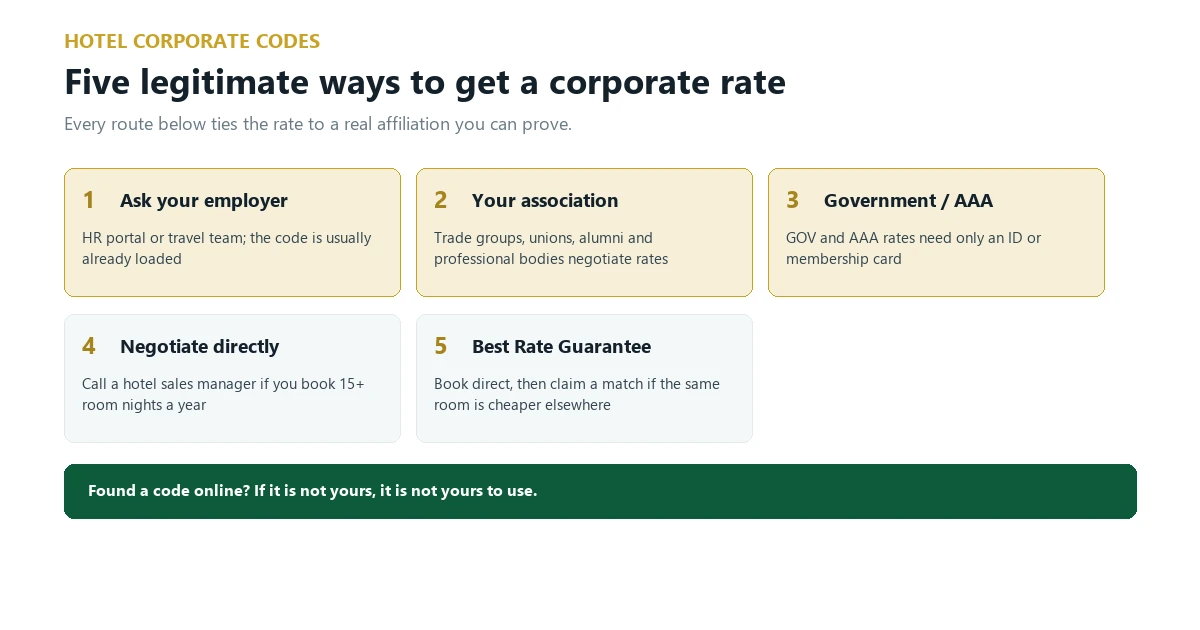
These are the routes that produce a rate you can actually defend at check-in. None of them involves a list of codes scraped from the internet.
- Ask your employer. The company’s HR portal, intranet or travel team usually publishes the codes it has negotiated. This is the first place to look and the one most people skip.
- Check your associations. Trade groups, unions, professional bodies and alumni organizations frequently negotiate hotel rates as a member benefit. If you pay dues to a group, look at its member benefits page.
- Use government or AAA rates. Government and military rates are available at nearly every major chain and need only valid ID; AAA and AARP rates need only a membership card. These are the simplest legitimate discounts in travel.
- Negotiate directly. If your small business books even 15 to 20 room nights a year at one property, call the hotel’s sales manager rather than the front desk. Consistent repeat business is often enough to secure a modest negotiated rate.
- Use the Best Rate Guarantee. All the major chains offer one: book direct, and if you find the same room and dates cheaper elsewhere, claim a match. This delivers a market-low price while keeping your direct booking and its loyalty benefits.
One more legitimate route is simply buying points for an award when the cash price is high. Our buy-points index compares the current offers across programs and shows when a top-up beats paying cash — a cleaner solution than borrowing someone else’s corporate rate.
How to book, step by step
Booking follows the same pattern at most chains. Go to the hotel’s official site or app, because third-party booking platforms generally do not accept corporate codes. Enter the code in the corporate or special-rates field before you search, then compare the result with the best public rate and the member rate for the same room and dates. Add your loyalty number — a corporate stay is normally a qualifying stay that earns points and elite nights at Marriott, Hilton, IHG and Hyatt.
Finally, carry proof. An acceptable document is a company badge or ID with your photo, a business card showing your name and company, or a work email the hotel can verify. If you travelled through an employer booking tool, keep the confirmation. The chains with active promotions often have cheaper public rates during sale periods, so check those hubs before you commit to a code that may not be the lowest price.
What each chain’s policy says
Policies change, and the details below are a snapshot as of November 2026. Always read the current terms on the chain’s own site before relying on a rate.
| Chain | Verification approach | Consequence of misuse | Official source |
|---|---|---|---|
| Marriott Bonvoy | Corporate QRV: corporate work email plus a one-time code on direct bookings, phased in during 2026; ID still requested at check-in | Rate can be changed at check-in; family members are not covered | Marriott help |
| IHG One Rewards | ID or validation at check-in; no public directory of corporate accounts | Terms list unauthorized corporate-rate abuse as grounds for account termination and loss of points | IHG terms |
| Hilton Honors | Hilton for Business registration with work-email verification; properties may ask for ID | Re-pricing to the best available rate when eligibility cannot be shown | Hilton Honors |
| World of Hyatt | Corporate or group code at booking; ID may be requested at the property | Re-pricing when the guest is not covered by the agreement | Hyatt terms |
The direction of travel is clear. Marriott’s Corporate QRV, reported by Business Travel News in October 2026, essentially adds two-factor authentication to a corporate booking: sign in to Bonvoy, enter a work email — free webmail does not count — and confirm the one-time code. Verification only needs doing once per company, and bookings through a company travel tool such as Concur are not affected. Other chains have not announced the same system, but tighter checking at check-in is a consistent trend.
The real risks
Guides that publish corporate codes usually add a small disclaimer and move on. The consequences deserve more attention than that.
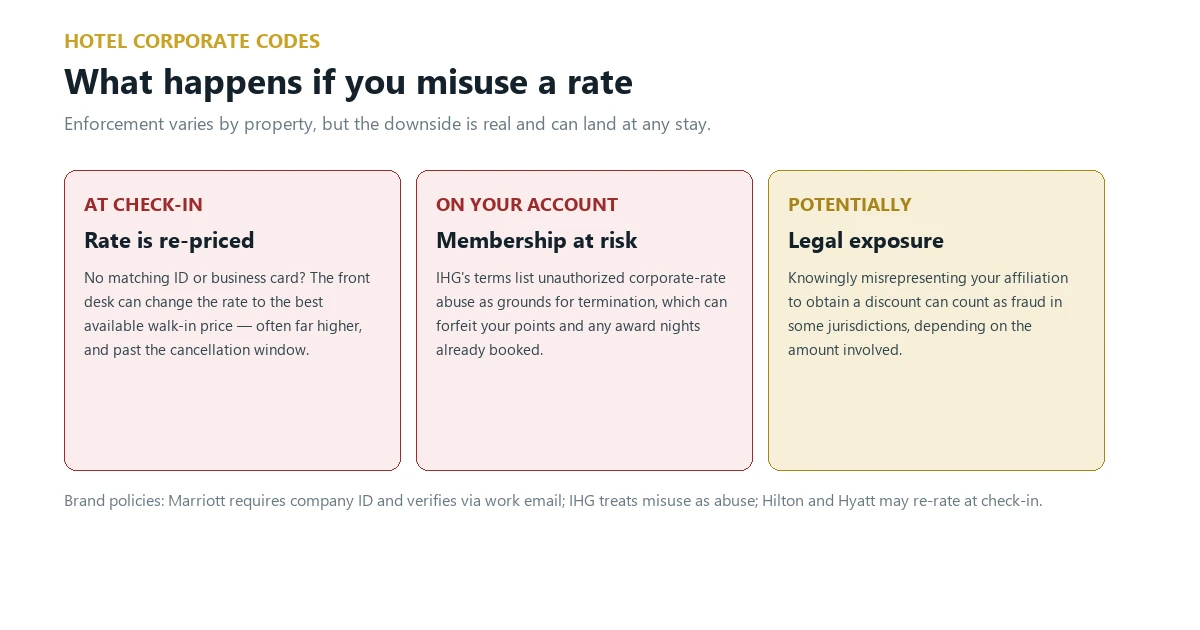
At the property. If you cannot prove eligibility, the hotel can re-price the room to its best available rate. That change often happens after the cancellation deadline, so a discounted booking can become the most expensive option available. Front desks in Asia check ID far more often than those in North America or Europe, but enforcement is rising everywhere on well-known accounts.
On your loyalty account. IHG’s membership terms explicitly name the abuse of corporate rates without authorization — including failing to show appropriate photo identification at check-in — as grounds for termination. Termination can mean forfeiting your point balance and any award nights you had already booked. That is a much larger loss than the discount on one stay.
Legally. Deliberately misrepresenting your affiliation to obtain a discount can constitute fraud in some jurisdictions, depending on the amount. This is rare in practice but it is the reason reputable sites decline to publish lists of codes they cannot verify.
Are corporate rates still worth it
For someone who is genuinely eligible, yes — a negotiated rate with flexible cancellation and full loyalty earning is a strong option, particularly during a busy event when public prices spike. For someone who is not eligible, there is no calculation to make: the rate is not yours to use. The sensible strategy is to compare the corporate rate against the member rate and any active public promotion, pick the lowest legitimate price, and keep the loyalty points flowing on a direct booking.
If you are building a strategy around hotel savings rather than one discount, the broader picture is covered in the hotel points valuation guide and the four brand promotion hubs linked above. Those are the legitimate levers — member promotions, bonus-point offers and careful redemptions — that compound over a year of travel without putting an account at risk.
More Hotel Guides
- How Much Are Hotel Points Worth? All Major Programs Compared
- Buy Miles and Points: Every Program That Is Worth It
- Marriott Bonvoy Promotions: What Is Live and Worth It
- Hilton Honors Promotions: What Is Live and Worth It
- IHG One Rewards Promotions: What Is Live and Worth It
- World of Hyatt Promotions: What Is Live and Worth It
Last updated: 17 November 2026. Chain policies verified against official help and membership terms as of November 2026; Marriott Corporate QRV rollout confirmed by Business Travel News, October 2026.
Frequently Asked Questions
What is a hotel corporate code?
It is a short identifier tied to a negotiated rate between a hotel chain and an organization that commits to a certain volume of room nights. Entering the code at booking unlocks that company’s price. It is not a public coupon: eligibility comes from the underlying agreement, and hotels can ask you to prove you are covered by it.
Is it legal to use a corporate code if I do not work for the company?
No. Corporate rates are contracted for employees and authorized users of the organization. Using a code you found online without that affiliation is a misuse of the rate, and hotels treat it as such. Some jurisdictions go further: knowingly misrepresenting your affiliation to obtain a discount can amount to fraud depending on the amount involved.
Can a hotel charge me more at check-in?
Yes. If you cannot show proof of eligibility when asked, the property can re-price the stay to its best available rate, which is often much higher than the corporate price you booked. This commonly happens after the free-cancellation window has closed, so the higher rate is effectively unavoidable.
Do corporate rates still earn points and elite nights?
Generally yes at the major chains. A corporate rate is a qualifying paid stay at Marriott, Hilton, IHG and Hyatt, so you earn the normal points and elite-night credit. That is a real advantage over many third-party discount bookings, which may not qualify. Check the specific rate’s terms before booking.
Why is Marriott asking for a work email?
Marriott is phasing in Corporate Qualified Rate Validation, or Corporate QRV, on direct bookings. You sign in to Bonvoy, enter your corporate work email and confirm with a one-time code sent there. Free email addresses do not count. Once verified for a company you do not repeat the step, and bookings made through your company’s own travel tool are unaffected.
Are corporate rates always cheaper than member rates?
No. Member rates, advance-purchase promotions and off-peak public sales can undercut a corporate code, especially in quiet periods. Corporate rates matter most when they include a flexible cancellation policy or breakfast, or when public rates spike during a busy event. Compare the total for the exact room and dates before choosing.
How do I find my own company’s corporate code?
Start with your employer’s HR portal or travel team, where the code is usually already published. Professional associations, government travel systems and alumni groups are the other legitimate sources. If your small business books repeatedly at one property, calling the hotel’s sales manager to negotiate a direct rate is a legitimate route too.