Alaska Airlines credit card choice comes down to two cards from one issuer: the Atmos Rewards Ascent Visa Signature and the Atmos Rewards Summit Visa Infinite. Both earn Atmos points, both carry a companion benefit, and both replaced the old Alaska Bank of America cards when Mileage Plan became Atmos Rewards in August 2025. The difference is $300 a year and a very different set of perks. This guide compares them line by line and tells you who should actually pay for the Summit.

At a glance
The two Atmos cards share an issuer (Bank of America) and an airline, but they are aimed at different travellers. Here is the short comparison before the detail:
| Feature | Ascent Visa Signature | Summit Visa Infinite |
|---|---|---|
| Annual fee | $95 | $395 |
| Alaska & Hawaiian earn | 3x points | 3x points |
| Other bonus categories | 2x gas, transit, streaming | 3x dining, foreign spend |
| Status points from spend | 1 per $3, no cap | 1 per $2, no cap + 10,000 each anniversary |
| Companion benefit | $99 Companion Fare | 25,000-point Global Companion Award |
| Lounge access | $100 off Alaska Lounge+ membership | 8 Alaska Lounge passes a year |
| Partner award fee | $20 applies | Waived |
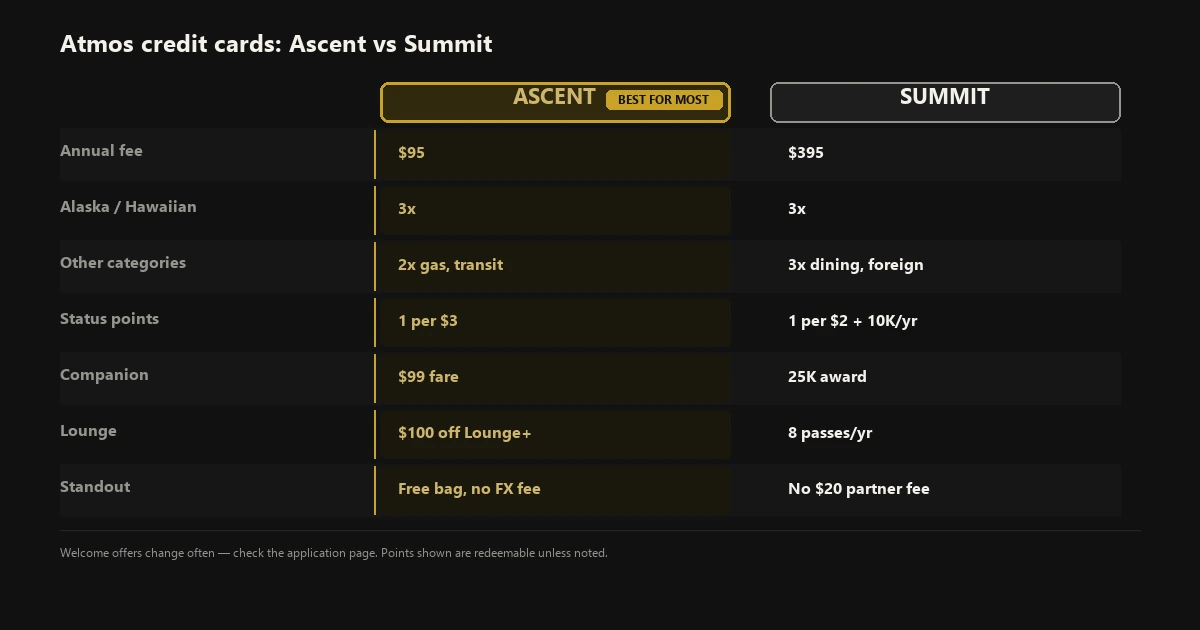
Read the table as a $300 question: would the extra Summit benefits save you more than $300 a year on travel you were already going to do? For most people the answer is no, and the Ascent is the right card. The sections below explain exactly when the answer flips.
The Ascent card
The Atmos Rewards Ascent Visa Signature charges a $95 annual fee and is the direct successor to the old Alaska Airlines Visa Signature. It earns 3 points per dollar on Alaska and Hawaiian purchases, 2 points on gas, EV charging, local transit and select streaming, and 1 point on everything else with no cap. Those are redeemable Atmos points, the same currency you use for award flights.
Its signature benefit is the $99 Companion Fare. Once you spend $6,000 on the card in an anniversary year, you get a fare that lets a companion fly with you on the same North American Alaska or Hawaiian itinerary for $99 plus taxes and fees from $23. On a $400 round trip, the companion seat costs around $122 all-in instead of $400 — a saving of roughly $278. One use a year covers the $95 annual fee nearly three times over, which is why the Ascent is the default recommendation.
The Ascent also includes a free checked bag for the cardholder and up to six companions on the same reservation, preferred boarding, no foreign transaction fee, and $100 off an annual Alaska Lounge+ membership. It is a straightforward card: low fee, one genuinely valuable recurring perk, and no need to chase spend to make it pay.
The Summit card
The Atmos Rewards Summit Visa Infinite costs $395 a year and is built for travellers who want faster status and stronger lounge access. It earns 3 points per dollar on Alaska and Hawaiian purchases, dining and foreign-currency transactions, and 1 point elsewhere. If you hold an eligible Bank of America account, a 10% bonus applies to points earned from card purchases on both cards.
The Summit’s recurring benefits are broader: eight Alaska Lounge passes a year (two per quarter, each valid for a full travel day), eight inflight Wi-Fi passes, an Avis President’s Club membership, a $50 voucher for Alaska cancellations or delays of two hours or more, and a waiver of the $20 partner award booking fee. Titanium members who carry the card also get complimentary same-day upgrades into global business class without spending points or a certificate.
Whether those perks justify $395 depends entirely on your travel pattern. The lounge passes matter if you fly through an airport with an Alaska Lounge at least once a quarter. The partner-fee waiver matters if you book partner awards often — our guide to Atmos Rewards partners shows which of those redemptions are worth making in the first place. If neither describes you, the $300 gap is hard to recover.
Status points: the hidden difference
Here is the part most card comparisons blur. Atmos runs two separate balances: redeemable points you spend on awards, and status points that move you toward Silver, Gold, Platinum or Titanium. The spending earn rates in the sections above are redeemable points. Status points from card spend are much smaller:
- Ascent: 1 status point per $3 spent, with no annual cap.
- Summit: 1 status point per $2 spent, with no cap, plus 10,000 status points automatically on each account anniversary.
That anniversary bonus is the single most useful line on the Summit. It puts you halfway to Silver (20,000 status points) before you fly. Alaska’s own example shows a Summit holder reaching Silver through card spend and non-air activity without boarding a plane. On the Ascent, $13,500 of annual spend produces only about 4,500 status points — a supplement to flying, not a substitute for it.
Both cards removed their old 30,000-point annual status cap in 2026, which matters for heavy spenders. For the full picture of what those tiers unlock and how long status lasts, see our Atmos Rewards elite status guide. And if you want to understand every way to build the redeemable balance these cards feed, start with how to earn Alaska miles.
Companion benefits compared
Both cards have a companion benefit, but they are different tools and neither is worth its advertised maximum automatically.
The Ascent’s $99 Companion Fare is a paid ticket for a companion on the same paid itinerary, booked on alaskaair.com and paid for with the card. Its value is concrete: subtract about $278 from a typical $400 trip, and it clears the annual fee in one use.
The Summit’s 25,000-point Global Companion Award takes 25,000 points off a companion’s award ticket when two travellers book the same qualifying itinerary on Alaska, Hawaiian or an eligible partner — any cabin, including international partners. It repeats every anniversary, and a 100,000-point award becomes available after $60,000 of spend in an anniversary year. On a long-haul business award where the second seat might price at 60,000 to 85,000 points, the saving is substantial — but only if you were already booking that premium award for two.
The right way to choose is to price the trip you actually take. If you fly North America in the main cabin twice a year, the $99 fare wins on simplicity. If you book international business awards for two, the 25,000-point award is worth more. Our guide to what Alaska miles are worth gives the valuation to run that comparison.
Welcome offers change often
Welcome bonuses on these two cards move frequently and vary by channel — the Alaska application page, a Bank of America product page and a mail offer can all show different point totals and spending thresholds. Historically the Ascent has run in the region of 60,000 to 80,000 points plus a $99 Companion Fare, and the Summit in the region of 80,000 to 100,000 points plus a 25,000-point Global Companion Award, after spending roughly $3,000 to $6,000 in the first 90 days. Treat those as recent ranges, not promises.
Always check the offer on the exact application page you intend to use, and read the disclosures. A larger first-year bonus is a good reason to apply, but it is not a reason to renew on a card whose recurring benefits do not fit you. Judge the renewal decision on the $95 versus $395 benefits above, not on a bonus you will only receive once.
Which card is worth it
For most travellers the answer is the Ascent. A $95 fee, a $99 Companion Fare that pays for itself in one trip, a free bag and no foreign transaction fee make it easy to justify. If you rarely fly enough to use eight lounge passes and do not book partner awards, paying $300 more for the Summit is spending for benefits you will leave on the table.
The Summit makes sense in three specific cases: you want a fast, flying-free path toward elite status (the 10,000 anniversary status points plus 1 per $2 spend), you fly through an Alaska Lounge often enough to use the passes, or you regularly book partner awards and want the $20 fee waived. If two or more of those describe you, the premium can pay for itself. If none do, stay on the Ascent and put the $300 difference toward a flight instead.
Frequently Asked Questions
How much are the annual fees on the Alaska Airlines credit cards?
The Atmos Rewards Ascent Visa Signature costs $95 a year and the Atmos Rewards Summit Visa Infinite costs $395 a year. Neither fee is routinely waived. The Ascent’s $99 Companion Fare can cover its fee in a single trip for most travellers.
Do the Atmos cards earn status points as well as redeemable points?
Yes, but as a separate balance. The Ascent earns 1 status point per $3 spent and the Summit earns 1 per $2, both uncapped. The Summit also adds 10,000 status points at each account anniversary. The 3x and 2x earning rates are redeemable points, not status points.
Which card is better for reaching Atmos elite status?
The Summit, clearly. Its 1 status point per $2 and automatic 10,000 anniversary status points put you halfway to Silver before you fly. At $13,500 of annual spend, the Ascent produces only about 4,500 status points, which is a supplement to flying rather than a standalone path.
What is the difference between the $99 Companion Fare and the Global Companion Award?
The Ascent’s $99 Companion Fare is a paid companion ticket on the same North American Alaska or Hawaiian itinerary, plus taxes and fees from $23, earned again after $6,000 of annual spend. The Summit’s 25,000-point Global Companion Award takes points off a companion’s award ticket on Alaska, Hawaiian or eligible partners, including international business class, and renews each anniversary.
Do the Alaska Airlines credit cards have foreign transaction fees?
No. Neither the Ascent nor the Summit charges a foreign transaction fee. The Summit additionally earns 3 points per dollar on foreign-currency purchases, and eligible Bank of America account holders get a 10% bonus on points earned from card purchases.
Is the Summit card worth the $300 extra over the Ascent?
Only if you will use its recurring perks. The Summit adds eight Alaska Lounge passes a year, 10,000 anniversary status points, a 25,000-point companion award and a waiver of the $20 partner award fee. If you use the lounge passes or book partner awards regularly, it can pay for itself; otherwise the Ascent is the better value.
More guides
- Alaska Airlines promotions
- How to earn Alaska miles
- Atmos Rewards elite status
- How much are Alaska miles worth
- The best way to use Alaska miles
- Atmos Rewards partners
- How to buy Alaska Atmos Rewards points
- How loyalty points work: the complete beginner’s guide
If the points you earn on either card are still short of the award you want, our guide to buying Alaska Atmos Rewards points explains when a top-up makes sense — though for most people the better move is to earn the balance through flying and spending first.