Atmos Rewards elite status is worth understanding if you fly Alaska or Hawaiian even a few times a year, because the program now lets you earn it on the ground as well as in the air. There are four tiers — Silver, Gold, Platinum and Titanium — and each one is set purely by the status points you bank between 1 January and 31 December.
The short version: Silver takes 20,000 status points, Gold 40,000, Platinum 80,000 and Titanium 135,000. Redeemable points and status points are two separate balances, award flights count toward status, and an Atmos credit card can get you a long way without flying. Below is the full breakdown, including what each tier pays and the rules most likely to catch you out.

Two balances: points vs status points
Atmos Rewards runs two counters, and confusing them is the single biggest mistake you can make with this program. Redeemable points are the currency you spend on award flights, upgrades and other rewards. They do not expire under the program rules. Status points cannot be spent at all — they exist only to decide your tier and your milestone rewards, and they reset to zero every 1 January.
A large redeemable balance therefore tells you nothing about your status, and a high tier does not mean you have points to fly with. You earn the two at different rates: flights generate both, but credit-card spend, Lyft rides, hotel stays and shopping partners generally add status points at their own separate rate. One genuinely useful quirk is that award flights earn status points too — one status point per mile flown, with no class-of-service bonus — so a trip you book with points still moves you toward the next tier even though it earns no new redeemable points. If you are short of redeemable points for a specific award, compare the cost with topping up your Atmos balance during a bonus before you book.
The four tiers
Status is decided once a year by the status points you accumulate in the calendar year. Here is the full ladder, with the oneworld tier each maps to:
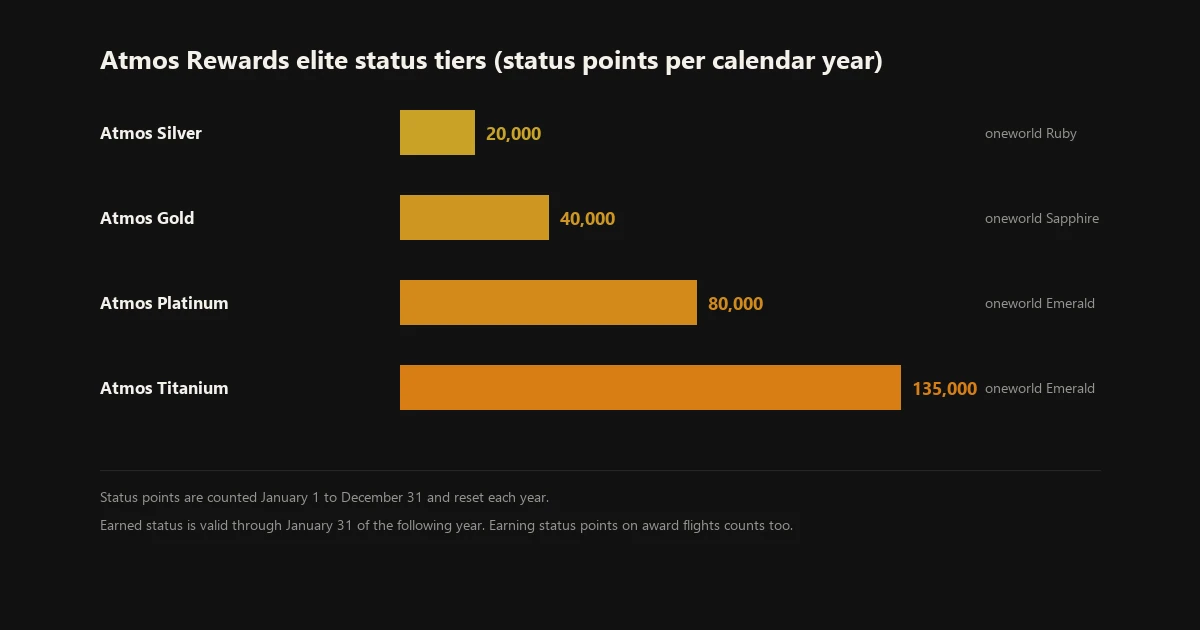
| Tier | Status points per calendar year | oneworld level | Bonus on redeemable points earned flying |
|---|---|---|---|
| Atmos Silver | 20,000 | Ruby | 25% |
| Atmos Gold | 40,000 | Sapphire | 50% |
| Atmos Platinum | 80,000 | Emerald | 100% |
| Atmos Titanium | 135,000 | Emerald | 150% |
The tier bonus is added to the redeemable points you earn on flights, including flights on Alaska’s partner airlines — it does not create status points. Getting from Silver to Titanium is a big jump: the top tier needs nearly seven times the status points of the bottom one.
What each tier gets you
Every tier from Silver up includes complimentary space-available upgrades to Premium Class and First Class on Alaska and Hawaiian flights within North America (including Hawaii) for you and one companion on the same booking, plus complimentary upgrades on eligible American Airlines routes. You also get preferred seating, priority check-in and free checked bags for yourself and companions on the reservation. The bag allowance grows with the tier: one at Silver, two at Gold, three at Platinum and Titanium.
The differences that matter most are at the top end. Gold is the first tier that brings oneworld Sapphire, which is what gets you oneworld business-class lounge access on eligible international itineraries — note that a domestic US trip, or a complimentary first-class upgrade by itself, does not open the Alaska Lounge. Platinum adds Emerald status and Premium Class seats at booking on almost every fare, rather than as an upgrade you wait on. Titanium adds complimentary onboard meals, the top of the upgrade list, dedicated check-in in Seattle and day-of-departure upgrades into premium cabins on the global network when space is available. That last one is an upgrade opportunity, not a guaranteed lie-flat seat, so buy the cabin you actually need if the trip depends on it.
Along the way, milestone rewards kick in at 10,000, 30,000, 55,000, 95,000, 125,000, 150,000, 200,000 and 250,000 status points — so you earn something before you reach a full tier, including a 10,000-status-point head start you can choose as a perk.
How to earn status points
In 2026, status points come from flying and from a growing list of everyday spending. The rates below are the ones published for 2026:
- Flights: Alaska, Hawaiian and partner flights earn status points based on distance flown and fare class. Award flights also earn one status point per mile, with no class bonus.
- Atmos credit cards: the Summit Visa Infinite earns 1 status point per $2 of net purchases; the Ascent, Business and Hawaiian Airlines Mastercards earn 1 per $3. Card annual fees do not earn status points, and card spend posts to your status balance over roughly four to six weeks.
- Lyft: 1 status point per $1 of base fare.
- Travel booked through Alaska or Hawaiian: hotels, vacation packages, cruises and Avis or Budget rentals earn 1 status point per $1 of base rate.
- Everyday partners: Atmos Shopping, Atmos Dining, CLEAR and Safeway earn 1 status point for every 3 base points you collect, excluding bonus points.
The card shortcut is real: putting $40,000 a year on the Summit card produces 20,000 status points from spending alone, which is Silver before you step on a plane. If you would rather buy your way toward a specific redemption than toward status, start with our guide to buying Alaska miles — note that purchased points add redeemable points but no status points. One rule to watch closely is the Saver fare. From 1 August 2026, Saver tickets bought on or after 11 June 2026 in fare class X no longer earn redeemable points or status points — they still count as lifetime flown miles toward Million Miler, but they will not move you up a tier. Older guidance telling you every fare earns status is out of date on this point.
Looking ahead, from 1 January 2027 members can choose how they earn on flights — by distance (1 point per mile), by price paid (5 points per dollar) or by segments (500 points per flight) — and can change that choice once a year. Existing members who never choose keep distance-based earning; new members who join in 2027 default to price paid.
What happened to MVP status
If you remember the old Mileage Plan names, the switch is straightforward. MVP became Atmos Silver, MVP Gold became Atmos Gold, MVP Gold 75K became Atmos Platinum, and MVP Gold 100K became Atmos Titanium. The first two kept their 20,000 and 40,000 thresholds, but the upper two went up: Platinum now needs 80,000 rather than 75,000, and Titanium 135,000 rather than 100,000 — a 35% jump at the top. Atmos Rewards itself is the merger of Mileage Plan and HawaiianMiles that launched in August 2025, with HawaiianMiles folding in on 1 October 2025.
How long status lasts
Status points are valid only in the calendar year you earn them and expire on 31 December — there is no automatic rollover into the next year. The status you earn, however, lasts for the rest of that year, the whole of the following year, and through 31 January of the year after that. Reach Gold in November 2026 and you hold it until 31 January 2028; reach it in February 2026 and the end date is the same, so qualifying early costs you nothing. Timing follows the activity date rather than the posting date, so a 2026 flight that posts in 2027 still counts for 2026.
Is chasing status worth it
For most people the honest answer is to aim at the first one or two tiers, not the top. Silver is attainable with ordinary flying plus a credit card, and it already delivers free bags, preferred seating and upgrade chances. Gold adds the oneworld Sapphire lounge benefit that frequent international travellers actually notice. Platinum and Titanium demand a level of spend that only makes sense if your employer is paying or you are flying and charging a great deal anyway — and Titanium’s 135,000-point threshold is a substantial step up from the old 100,000.
If your interest is the value you get back from the points themselves rather than the status line, start with our guide to what Alaska miles are worth, which explains the redemptions a bonus or a top-up should be measured against — and before you buy, review Alaska’s current buy-miles offer to see what the bonus is actually paying. For the invitation-only concierge benefit that sits above the published tiers, see our Atmos Global Concierge guide.
Frequently Asked Questions
What are the Atmos Rewards elite status tiers?
There are four: Silver at 20,000 status points, Gold at 40,000, Platinum at 80,000 and Titanium at 135,000, all measured between 1 January and 31 December. They replace the old MVP, MVP Gold, Gold 75K and Gold 100K names.
Do award flights earn Atmos elite status?
Yes. Award flights booked with Atmos points earn one status point per mile flown, with no class-of-service bonus. You do not earn new redeemable points on those flights, but the status points still count toward your tier and milestones.
Can I earn Atmos status without flying?
Yes. In 2026 you can earn status points through Atmos credit-card spending (1 per $2 on the Summit card, 1 per $3 on Ascent and Business cards), Lyft rides, hotels, vacation packages, cruises, car rentals and shopping or dining partners. $40,000 of annual spend on the Summit card alone reaches Silver’s 20,000-point threshold.
How long does Atmos Rewards status last?
Status earned in a calendar year lasts for the rest of that year, the full following year, and through 31 January of the year after that. Status points themselves reset every 1 January and do not roll over.
Which Atmos tier gets lounge access?
Gold maps to oneworld Sapphire and Platinum and Titanium to oneworld Emerald, which bring oneworld lounge benefits on eligible international itineraries. Atmos status alone does not grant Alaska Lounge access on a domestic US trip, and a complimentary first-class upgrade does not include lounge access.
Do Saver fares earn status points?
No, not for Saver tickets in fare class X bought on or after 11 June 2026 for travel on or after 1 August 2026. Those tickets earn neither redeemable points nor status points, though they still count as lifetime flown miles toward Million Miler.
More guides
- Alaska Airlines promotions
- How to buy Alaska Atmos Rewards points
- How much are Alaska miles worth
- The best way to use Alaska miles
- Atmos Global Concierge
Want the full picture of how loyalty points work across programs? Start with our complete guide to loyalty points.