How to earn Alaska miles comes down to a short list of routes: fly on Alaska, Hawaiian or a partner airline, spend on an Atmos Rewards credit card, transfer from Bilt, or use one of the smaller hotel and everyday partners. The good news is that you can build a useful balance without flying at all. The catch is that the ratios vary enormously, and one of the best routes — Bilt at 1:1 — is easy to miss if you assume Chase or American Express are included.
The short version: Bilt is the only major bank currency that transfers to Atmos Rewards at 1:1; the Atmos credit cards earn on ordinary spending and also push you toward elite status; hotel transfers range from a fair 3:1 at Marriott to a poor 10:1 at Best Western. A bigger change lands on 1 January 2027, when every member picks how flights earn — by distance, by price or by segment. Here is each route, what it actually pays, and which ones are worth your effort.

The eight earning routes
Atmos Rewards gives you more entry points than most airline programs. Some are fast and valuable, some are slow and barely worth the clicks. This chart groups them so you can see the full set before you decide where to concentrate:
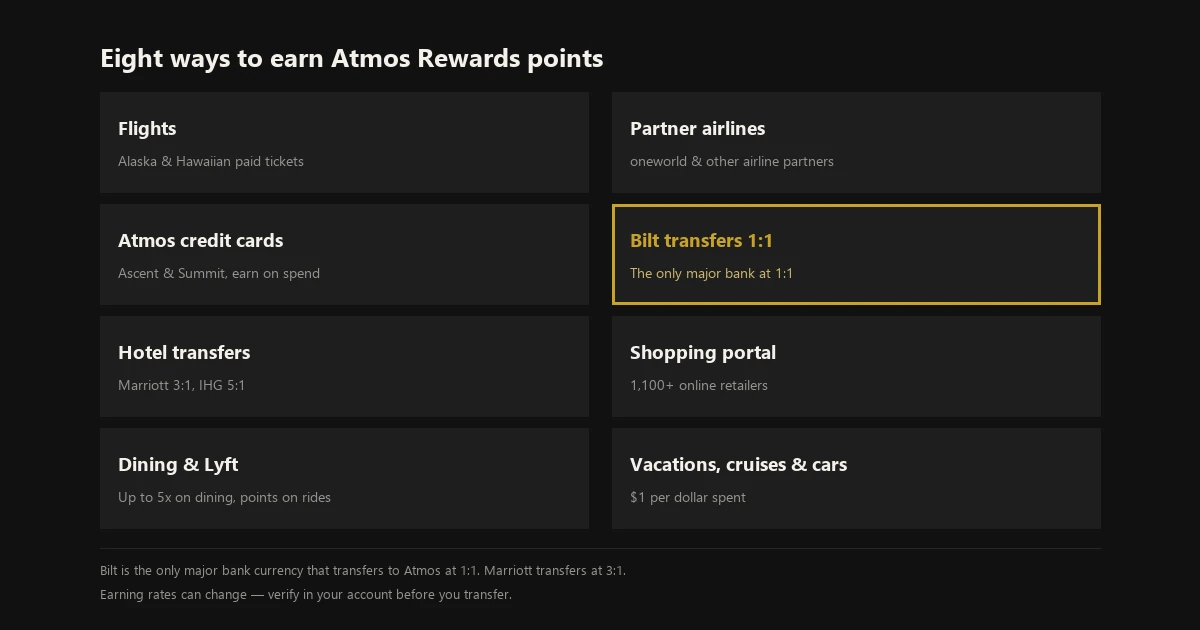
The two routes that do the heavy lifting for most people are the co-branded cards and Bilt transfers. Everything else is either a supplement — a few hundred points here and there — or a way to rescue a balance that is just short of an award.
Flying and the 2027 earning choice
Flights on Alaska, Hawaiian and partner airlines have always been the core way to earn. What changes on 1 January 2027 is that you get to pick the formula, and the choice sets both your redeemable points and your status points on paid flights. The three published options are:
| Earning method | On paid flights | Status points on award flights | Best for |
|---|---|---|---|
| Distance travelled | 1 point and 1 status point per mile flown | 1 per mile flown | Long flights in economy |
| Price paid | 5 points and 5 status points per eligible dollar | 1 per 20 points redeemed | Expensive fares and premium cabins |
| Segments flown | 500 points and 500 status points per flight | 500 per segment | Short hops and interisland flights |
Eligible spend for price-paid earning is the base fare plus carrier-imposed surcharges, excluding government taxes and fees; paid seats and paid cabin upgrades on Alaska and Hawaiian count too. Two arithmetic rules make the choice easier. Price paid beats distance once you pay more than about 20 cents per eligible mile. Segments beat distance on any flight under 500 miles. Against price paid, a segment wins when the eligible fare is under $100. Do the sums on your own last twelve months of travel — the decision applies to all your flights, not trip by trip, and you can change it only once a calendar year.
Existing members who never choose keep distance-based earning, but that is not the same deal it is in 2026: from 1 January 2027 distance earning loses both the class-of-service bonus and the 500-point minimum on short flights. Members who join on or after 1 January 2027 default to price paid. Award flights booked with Atmos points earn status points but no new redeemable points, and an award booked through another airline’s programme earns nothing in Atmos — you can credit a flight to one program only. Partner airlines also have their own earning charts, and several (including Korean Air, Philippine Airlines and STARLUX) credit to Atmos only when the ticket is issued by Alaska or Hawaiian.
One rule is already in force and none of the 2027 choices restores it: Saver tickets in booking class X bought on or after 11 June 2026 for travel on or after 1 August 2026 earn neither redeemable points nor status points. They still count as flown miles toward Million Miler. If a fare is that cheap, do not count on it to build a balance — compare the cash price with buying Alaska miles during a bonus and booking an award instead.
Atmos Rewards credit cards
The three co-branded Bank of America cards — Ascent, Summit and the Business card — are the most reliable way to earn without flying, and they work toward elite status as well as toward a spendable balance. The Ascent Visa Signature carries a $95 annual fee and earns 3 points per dollar on eligible Alaska and Hawaiian purchases, 2 per dollar on gas, EV charging, streaming, cable and local transit including rideshare, and 1 per dollar elsewhere. The Summit Visa Infinite has a $395 annual fee and earns 3 per dollar on dining, foreign transactions and Alaska or Hawaiian purchases, 1 per dollar elsewhere, plus a 10% points bonus with an eligible Bank of America account.
Separately from those earn rates, card spending generates status points: 1 status point per $2 of net purchases on the Summit card and 1 per $3 on Ascent, Business and Hawaiian Airlines Mastercards. Annual fees do not earn status points, and the status points post roughly four to six weeks after the purchases. That means $40,000 of annual spend on the Summit card alone reaches Silver before you take a trip. Welcome bonuses are often the single largest injection a new account gets, so compare the current offers across all three cards before applying.
Cards are also where a balance can stall: if you are close to an award but short a few thousand points, a top-up through an Alaska miles sale will finish the job faster than another month of spending — but purchased points add redeemable points only, never status points. For the full picture of what a finished balance is worth, see our guide to Alaska mile values.
Bilt transfers: the only 1:1 bank route
If you hold flexible bank points, this is the detail that matters most: Bilt Rewards transfers to Atmos Rewards at a full 1:1 ratio, in 1,000-point increments with a 2,000-point minimum, and the transfer normally lands within hours. Chase Ultimate Rewards, American Express Membership Rewards, Capital One and Citi points do not transfer to Atmos at all, and there is no legitimate indirect workaround. If your points are sitting in one of those programs, they cannot become Alaska miles.
Bilt is especially useful for renters, because it lets you earn points on rent without a transaction fee — usually the largest fixed cost in a household budget — and then move those points across at par. Bank of America points are expected to become transferable into Atmos in 2027, but the eligible cards and the ratio had not been published as of November 2026. Until then, Bilt is the only 1:1 door into the program, which is why it belongs at the top of any list of how to earn Alaska miles from everyday spending.
Hotel transfers
Four hotel programs transfer into Atmos Rewards, but the ratios are nothing like the 1:1 you get from Bilt. Treat them as a way to use up points you already hold, not as a reason to earn hotel points in the first place.
| Transfer from | Ratio into Atmos | Minimum | Verdict |
|---|---|---|---|
| Marriott Bonvoy | 3:1, plus 5,000 bonus points per 60,000 transferred | 3,000 Bonvoy | Best of the hotel options, but still weak |
| Choice Privileges | 5,000:1,000 (5:1) | 5,000 Choice | Only for topping off |
| IHG One Rewards | 10,000:2,000 (5:1) | 10,000 IHG | Only for topping off |
| Best Western Rewards | 5,000:1,000 (10:1) | 5,000 Best Western | Poor value |
Marriott is the least damaging of the four because the 60,000-point block turns 60,000 Bonvoy into 25,000 Atmos points once the 5,000 bonus is added. That is still a long way from what those Bonvoy points could be worth as a hotel night, so do not manufacture Marriott points for this purpose. A transfer makes sense when you have a surplus balance that will otherwise go unused, or when you are a few thousand Atmos points short of a specific award. For a pure top-up with no hotel points to spend, check the current price of buying Alaska miles and compare the two before you move anything.
Shopping, dining and everyday partners
The remaining channels will not build a balance on their own, but they are easy enough to leave running in the background. Atmos Rewards Shopping is a portal with more than 1,100 retailers; click through before you buy and the points post after the retailer confirms the purchase. Atmos Dining lets you register a card and earn up to 5 points per dollar at participating restaurants. Lyft rides earn 1 status point per dollar of base fare, and everyday partners such as CLEAR and Safeway earn 1 status point for every 3 base points collected, excluding bonuses.
Travel booked through Alaska or Hawaiian — hotels, vacation packages, cruises and Avis or Budget rentals — earns 1 point and 1 status point per dollar of base rate. That is a better rate than most hotel transfer ratios, so if you have a paid hotel stay coming up, booking it through the airline portal can beat moving points from a hotel program. Just verify the earning rate and the eligible rate types before you pay, because portal terms change more often than the award chart.
Which routes are worth it
Rank the routes by what an hour of your effort returns. Bilt transfers and co-branded card spending sit at the top: both are fast, both are 1:1 or better in practical terms, and one of them also builds elite status. Flying sits just behind, because from 2027 the choice of distance, price or segments lets you tune it to your own travel — but only if you do the arithmetic and commit to one method for the year. Hotel transfers sit near the bottom and are defensible only as a top-up or a way to clear an unused balance.
A pointless way to earn is chasing small partner credits without a redemption in mind. Points in an airline program are worth most when they are spent on a flight you actually want to take, so start from the award, work back to the number of points it needs, then pick the route that closes the gap. Our guide to the best uses of Alaska miles shows which redemptions are worth saving for, and the Alaska promotions hub tracks the offers that can shorten the wait. If you would rather see every current deal in one place, start with the hub; if you are deciding which earning route to commit to, the answer is almost always the card you already spend on plus Bilt.
Before you transfer hotel points or buy a balance, work out what the finished award would cost in cash. A useful reference is our complete guide to loyalty points, which explains how earn rates and transfer ratios interact across programs.
Frequently Asked Questions
What is the best way to earn Alaska miles?
For most people the fastest route is a combination: put everyday spend on an Atmos Rewards credit card, transfer Bilt points at 1:1 if you have them, and credit your flights to Atmos. Buying points during a bonus is a shortcut for a specific award, not a general earning strategy, and purchased points do not count toward elite status.
Can I transfer Chase or American Express points to Alaska miles?
No. Neither Chase nor American Express transfers to Atmos Rewards, and Capital One and Citi do not either. Bilt Rewards is the only major bank currency with a 1:1 transfer. Marriott Bonvoy transfers at 3:1, with a bonus on transfers of 60,000 points or more.
Do Bilt points transfer to Atmos Rewards at 1:1?
Yes. Bilt points transfer to Atmos Rewards at 1:1, with a 2,000-point minimum, and transfers normally complete within hours. Bank of America points are expected to become transferable in 2027, but the eligible cards and the ratio have not been published.
What are the three flight earning options starting in 2027?
From 1 January 2027 you can earn by distance (1 point and 1 status point per mile), by price paid (5 points and 5 status points per eligible dollar), or by segments (500 points and 500 status points per flight). You can change your choice once a calendar year. Existing members who do nothing keep distance earning; new members default to price paid.
Do Saver fares earn Alaska miles?
Saver tickets in booking class X bought on or after 11 June 2026 for travel on or after 1 August 2026 earn neither redeemable points nor status points. Those flights still count as flown miles toward Million Miler. Your 2027 earning choice does not restore points on those fares.
Can I earn Atmos status points by buying miles?
No. Buying points adds redeemable points only, never status points. Status points come from flying, Atmos credit-card spending, Lyft rides, hotel and travel bookings, and shopping or dining partners. If your goal is elite status, focus on those channels rather than a points purchase.