How to earn Accor points comes down to one habit and a handful of side channels: book direct, and the brand you pick decides how fast the balance grows.
The short version: hotel stays pay between 5 and 25 Reward points per EUR10 depending on the brand, and your status bonus adds up to 100 percent on top. Dining, car rental, shopping and surveys top up the balance between trips. Linking an airline partner adds miles without touching your point rate. Transferring points to an airline, on the other hand, is the one move worth avoiding entirely. Every route below starts with the same precondition, so if you are not yet booking direct with Accor, fix that before optimising anything else.

Hotel stays: the main engine
Almost everything that matters happens on a hotel stay, and almost all of the disappointment comes from one mistake: booking through the wrong channel. Accor counts a stay as eligible only when you book through all.accor.com, the ALL Accor app, the hotel directly or the ALL call centre. Book the same room through Booking.com, Expedia, Agoda or a tour operator and you earn nothing — no Reward points, no status nights, no progress toward a tier. The room rate is often identical, which is why members who travel constantly can still finish the year with an empty account.
The second variable is the brand. Accor prices earn rates by tier, so the property you choose changes the return as much as your status does. A night at a Sofitel earns several times what the same euro spends at an ibis budget. That does not mean you should always book the expensive hotel — the point of a loyalty programme is to be rewarded for the stays you were going to take anyway — but it does explain why two members with similar travel volumes end up with very different balances.
Promotional multipliers are worth planning around, with one caveat. Accor runs bonus-point offers constantly, and a triple-points window can add more to a balance than a month of ordinary stays. The caveat is that promotional points are Reward points only. They do not accelerate status, which comes from base eligible spend. If you are close to a tier, a bonus promotion will not close the gap. Our Accor promotions hub tracks which offers are live and what each one actually pays.
Base rates by brand, and the status bonus
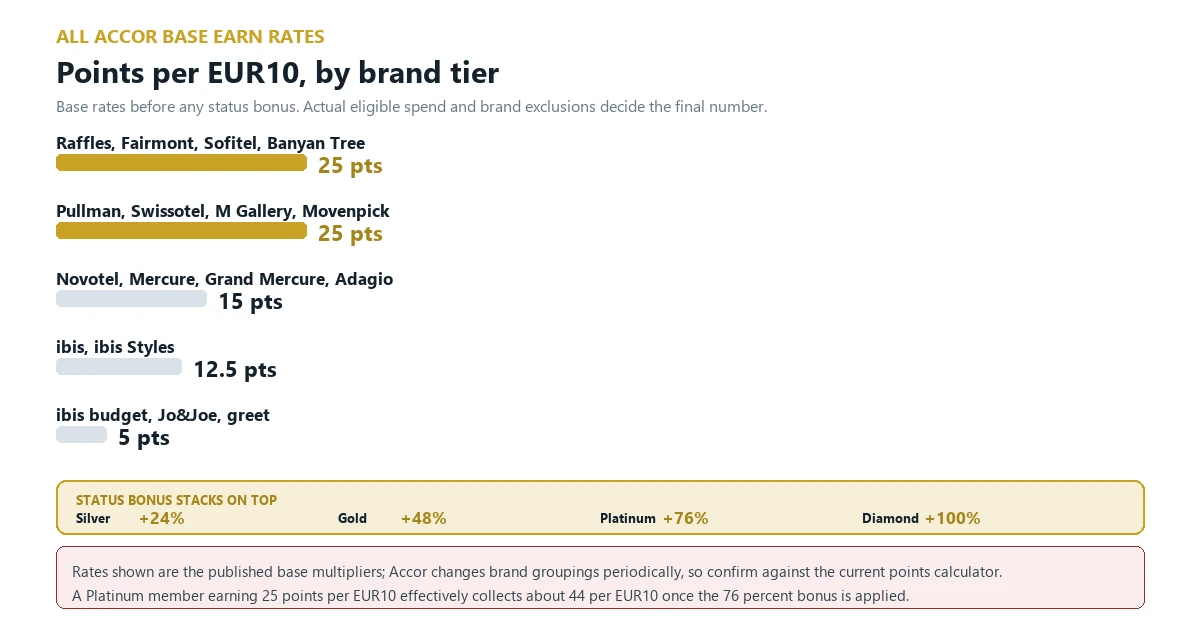
The published base rates sit in a narrow band at the top of the portfolio and fall away quickly at the bottom. Luxury and premium brands — Raffles, Fairmont, Sofitel, Banyan Tree, Pullman, Swissotel, M Gallery and Movenpick — pay 25 Reward points per EUR10 of eligible spend. Midscale brands such as Novotel, Mercure, Grand Mercure and Adagio pay around 15. ibis and ibis Styles pay 12.5, and the economy end — ibis budget, Jo&Joe and greet — pays 5.
| Brand tier | Examples | Points per EUR10 | With Platinum (+76%) |
|---|---|---|---|
| Luxury | Raffles, Fairmont, Sofitel, Banyan Tree | 25 | 44 |
| Premium | Pullman, Swissotel, M Gallery, Movenpick | 25 | 44 |
| Midscale | Novotel, Mercure, Grand Mercure, Adagio | 15 | 26 |
| Economy | ibis, ibis Styles | 12.5 | 22 |
| Budget | ibis budget, Jo&Joe, greet | 5 | 8.8 |
The status bonus multiplies those numbers, and the spread is wider than most members expect. Silver adds 24 percent, Gold 48 percent, Platinum 76 percent and Diamond 100 percent. A Platinum member at a Sofitel is therefore collecting roughly 44 points per EUR10 rather than 25, almost double the Classic rate for an identical stay. This is the single strongest argument for consolidating stays with Accor rather than spreading them across chains: the bonus compounds with every tier you reach.
Two details keep the arithmetic honest. First, eligible spend is the pre-tax room charge plus qualifying incidentals, not the full folio — resort fees, taxes and some third-party charges do not count. Second, brand groupings change. Accor has reorganised its brand ladder more than once, so the figures above are a reliable guide rather than a permanent promise. The points calculator inside your account is the authoritative source for a specific property. Our Accor elite status guide covers the thresholds that unlock each bonus level.
Dining and everyday spend
Accor pays points on food and drink at participating hotels even when you are not staying, which makes dining the most accessible side channel. The rate is 1 Reward point per EUR1 spent, credited when the charge is billed to your ALL account. In practice this means telling the restaurant you are a member and making sure the number is attached before the bill is closed — a charge paid without the membership number on it is very difficult to recover afterwards.
The value is modest but real. A EUR120 dinner earns 120 points, worth about EUR2.40 at Accor’s fixed redemption rate. That is not a reason to choose a hotel restaurant over a better one nearby, but if you are eating there anyway, the points are free. Where dining genuinely pays is on longer stays at properties with multiple outlets, because breakfast, lunch, dinner and bar charges all accumulate onto a folio that is already earning.
Charge-to-room is the mechanic that makes this work. When you are staying, every restaurant and bar charge billed to your room rolls into the eligible folio and can also pick up your status bonus. Paying separately at the table often means the points post at the base rate with no bonus and, occasionally, do not post at all. The habit is simple: sign everything to the room and settle once at checkout.
Car rental, shopping and surveys
Car rental is the best of the partner channels and the easiest to use. Hertz pays up to 5 Reward points per EUR1, Europcar pays 3, and Sixt pays 200 points per EUR50. On a week-long rental that is a meaningful top-up for a booking you would have made regardless. The points post after the rental completes, so treat them as a bonus rather than something to plan around.
Shopping through Collections — Accor’s retail portal — earns points at rates set by each retailer, and the range is wide. Fashion, electronics and homeware merchants all participate in selected markets. The mechanic is a tracked click-through, which means the same caveats as any affiliate portal: start from the Collections site, complete the purchase in the same session, and expect cancellations or refunds to reverse the points. It is a reasonable way to earn on things you were buying anyway, and a poor reason to buy something you were not.
Surveys through e-Rewards and ClubOpinions are the slowest route. The points are small, the qualification process is inconsistent, and the time cost is real. Their genuine use case is narrow: keeping an account active when no stay is planned. If your points are approaching the 12-month deadline and a trip is not on the horizon, a survey is a legitimate way to post qualifying activity — but so is a cheap ibis night, and that also gives you somewhere to sleep. Our Accor points expiry guide explains exactly what counts as activity and what does not.
Airline double dipping
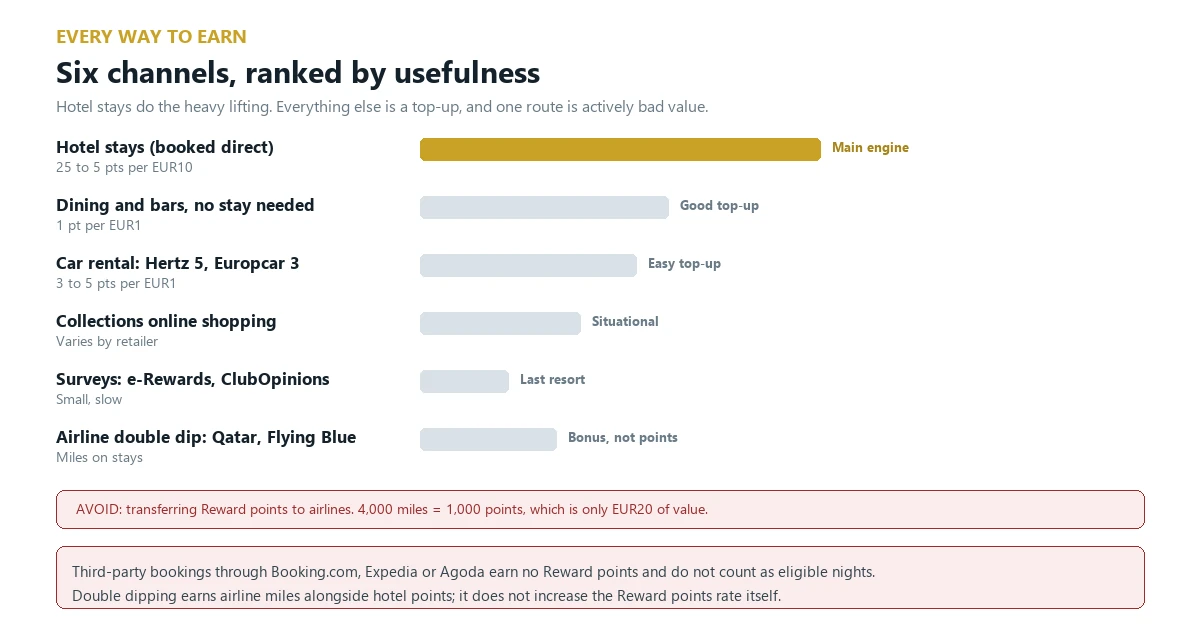
Double dipping is the most underused feature in the programme, and it does not cost anything. Link your ALL account to a partner airline and eligible hotel stays credit miles to the airline at the same time as Reward points to Accor. Qatar Airways Privilege Club, Flying Blue and Qantas all participate, along with several others. The link is a one-time setup in your account settings, and from then on the miles accrue automatically.
Flying Blue goes further in one direction: eligible Air France and KLM flights earn 1 Accor Reward point per EUR2 spent, on top of the Flying Blue miles you would earn anyway. Linking the accounts also triggers a small welcome boost of status nights and airline experience points. None of this changes your hotel earn rate — it is a second currency from the same trip, not a multiplier on the first.
There is one structural detail worth knowing. Hotel stays credit miles, not Reward points, so double dipping does not speed up your Accor balance. If your goal is a larger Accor balance, the airline link does nothing for it. If your goal is to get value from the flying you already do, it is free upside. Being clear about which one you want prevents the mild disappointment of expecting a points boost that never arrives. For a sense of how Accor points compare in value with the miles on the other side of the link, our Accor points valuation guide converts both into cash.
Why transferring to airlines is a trap
Every transfer direction is not equal, and the outbound one is bad. Our best-use guide shows exactly how much of the balance survives each route. Accor’s published ratios send roughly 4,000 airline miles out for 1,000 Reward points. Since 1,000 Reward points are worth a fixed EUR20 as hotel credit, you are paying about 2 euro cents per mile. Most airline miles are worth between 1 and 1.5 cents in practice, and the better redemptions cluster well below the rate you just paid. The transfer destroys value on the way out, every time.
The inbound direction is more defensible. Several airline programmes transfer into Accor at ratios that are at least arithmetically coherent, and a member with a large miles balance and no award availability can sometimes do better converting into hotel credit than leaving the miles idle. Our cross-programme points value chart sets the two sides side by side if you want the comparison in numbers rather than adjectives.
The practical rule is simple: earn Accor points, spend Accor points on Accor stays, and treat airline transfers as a one-way valve you do not open. If you want airline miles, earn them from flying or from a credit card that transfers to airlines, not from a currency whose fixed value you are giving up.
Three earning mistakes that cost the most
Booking through an OTA. This is the expensive one, because it silently zeroes out an entire stay. A member who books ten nights a year through a third-party site earns nothing from any of them, and no amount of status or promotion recovers it. Book direct with Accor — the rate is usually the same or better once member pricing applies, and the points actually post.
Chasing multipliers for status. Promotional offers multiply Reward points, not status points. A member who books a triple-points weekend expecting it to push them toward Gold will be disappointed, because the status points earned are based on base spend alone. Read the terms of any offer before you plan a trip around it, and use our status guide to see what actually moves the tier needle.
Letting a balance lapse. Accor points expire 12 months after the last eligible earning activity, and redeeming does not reset the clock. A member who carefully spends part of a balance in month eleven can still lose the rest. The protection is an earning event, not a redemption, and the detail is worth understanding before you plan a rescue. Our expiry guide walks through the timing, including why a stay counts from checkout rather than booking.
How to earn faster, honestly
The honest answer is unglamorous: book direct, stay in the brands that pay better, and let your status bonus compound. A member who moves from Classic to Platinum at the same hotels roughly doubles their earn rate without changing a single booking. That is a bigger effect than any single promotion, and it arrives automatically once the nights accumulate. If you have not already switched your booking habit, start by booking through Accor directly — it is the precondition for every number on this page.
Layer the side channels where they cost nothing. Sign restaurant charges to the room, link an airline partner, and use a car rental partner when you are renting anyway. Skip the ones that require effort disproportionate to the reward — surveys in particular. And if you are considering a paid subscription to accelerate earning, our Accor Plus and ALL Signature guide runs the break-even math, because those products change the calculation in ways the base rates do not show.
Bottom line: Accor points come from direct hotel stays at 5 to 25 points per EUR10 depending on brand, and our Accor hotel brands guide lists which tier pays which rate, multiplied by up to 100 percent for status. Dining, car rental and shopping add smaller amounts, airline links add miles rather than points, and transferring Reward points out to an airline is the one route that reliably loses value.
Last updated: 18 November 2026.
FAQ
How many points do you earn per euro at Accor?
It depends on the brand. Luxury and premium properties such as Raffles, Fairmont, Sofitel and Pullman pay 25 Reward points per EUR10 of eligible spend. Midscale brands such as Novotel, Mercure and Adagio pay around 15 per EUR10. ibis and ibis Styles pay 12.5, and ibis budget, Jo&Joe and greet pay 5. Your status bonus is applied on top of the base rate, so a Platinum member earns 76 percent more than the figures above.
Do I earn Accor points when I book through Booking.com or Expedia?
No. Only bookings made direct through all.accor.com, the ALL Accor app, the hotel itself or the ALL call centre count as eligible stays. Reservations through third-party travel agents, tour operators and online travel agencies earn no Reward points and no status nights, even though you pay the same room rate. This is the single biggest reason members see an empty account after a year of travel.
Can I earn Accor points without staying at a hotel?
Yes. Dining at participating Accor restaurants and bars earns 1 point per EUR1 without a room booking, as long as the charge is credited to your ALL account. Car rental through Hertz, Europcar or Sixt earns between 3 and 5 points per EUR1. Shopping through Collections and completing surveys with e-Rewards or ClubOpinions also earn points, though in smaller amounts and more slowly.
What is Accor airline double dipping?
Double dipping lets you earn airline miles and hotel points from the same trip. Link your ALL account with a partner such as Qatar Airways Privilege Club, Flying Blue or Qantas, and eligible hotel stays credit miles to the airline alongside Reward points to Accor. Flying Blue also pays Reward points on eligible Air France and KLM flights at 1 point per EUR2 spent. It adds a second currency to a stay you were taking anyway, which is why it is worth the two minutes it takes to link the accounts.
Is transferring Accor points to airlines a good idea?
No. The published ratios are around 4,000 airline miles for 1,000 Reward points, and 1,000 Reward points are only worth EUR20 as hotel credit. You are effectively paying about 2 euro cents per mile, which is far above what most airline miles are worth in practice. Convert in the other direction if the option exists and you need Accor points, but do not send Reward points out to an airline programme.
Does elite status increase how many points I earn?
Yes, and the bonus is substantial. Silver adds 24 percent to the base earn rate, Gold adds 48 percent, Platinum adds 76 percent and Diamond doubles it. The bonus applies to the base points earned on eligible spend, not to promotional bonus points. At the top tiers the difference is large enough that the same stay can be worth twice as many points to a Diamond member as to a Classic member.
Do promotional bonus points count toward status?
No. Promotional offers multiply Reward points, not status points. A triple-points promotion adds Reward points to your spendable balance but contributes nothing extra to the status points that decide your tier. Status points come from base eligible spend and from qualifying meetings and events. If you are chasing a tier, read the offer terms carefully, because a generous-looking multiplier often does nothing for your status progress.