Accor Plus worth it? Yes — when your stays already land in Accor hotels and you use the regional perks. The membership is a prepaid discount and status shortcut, not a points-earning scheme that pays for itself everywhere.
The short version: ALL Accor+ Explorer is the old Accor Plus, now a global card with 15 percent off rooms, two free-night vouchers in Asia-Pacific and 30 status nights that hand you Gold. ALL Signature is a different product that sends you Reward points and status points every month. Neither is a universal win. The value depends entirely on where you travel and whether you would have booked those hotels anyway.

What Accor paid subscriptions actually are
Accor does not sell Reward points the way Marriott and Hilton do. There is no buy-points button on the English site, and no points broker with a direct Accor contract. What Accor sells instead is access: a set of annual subscriptions that either cut the price of a room or credit your account with points on a schedule. That structural difference is why the classic “is buying points worth it” question does not apply here, and why a dedicated subscription page matters more than a buy-points guide would.
Since October 2025 the discount cards have sat under the ALL Accor+ name. ibis covers the three ibis brands, Voyager covers more than 30 brands worldwide, and Explorer — previously Accor Plus — adds the free-night and dining benefits that made the old card famous in Asia-Pacific. ALL Signature runs alongside them as a points club that started in Brazil and is now open to members worldwide. You can hold one of each, and Accor actively encourages combining a discount card with a Signature plan.
The mental model is straightforward: a subscription is a fixed annual cost that you recover through savings you were already going to make. If you would never pay EUR225 for a hotel membership because your Accor nights are rare, the arithmetic will not work no matter how good the headline benefits look. Start from your own stay pattern, then match it to the card — not the other way round. Our Accor promotions hub is the companion page for the limited-time offers you can stack on top of a membership, and Accor’s subscription page lists which plans are sold in your region.
The four cards compared
Four products compete for the same wallet, but they are not variations of one idea. Two are narrow discount cards, one is a broad discount card with regional extras, and one is a points subscription. The table below shows what you actually get for a typical annual price in 2026.
| Subscription | Typical annual price | Core benefit | Where it works |
|---|---|---|---|
| ALL Accor+ ibis | EUR99 | 15% off ibis brands, 10 status nights | Worldwide, ibis only |
| ALL Accor+ Voyager | EUR179 | 15% off 30+ brands, 20 status nights | Worldwide, no regional extras |
| ALL Accor+ Explorer | EUR225 (USD255 RoW) | 15% off, 2 Stay Plus nights, 30% dining, 30 status nights | Rooms worldwide; vouchers and dining in Asia-Pacific and Middle East |
| ALL Signature Absolute | About EUR1,250 | 75,000 Reward points, 12,000 status points, up to 30 status nights | Points usable worldwide; some benefits Brazil-focused |
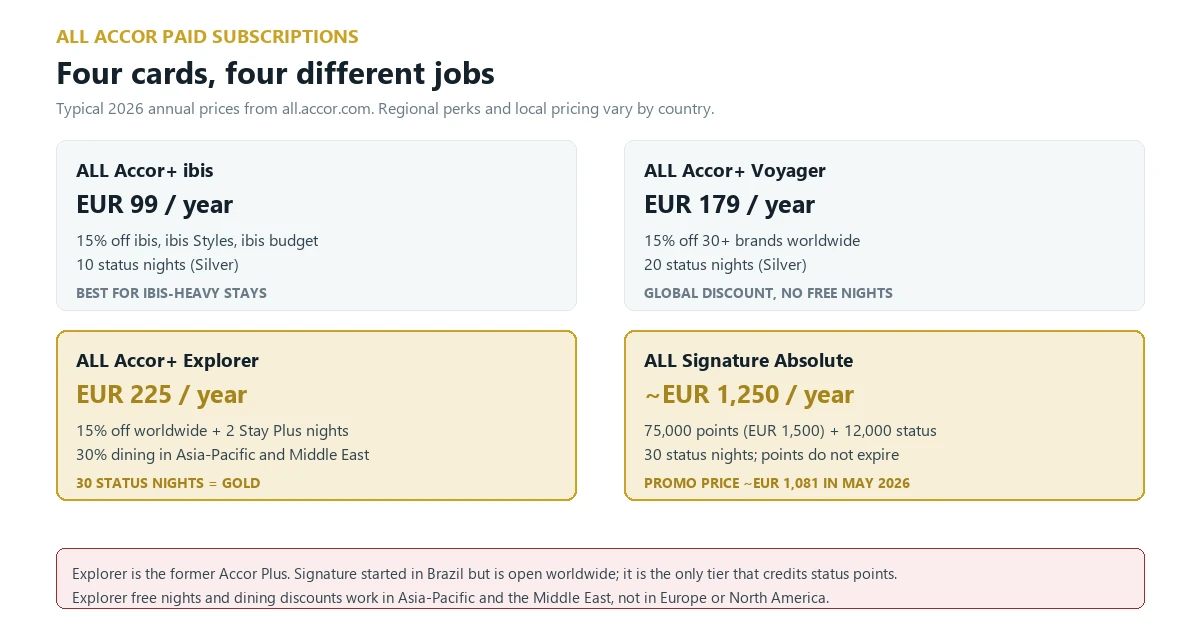
The most important line in that table is the last column. Explorer’s two free nights and 30 percent dining discount are worth a great deal in Bangkok, Kuala Lumpur or Dubai and worth nothing in Paris or Chicago. Accor publishes the membership globally, but the benefits attached to it are regional. A European reader who signs up expecting to use a Stay Plus voucher at a French Novotel will be disappointed; the 15 percent room discount still applies, but that alone is a much thinner proposition.
Signature flips the logic. Its headline benefit is a monthly points credit that can be spent at any participating Accor hotel, in any region, at a fixed 2 euro cents per point. It has no free nights and usually no dining discount. That makes it a better fit for someone who wants predictable value across a mixed footprint rather than deep discounts in one region. If you want to understand what those points are worth before comparing prices, our Accor points valuation guide explains the fixed rate and why it is not comparable to Hyatt’s dynamic awards.
ALL Signature Absolute: the break-even math
Absolute is the tier that attracts the most attention because the numbers are unusually clean. Over twelve months it delivers 75,000 Reward points: 5,000 every month, plus an extra 5,000 every fourth month. That is an earning route in its own right, and our Accor points earning guide shows how it compares with ordinary stays. At Accor’s fixed redemption rate of 2,000 points for EUR40, that is EUR1,500 of credit against eligible stays. The standard annual price sits near EUR1,250, so the points alone return roughly 20 percent on face value, and 2026 first-year promotions have brought the cost close to EUR1,081 — a 28 percent discount on the points.
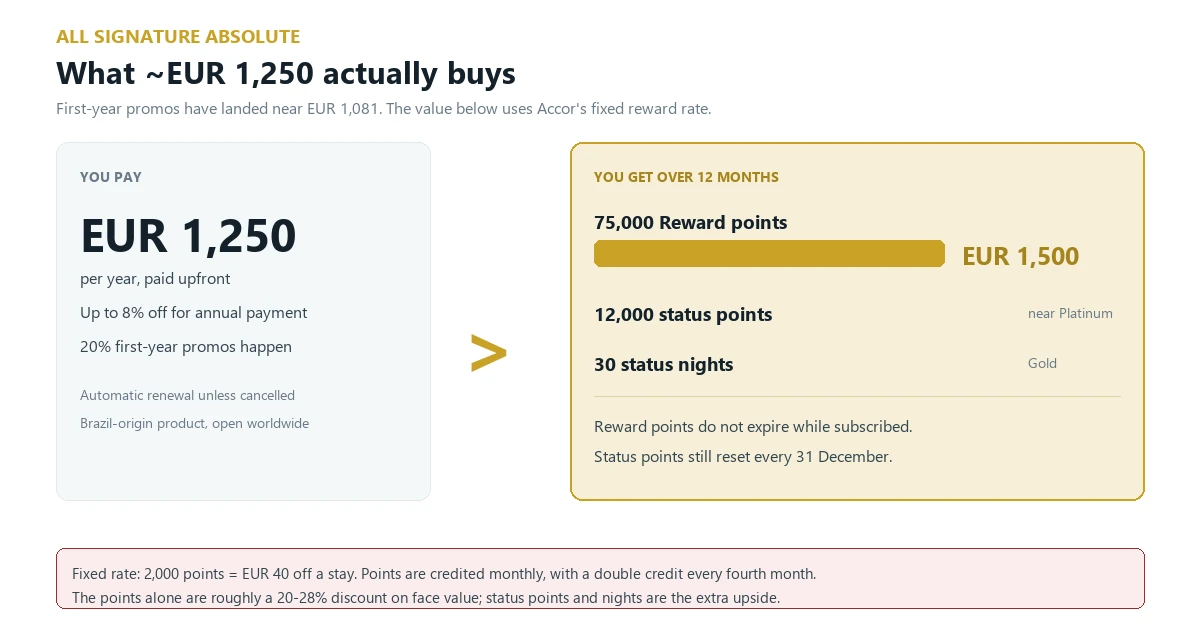
On top of the points, Absolute credits 1,000 status points a month, 12,000 across the year, and five status nights a month capped at 30 in total. Gold needs 7,000 status points or 30 nights, Platinum needs 14,000 or 60. A member who signs up in January is therefore Gold within seven months from points alone and close to Platinum by December. For someone whose stays never reach 30 nights, that is a genuine shortcut to a tier with better upgrades and, in many markets, breakfast.
The catch is timing and lock-in. Points arrive monthly, not on day one, so you cannot use the full EUR1,500 on a single winter trip in January. The value is fixed to Accor stays, which means the “discount” only exists if you were already going to spend at Accor. And the subscription renews automatically unless you cancel. If you would otherwise have booked independent hotels, paying EUR1,250 for credit at a chain you do not use is not a saving — it is a change of behaviour you may not make.
There is also an expiry interaction worth understanding. Reward points do not expire while the Signature subscription is active, which is a real advantage over the standard 12-month rule that applies to ordinary members. Our Accor points expiry guide explains how that 12-month clock is measured and what breaks it. Status points are different: they still clear on 31 December every year. A December sign-up gets far fewer usable status points in that calendar year than a January sign-up, even though both pay the same annual fee. If you are comparing this with another programme’s expiry rules, the World of Hyatt expiry guide shows how a 24-month window changes the calculation.
Before committing to an annual plan, it is worth looking at the current Accor subscription options and checking whether a first-year promotion is running, because the Absolute tier is often discounted by 15 to 20 percent for new members. Paying list price when a code exists is the easiest way to erode the break-even margin.
Explorer and the free-night question
Explorer is the product most people mean when they ask whether Accor Plus is worth it. The annual fee buys 15 percent off the best available public rate at more than 4,500 hotels across 30-plus brands, though not every brand honours every benefit, as our Accor hotel brands guide explains, two Stay Plus vouchers that turn a two-night stay into one paid night, 30 percent off food and 15 percent off drinks at participating Asia-Pacific restaurants, access to Red Hot Room member sales, and 30 status nights that deliver Gold immediately. For what Gold and Platinum unlock beyond the discount card, see the Accor elite status guide.
The free nights are the decision point. Each voucher requires a qualifying two-night stay and is limited to hotels in Asia-Pacific and the Middle East, with blackout dates and properties that do not allocate inventory. Used at a property where the second night costs more than half the annual fee, one voucher can cover the whole membership. Used at a budget property on a peak weekend when no inventory is released, it is worth nothing. Realistically, members who travel in the region use one or both vouchers at mid-range Sofitel, Pullman or Novotel properties where a night costs enough to matter.
The 15 percent discount is the reliable part. Accor applies it to the best flexible public rate, and it stacks with member rates and many promotional offers. On four nights a year at an average of EUR180, the saving is roughly EUR108 — not enough on its own to cover EUR225, but close once a free night is added. On ten nights a year it becomes EUR270 and the membership is clearly profitable. That is the honest break-even: roughly six to eight nights a year, assuming you use at least one voucher and eat at Accor restaurants occasionally.
European and North American members should discount the vouchers and dining entirely. A EUR225 card that saves 15 percent on six EUR150 nights returns EUR135, well short of the fee. In that case Voyager at EUR179 is the more rational choice: the same 15 percent discount and 20 status nights, without paying for perks you cannot use.
ibis and Voyager: narrow but cheap
The ibis card at EUR99 is the easiest subscription to justify on paper. It gives 15 percent off ibis, ibis Styles and ibis budget worldwide, plus 10 status nights for Silver and a two-day room availability guarantee. If your travel is mostly short city breaks in ibis properties, seven or eight nights a year cover the fee. If you occasionally stay at a Mercure or a Pullman, the card does nothing and Voyager is the better buy.
Voyager at EUR179 is the general-purpose option. It covers 30-plus brands with the same 15 percent discount, 20 status nights, premium customer service and the availability guarantee, but no free-night vouchers and no dining discount. For a traveller who wants a simple discount on all Accor stays without regional conditions, this is the cleanest product in the range. It is also the card I would recommend to someone who wants to test whether an Accor subscription works for them before moving up to Explorer.
One rule applies to all three discount cards: status nights from paid subscriptions are capped at 30 per calendar year in total. Buying Explorer and Voyager together does not give you 50 nights. The cap is across all subscriptions, which is why the sensible combination is one discount card plus one points plan, not two discount cards. Accor’s own subscription hub asks where you travel and what you want before recommending a card, and it is worth using that flow rather than assuming the most expensive option is the best.
Who should buy, and who should skip
Subscriptions are personal arithmetic. The four-quadrant view below cuts through the marketing by pairing travel volume with region.
| Your pattern | Best fit | Why |
|---|---|---|
| Frequent Asia-Pacific or Middle East stays, 6+ nights | Explorer | Free nights and dining discounts are usable; 15% off and Gold add more |
| Frequent stays anywhere, mixed brands | Voyager, possibly plus Signature | Global 15% off without paying for regional perks you never use |
| Mostly ibis stays, short trips | ibis | Lowest fee, direct 15% saving at the brands you already choose |
| Accor-heavy spender wanting status and points | Signature Absolute | 75,000 points and 12,000 status points beat staying as a free member |
| A handful of Accor nights a year, mostly Europe or US | None | Discounts will not cover the fee; keep the free membership |
The “none” row is not a cop-out. Free ALL membership already gives member rates, points on stays and occasional targeted promotions. Paying for a subscription is a bet that your behaviour will not change, and for most occasional travellers that bet loses. The exception is a member who is one or two stays away from Platinum and values the breakfast and upgrade benefits enough to buy the missing status — in that case the card is effectively a status purchase with a discount attached.
There is a second exception worth naming: a household where one person travels for work and accumulates nights, while the other books leisure stays. Explorer lets you earn on two rooms on the same booking in many properties, which can push a family over the free-night threshold much faster. That is a specific but real case where the card pays for itself on two or three trips rather than six.
Three traps before you subscribe
Trap one: counting regional perks at face value everywhere. The two Stay Plus vouchers and the 30 percent dining benefit are worth a lot in Asia-Pacific and the Middle East and close to zero elsewhere. If your Accor nights are in Europe, price the card as a 15 percent discount and nothing more. A quick search of the hotels you would actually book will give you a more honest answer than any list of headline benefits.
Trap two: assuming status nights stack across cards. Accor caps status nights from paid subscriptions at 30 per calendar year in total. Explorer’s 30 nights already hit the ceiling, so adding Voyager or ibis gives you no additional progress. Signature’s monthly nights are subject to the same cap. Status points do stack, which is why the useful pairing is a discount card plus Signature, not two discount cards.
Trap three: forgetting the renewal date. Every Accor subscription renews automatically. A card that made sense during a year of heavy Asia-Pacific travel can be dead weight twelve months later when your trips move elsewhere. Put the renewal date in a calendar when you subscribe and re-run the break-even math before it charges again. The same applies to Signature: the points keep arriving, but if you no longer stay at Accor hotels the credit has nowhere to go.
One more nuance for points-focused members: a subscription does not make airline transfers good value. Our Accor redemption guide shows what the same points return as hotel credit instead. Accor points remain a fixed 2-eurocent rebate, so moving them to Avios at 1:1 is still paying far above what an Avios is worth. Our cross-chain valuation chart shows why fixed-value points should be spent as cash credit, not converted into a currency with a different value structure.
Verdict: is Accor Plus worth it?
For a traveller who spends six or more nights a year in Asia-Pacific Accor hotels and uses at least one free-night voucher, Explorer is worth it — the vouchers alone can cover the fee, and the 15 percent discount plus Gold status are genuine upside. For a global traveller who wants a simple discount without regional conditions, Voyager at EUR179 is the better fit. For someone who mostly stays at ibis, the EUR99 ibis card is an easy win on eight nights a year. And for a high-volume Accor guest who already has status or wants to fast-track it, Signature Absolute returns roughly 20 to 28 percent of the annual fee in fixed-value points plus a meaningful status boost.
For everyone else, the answer is no. Occasional Accor guests in Europe or North America should keep the free membership, earn points on the nights they already book and wait for a promotional offer before paying for anything. The value of these cards is entirely conditional on your own travel pattern, and no amount of headline benefit changes that. If you do decide the numbers work, compare the current Accor Plus plans before subscribing, because first-year promotions are common and change the break-even point materially.
Bottom line: Accor Plus is worth it as a discount-and-status tool for repeat Accor guests in the right region. It is not a points deal, it is not universal, and it should be bought against your own night count rather than the advertised benefit list.
Last updated: 18 November 2026.
FAQ
Is Accor Plus worth it in 2026?
It is worth it if you stay at Accor hotels at least a few times a year, especially in Asia-Pacific or the Middle East where the free nights and dining discounts apply. Explorer pays for itself with two Stay Plus vouchers if you would have paid for those nights anyway, and it also gives 30 status nights and Gold status. If you mostly stay in Europe or North America and never eat at Accor restaurants, the regional perks disappear and the 15 percent room discount alone rarely covers the annual fee.
What is the difference between Accor Plus, ALL Accor+ and ALL Signature?
Accor Plus was renamed ALL Accor+ Explorer in October 2025. ALL Accor+ is now the umbrella for three hotel-discount cards: ibis, Voyager and Explorer. ALL Signature is a separate points subscription that credits Reward points and status points every month instead of focusing on room discounts. The two can be combined, and they solve different problems: one cuts what you pay, the other builds a balance and accelerates status.
How much does ALL Accor+ Explorer cost?
The published annual price is EUR225 including tax in most European markets, or USD255 on the Rest of the World version of the site. Local prices in Asia-Pacific are set in local currency and vary by country; Indonesia is often the cheapest market. Accor sometimes offers 2,000 bonus points or a first-year discount, so it is worth checking the current offer before subscribing rather than renewing at list price automatically.
Is ALL Signature Absolute a good deal?
On the numbers, yes, if you will actually use Accor points. The Absolute tier delivers 75,000 Reward points over 12 months, worth a fixed EUR1,500 at Accor’s published rate, plus 12,000 status points and up to 30 status nights. The standard annual price is around EUR1,250, so the points alone return roughly 20 to 28 percent on face value, and 2026 promotions have brought the first year near EUR1,081. The catch is that the value is locked to Accor stays and the points arrive monthly rather than up front.
Do ALL Signature points really never expire?
Reward points do not expire while your Signature subscription is active. Once the subscription lapses, the normal 12-month rule applies again, counted from your last qualifying activity. Status points are different: they still reset on 31 December every year regardless of the subscription, so you cannot bank them across calendar years. That split catches people out when they assume one subscription freezes both clocks.
Can I combine an ALL Accor+ card with ALL Signature?
Yes. Accor allows members to hold a discount card such as Explorer or Voyager alongside a Signature points plan, and the benefits stack where they overlap. Status nights from all paid subscriptions are capped at 30 per calendar year in total, so a second card will not double your night credits. Points and discounts do stack, which is why frequent Accor guests sometimes hold both.
Does an Accor Plus membership give Gold status?
Explorer gives 30 status nights, which is enough for Gold. Voyager gives 20 nights and ibis gives 10, both of which land at Silver. Signature Absolute adds 1,000 status points a month and 5 status nights a month, capped at 30 nights a year. Gold is a meaningful tier at Accor because it improves upgrade chances and, in many Asia-Pacific properties, adds breakfast benefits that cheaper tiers miss.