The Aeroplan award chart is not one chart. It is two systems running side by side, and which one applies depends on who operates the flight. Partner airlines such as Lufthansa, ANA and Singapore use a fixed, distance-based table with no carrier fuel surcharges. Air Canada itself and a short list of select partners use dynamic pricing, where the published figure is only a floor. This guide explains how to read both.
The short version: find a bookable seat first, then price it on the correct side. Partner awards are predictable but seat-limited; dynamic awards have seats but prices move with demand. The chart was revised on 1 June 2026, and the change was mixed — some economy and short-haul business prices fell while long-haul premium cabins rose.
The two pricing systems
Aeroplan separates award pricing by operating carrier. Flights on Star Alliance partners and other partner airlines are priced from a published chart: you find the distance between the zone pair, look up the cabin, and that is the price if a reward seat is available. Flights on Air Canada metal, plus select partners including United, Emirates, flydubai, Etihad and several regional Canadian carriers, are priced dynamically. Dynamic prices respond to demand the way cash fares do.
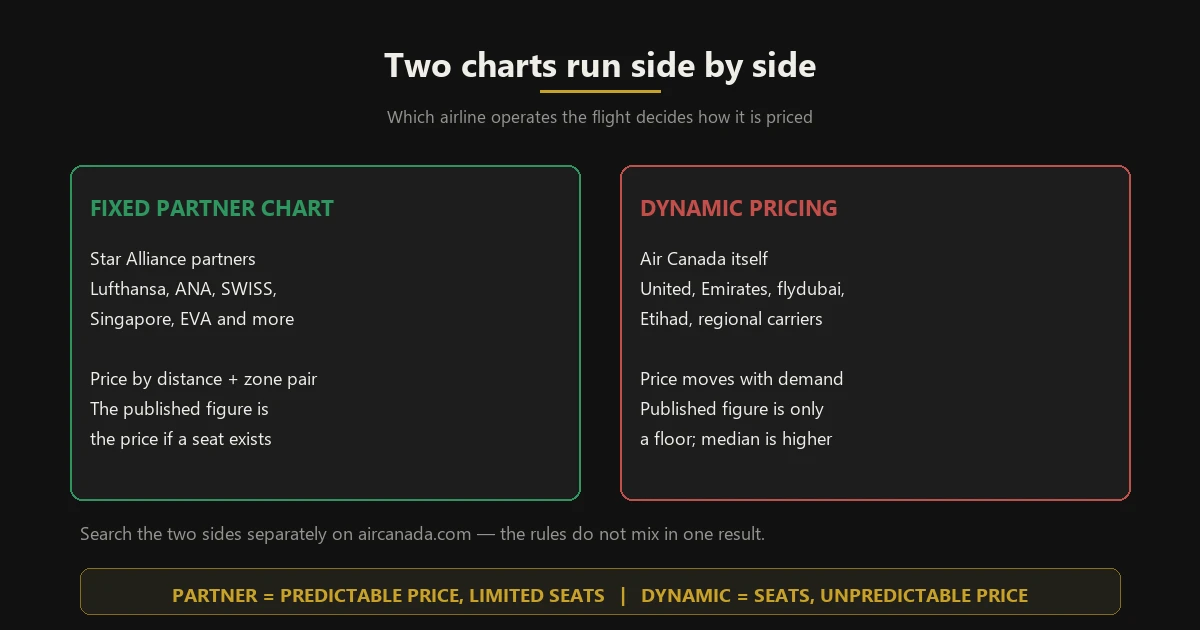
This split is why two itineraries that look similar can price so differently. A Lufthansa business class seat from Toronto to Frankfurt has a fixed chart price. The same trip on Air Canada has a starting price that may be far below what you are actually asked to pay. Neither number is wrong; they come from different rules.
How the fixed partner chart works
The partner chart has two inputs: the zone pair you are flying between and the total distance flown. Aeroplan measures actual great-circle miles across the whole itinerary, not the distance between your origin and final destination in a straight line. A connection can therefore push a trip into a higher band and raise the price by thousands of points.
Cabins are priced separately, and each partner award is one-way per passenger. A round trip is two separate one-way awards and may price differently in each direction. The chart publishes economy, business and first class prices for most zone pairs; premium economy is not published for every pairing, so it may not be available as a partner award.
Current distance bands
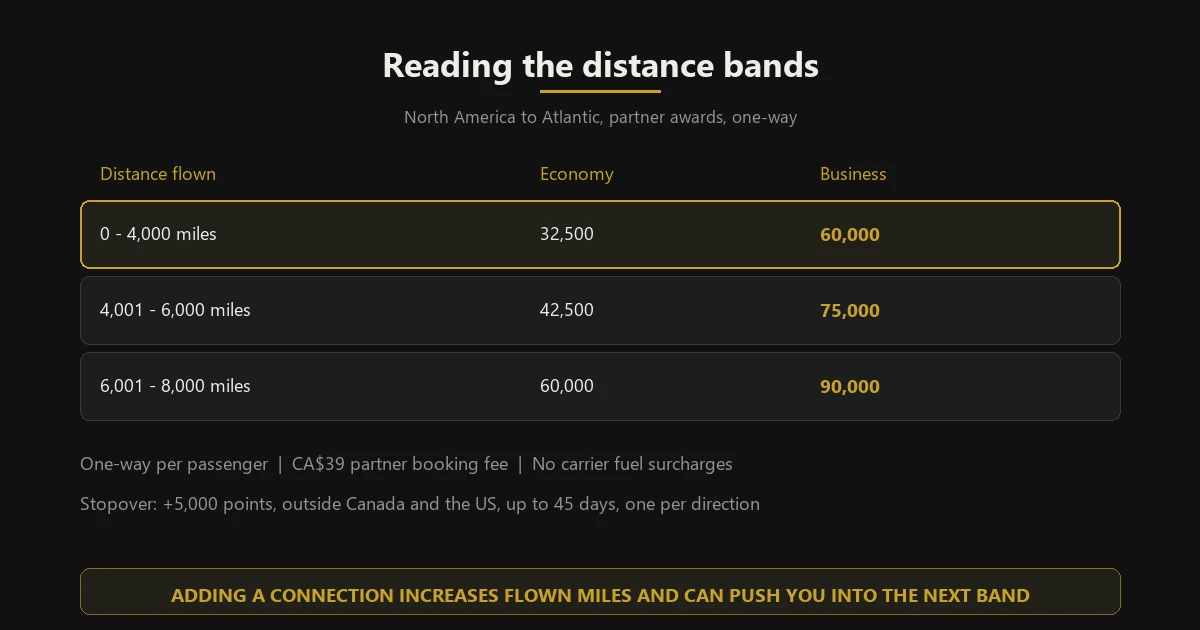
The table below shows the current one-way partner prices from North America to the Atlantic zone, using the chart version that applies to bookings made on or after 1 June 2026. Treat these as the published figures for partner-operated flights, not as the price of an Air Canada flight.
| Distance flown | Economy | Business |
|---|---|---|
| 0 to 4,000 miles | 32,500 points | 60,000 points |
| 4,001 to 6,000 miles | 42,500 points | 75,000 points |
| 6,001 to 8,000 miles | 60,000 points | 90,000 points |
On the North America to Pacific side, the cheapest band runs to 5,000 miles: 32,500 points in economy and 55,000 in business one-way on partners. Vancouver to Tokyo falls in this band, which is why it is consistently one of the best-value uses of Aeroplan points. From Toronto the distance is greater and the price moves up a band.
What changed on 1 June 2026
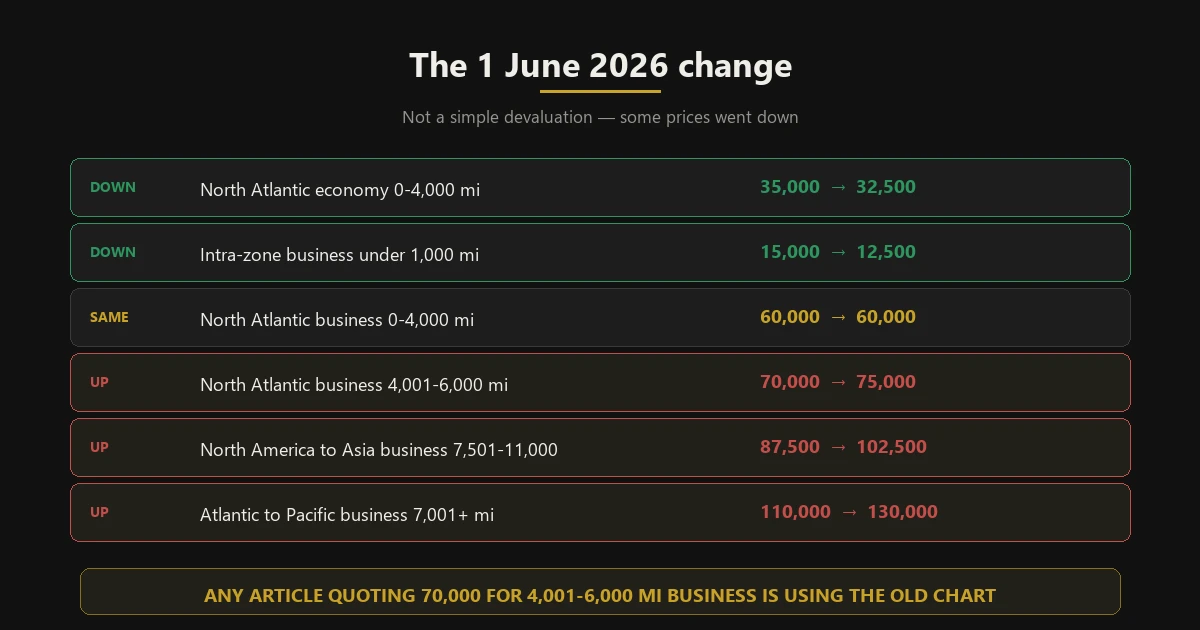
Air Canada revised the Flight Reward Chart for tickets booked or reissued on or after 1 June 2026. Calling it a devaluation is too simple: several prices went down, one key band stayed the same, and long-haul premium cabins rose sharply.
| Direction | Route and band | Old | New |
|---|---|---|---|
| Fell | North Atlantic economy, 0 to 4,000 miles | 35,000 | 32,500 |
| Fell | Intra-zone business, under 1,000 miles | 15,000 | 12,500 |
| Unchanged | North Atlantic business, 0 to 4,000 miles | 60,000 | 60,000 |
| Rose | North Atlantic business, 4,001 to 6,000 miles | 70,000 | 75,000 |
| Rose | North America to Asia business, 7,501 to 11,000 miles | 87,500 | 102,500 |
| Rose | Atlantic to Pacific business, 7,001 miles and above | 110,000 | 130,000 |
If a guide quotes 70,000 points for a transatlantic business seat from a US gateway to somewhere beyond 4,000 miles, it was written before the change. The figure that still holds for most East Coast to Europe flights is 60,000, because New York to Frankfurt at 3,845 miles stays under the 4,000-mile line. Add a connection to Warsaw and the whole award reprices at 75,000.
Reading dynamic prices
For Air Canada and the select partners, the chart publishes a starting price and, for routes to or from North America, a median that Air Canada updates quarterly. The starting price is a floor available on the best days, not a typical result. On North America to Atlantic business flights in the 0 to 4,000-mile band, the floor is 60,000 points while the published median has risen to roughly 129,300, up from about 107,500 a year earlier.
Budget from the median, not the floor, and treat anything close to the floor as a good find. Dynamic awards also include Air Canada’s own flights, so a mixed itinerary can combine a fixed partner price with a dynamic segment on top. That is how a trip advertised at 75,000 points can end up costing 75,800 after an Air Canada feeder flight is added.
Fees, stopovers and routing rules
Every partner award carries a CA$39 booking fee plus applicable taxes and third-party charges. Aeroplan does not pass on carrier-imposed fuel surcharges on partner tickets, which is a real advantage over several European programmes and keeps the cash portion of a booking modest. Taxes can be paid partly with points if you prefer.
One stopover is allowed per direction of travel on a partner award for an additional 5,000 points, up to 45 days, and the stopover city must be outside Canada and the United States. A round trip can therefore include two stopovers, one each way; a one-way award can include one. Frankfurt works as a stopover, Chicago does not. Itineraries with five or six segments, including most stopover combinations, require a phone agent.
How to search effectively
Search Air Canada flights and partner flights separately on aircanada.com. The two sides follow different rules, and a single search result will not show you the cheaper of the two if they are mixed. For partner availability, many travellers start on United’s site, where Star Alliance saver space is visible across a 30-day calendar, then verify the same seats on Air Canada before transferring any points.
Because the partner chart is fixed, the constraint is availability rather than price: the site will happily quote 75,000 points for dates where no seat exists. Decide your travel window first, confirm seats, then transfer. And never hold Aeroplan points speculatively for long — they expire after 18 months without qualifying activity, and the chart can change again.
Frequently asked questions
Is the Aeroplan award chart fixed or dynamic?
Both, depending on the airline. Star Alliance and other partners use a fixed distance-based chart. Air Canada and select partners including United, Emirates, flydubai and Etihad use dynamic pricing with a published floor.
How many points does a flight to Europe cost?
On a partner airline from North America to the Atlantic zone, 0 to 4,000 miles costs 32,500 in economy and 60,000 in business one-way. From 4,001 to 6,000 miles it is 42,500 and 75,000. Air Canada’s own dynamic prices usually run higher than the floor.
Did the Aeroplan chart get worse in 2026?
Not uniformly. The 1 June 2026 revision cut some economy and short-haul business prices, left the 0 to 4,000-mile transatlantic business price at 60,000, and raised long-haul premium cabins — North America to Asia business at 7,501 to 11,000 miles went from 87,500 to 102,500.
Are Aeroplan award prices one-way or round trip?
One-way per passenger. Aeroplan prices every flight as a separate one-way award, so a round trip consists of two awards and the two directions may differ in price and availability.
Does Aeroplan charge fuel surcharges?
No carrier-imposed fuel surcharges are passed on for partner awards. Taxes and third-party charges still apply, along with a CA$39 partner booking fee. This often makes an Aeroplan partner ticket cheaper in cash than the same flight booked through a European programme.
How does the Aeroplan stopover work?
A stopover costs 5,000 extra points, can last up to 45 days, and must be in a city outside Canada and the United States. You get one per direction of travel, so a round trip can include two. It is available on partner awards and usually requires booking by phone.
More Aeroplan Guides
- Aeroplan promotions, what is live and which offers are worth taking.
- Best ways to use Aeroplan points, sweet spots and stopovers on this chart.
- How much are Aeroplan points worth, the 1.4 to 1.5 cent baseline.
- How to earn Aeroplan points, bank transfers, hotel ratios and routing traps.
- Do Aeroplan miles expire, the 18-month rule and every exemption.
- Aeroplan Elite Status, the 2026 SQC tiers and benefits.
Last updated: 22 November 2026. Figures are from Air Canada’s Flight Reward Chart version 2026-08, applying to bookings made on or after 1 June 2026. Confirm the current chart before transferring points.