Do AAdvantage miles expire? Yes — American Airlines voids the whole balance after 24 months with no qualifying activity. But two groups are exempt, and one of them covers a huge number of travelers: if you hold a Citi AAdvantage card as the primary cardmember, your miles do not expire while that card is open. This guide covers the exact 24-month rule, who is exempt, the cheapest ways to keep a balance alive, and what it costs to get miles back if you have already lost them.
The short version: one qualifying activity — a flight, a redemption, a mile purchase, or ordinary spending with a partner — pushes your expiration date 24 months forward, and there is no minimum. Members under 21 and primary AAdvantage cardmembers are exempt. Miss the window and you can reactivate within 24 months for a fee of $60 to $2,000, up to 500,000 miles, though those miles never earn Loyalty Points.
AAdvantage expiration at a glance
| Question | Answer |
|---|---|
| Do AAdvantage miles expire? | Yes, after 24 months with no qualifying activity. |
| How much activity is needed? | One qualifying transaction. There is no minimum number of miles. |
| Who is exempt? | Members under 21, and primary AAdvantage cardmembers while the card is open. |
| Can expired miles come back? | Yes, within 24 months of expiry, up to 500,000 miles, for $60 to $2,000. |
The 24-month rule, in plain terms
American Airlines measures inactivity in blocks of 24 months. If your AAdvantage account goes a full 24 months without any qualifying activity, every mile in that account expires at once — not just the oldest ones. A single qualifying activity resets the clock: it moves the expiration date of all your unexpired miles to 24 months from the date of that activity.
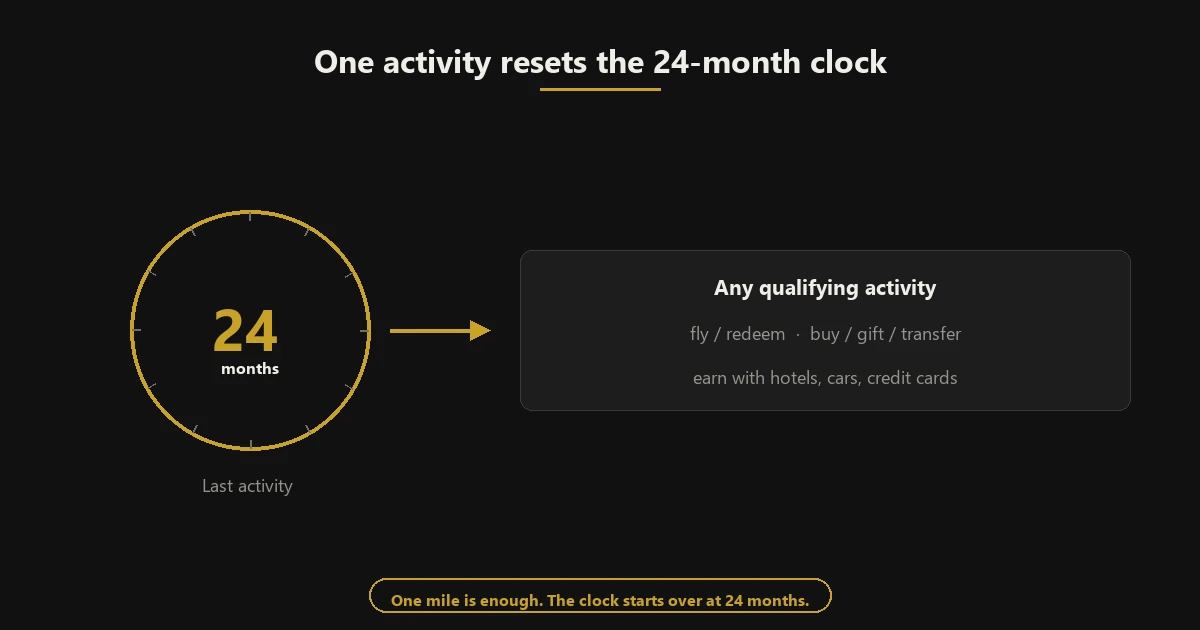
This is a rolling window, not a fixed annual sweep. There is no date on the calendar when American wipes accounts; the deadline follows your own last activity. That is why the single most useful habit is knowing the date shown in your account and acting well before it. Rule of thumb: set a reminder for month 20 after your last activity, which leaves four months to fix a posting error.
Two details trip people up. The clock applies to the whole balance, so a large, years-old stash and a handful of recent miles all expire on the same date — there is no partial expiry to worry about. And because the window rolls, an activity in month 23 is just as effective as one in month 1; both push the date out a full 24 months from the day the activity posts. What matters is that something qualifying lands before the deadline, not how long you have been a member or how often you fly.
What counts as qualifying activity
The AAdvantage terms list three categories. All three keep your miles alive, and none has a minimum threshold.
- Earning or redeeming with American or a partner airline. Flying American, American Eagle or an AAdvantage airline partner and crediting the miles counts, as does redeeming an award for a flight or another eligible reward.
- Buy, gift or transfer miles. Completing any Buy Miles, Gift Miles or Transfer Miles transaction is explicitly listed as qualifying activity. A small purchase during a sale can reset the clock — though only buy if you would use the miles anyway.
- Earning with partners. Accruing miles through participating hotels, car rental companies, credit cards and other service providers counts.
Several traps are worth flagging. First, simply signing in to your account is not qualifying activity — the terms describe earning, redeeming or a paid mile transaction, not logging in. Second, a Basic Economy ticket bought on or after 17 December 2025 earns neither miles nor Loyalty Points, so it produces no activity either. If you are counting on a cheap fare to protect a balance, check the fare rules first. Third, donating miles to a charity is not named in the terms as qualifying activity; it may work in practice, but since the rules do not promise it, do not rely on a donation as your only protection — verify your date afterward.
One more nuance concerns pending activity. A partner transaction can take weeks to post, and the qualifying activity date may differ from the day you spent the money. If your deadline is close, complete the activity early and confirm it has appeared in your account rather than assuming a pending purchase has already saved the balance. Miles earned from a flight you booked but did not take also do not count, because the miles are only credited once you fly.
Note also that qualifying activity is about keeping award miles alive, which is separate from elite status. If you want the full picture of how miles are earned and how Loyalty Points work, the earn AAdvantage miles guide walks through every channel.
Who is exempt from the 24-month rule
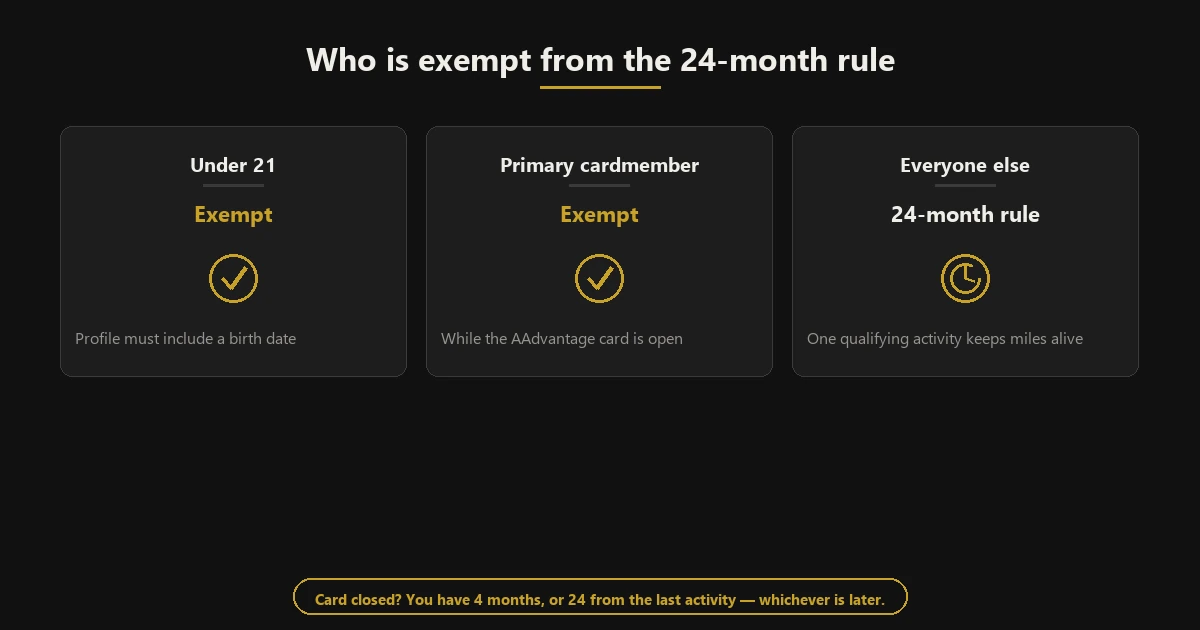
Members under 21. The 24-month requirement does not apply while you are under 21, but your profile must include a birth date for the exemption to be recognized. Turn 21 and you have 24 months from your 21st birthday to record activity or lose the miles.
Primary AAdvantage cardmembers. If you are the primary cardholder on a Citi AAdvantage card, your accrued miles do not expire while that account is open — even with zero activity. It usually takes up to 24 hours after the bank approves a new card for the account to reflect that no expiration date applies. Authorized users are not covered; the exemption belongs to the primary cardmember.
The card-closure catch. The exemption ends the moment you close the card. At that point you must have earning or redeeming activity within four months of closure, or within 24 months of your last qualifying activity — whichever is later — to keep the miles. New AAdvantage accounts have their own rule too: American may close an account created in the prior 24 months that shows no activity for 12 months.
How to check your date and keep miles alive
Sign in to your AAdvantage account; the account summary shows your balance and the earliest date your miles could expire. From there, the cheapest ways to protect a balance are the ones that fit spending you would do anyway:
- Shop through the AAdvantage eShopping portal. Register, click through to a retailer and make an ordinary purchase.
- Dine with AAdvantage Dining. Enroll, link a payment card and eat at a participating restaurant.
- Use a partner hotel or car rental. Put your AAdvantage number on an eligible booking.
- Redeem a small award. Even a low-cost redemption is qualifying activity for the remaining balance.
- Keep a no-annual-fee AAdvantage card open. If you rarely fly, a $0-fee card is the simplest permanent exemption.
Avoid paying for activity that costs more than the miles are worth. Buying miles purely to reset the clock is technically valid but expensive; see the buy AAdvantage miles guide for the current price ladder before considering it. And check that any activity actually posts to your account — a pending transaction is not confirmed protection.
For most people the whole problem reduces to one of three situations. If you fly American even occasionally, ordinary travel keeps the account current and you can ignore expiration entirely. If you do not fly but already hold a Citi AAdvantage card, keep the card open and the deadline does not apply — just remember that closing it starts a short countdown. If you neither fly nor hold the card, put one small recurring action on autopilot: a quarterly shopping-portal purchase or a linked dining card is enough to make the 24-month rule irrelevant. The mistake to avoid is assuming a big balance is permanent simply because it took years to build; American measures only the time since your last qualifying activity, not the effort behind the miles.
If your miles already expired
American will sell expired miles back, but only on specific terms. You have a 24-month window after the expiration date to request reactivation, and you can bring back at most 500,000 miles in that window; anything not reactivated is forfeited. The fee is based on how many miles you restore and currently ranges from $60 to $2,000. Requests go through AA.com/reactivate or AAdvantage Customer Service.
Three limits matter before you pay. Reactivation is non-refundable and irreversible. The returned miles do not earn Loyalty Points and do not count toward AAdvantage tier status or Million Miler status — so if your goal was status, reactivation will not help. And the restored miles remain subject to the same 24-month rule, so you will need fresh activity to keep them.
Run the numbers before authorizing the fee. At the 1.4-to-1.5-cent benchmark used for AAdvantage miles, even a $200 reactivation on 50,000 miles works out to well under a cent per mile — but only if you actually redeem them for solid value. If the miles would have sat idle again, or if the fee approaches what a comparable award would cost in cash, let them go. Reactivation is a way to rescue a redemption you have already planned, not a reason to pay to keep a balance you do not intend to use. For context on what a balance is worth before spending to recover it, see how much AAdvantage miles are worth.
How American compares to other airlines
| Program | Do miles expire? |
|---|---|
| American AAdvantage | Yes — 24 months of inactivity, with exemptions |
| Delta SkyMiles | No — miles do not expire |
| United MileagePlus | No — miles do not expire |
| Southwest Rapid Rewards | No — points do not expire |
| JetBlue TrueBlue | No — points do not expire |
American is the outlier here. If you park balances across several programs, AAdvantage is the one that needs a deliberate maintenance habit; the others can sit untouched. That does not make the miles worse — AAdvantage partner redemptions are among the strongest in the industry — but it does mean an idle account has a real cost. The partner airlines guide shows where those miles are worth keeping alive.
Verdict
Do AAdvantage miles expire? Yes for most people, and the 24-month clock is unforgiving because it wipes the entire balance at once. But the practical risk is low if you hold a Citi AAdvantage card as the primary member — that single fact removes the deadline for a large share of travelers. Everyone else should check their expiration date now, and let one small purchase or redemption through a partner reset it each year. Reactivation exists as a safety net, but at $60 to $2,000 with no status credit, it is a last resort, not a plan.
Last updated: 20 November 2026.
Frequently asked questions
Do AAdvantage miles expire if I have elite status?
Elite status by itself is not listed as an exemption. Status is based on Loyalty Points and renews on its own schedule, while expiration follows qualifying activity. In practice, members with status are usually flying or earning often enough to reset the clock, but do not assume status protects an inactive account.
Does signing in to my AAdvantage account keep miles active?
No. American defines qualifying activity as earning or redeeming miles, or completing a buy, gift or transfer transaction. Logging in to check your balance does not count as activity.
Do I lose all my miles or only the oldest ones?
All of them. When an account has no qualifying activity for 24 months, every unexpired mile in that account expires together. A single activity before the deadline protects the full balance.
How much does it cost to reactivate expired AAdvantage miles?
The reactivation fee currently ranges from $60 to $2,000 depending on how many miles you restore, and American can adjust it. You can reactivate within 24 months of expiry, up to 500,000 miles, and the transaction is non-refundable.
Do reactivated miles count toward elite status?
No. Reactivated miles do not earn Loyalty Points and do not count toward AAdvantage tier qualification or Million Miler status. They also stay subject to the normal 24-month expiration rule.
Are AAdvantage miles exempt while my credit card is open?
Yes, if you are the primary cardmember on a Citi AAdvantage card. Your miles do not expire while the account is open. After you close the card, you need activity within four months of closure or 24 months of your last qualifying activity, whichever is later.
More American Airlines guides
- How to earn AAdvantage miles, for the activities that reset the expiration clock.
- AAdvantage elite status, and why reactivated miles do not build status.
- Buying AAdvantage miles, including the cost of a mile purchase made purely to stay active.
- AAdvantage promotions hub, for what is currently on offer.
Check the expiration date shown in your AAdvantage account. If it is within six months, register for eShopping and Dining and make one small purchase or redemption, then set a reminder to repeat it every year.