How to earn AAdvantage miles comes down to one idea that trips up a lot of people: American Airlines gives you two things for most qualifying activity. You get redeemable miles to spend, and you get Loyalty Points that decide your status. One purchase, two currencies, and the rules for each are not the same. More than half of all AAdvantage miles are earned from everyday spending rather than flying, so the ways to build a balance are much wider than booking a flight.
The short version: earn on American Airlines and oneworld flights, on Citi co-brand card spending, and through shopping, dining, hotel and car partners. Each eligible mile you earn puts a Loyalty Point in the same account. What does not count is just as important — buying miles, welcome bonuses and Basic Economy fares add miles but no status credit. This guide walks through every channel and flags the traps.
Earning AAdvantage miles at a glance
Four channels feed an AAdvantage balance, and most of them feed both the mile counter and the status counter at once. Here is the frame before the detail.
| Channel | Earns miles? | Earns Loyalty Points? | Key detail |
|---|---|---|---|
| American Airlines & oneworld flights | Yes | Yes | 1 Loyalty Point per eligible mile; elite bonus applies |
| Citi co-brand card spending | Yes | Yes | 1 point per eligible dollar; posts 8–10 weeks after the statement |
| Shopping, dining, hotel & car partners | Yes | Yes | Rates vary by partner; car rentals pay 2–5 miles per dollar |
| Buy, gift or transfer miles | Yes | No | Adds spendable miles only, never status credit |
| Basic Economy (bought 17 Dec 2025 or later) | No | No | Neither miles nor points, on American or partners |
The thing worth holding on to is the third column. Most ways of collecting miles also move you toward status, which is why AAdvantage status can be reached without flying much. A small set of activities breaks that link, and those are the ones to recognise before you spend money assuming they count. The status qualification year runs from 1 March to the last day of February, so the points you earn across a full year of ordinary spending decide your tier for the following year — not a single trip or a single bonus offer.
Miles and Loyalty Points on the same spend
American Airlines states the relationship plainly: for every eligible AAdvantage mile you earn, you also earn one Loyalty Point. They arrive together from the same activity, but they are spent in completely different ways. Miles are the currency you redeem — for flights, upgrades, hotels and experiences. Loyalty Points are the counter that decides whether you reach Gold, Platinum, Platinum Pro or Executive Platinum.
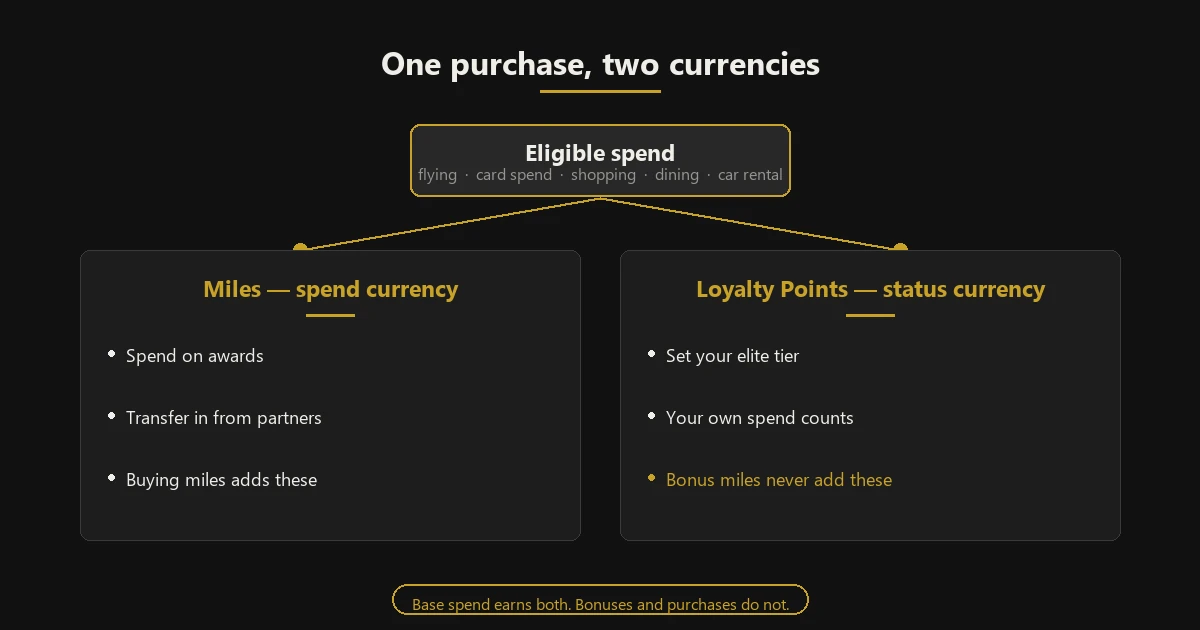
That single sentence — one eligible mile, one Loyalty Point — explains most of what is unusual about this program. On a single flight the two figures match. On credit-card spending, one eligible dollar produces a mile and a point together. On a car rental the rate might be four miles and four points per dollar for a Platinum member. The two balances stay in step as long as the activity is one that earns Loyalty Points.
Where they separate is the part that matters. Not every mile is an eligible mile. American calls out two categories explicitly: bonus miles and miles from a buy, gift or transfer transaction. Both land in your redeemable-mile balance and neither earns a Loyalty Point. So an account can hold a large number of miles while its status counter barely moves — a situation that surprises people who assume every mile in the balance is interchangeable.
The practical habit is to read the word base before you count anything. Base miles from eligible travel or spending produce both currencies. Anything labelled a bonus — a welcome offer, a promotion, an elite bonus on top of a flight — is extra miles for spending, not extra status credit. That distinction runs through every channel below, and it is the reason a strategy built only around bonus offers will leave you a long way from elite status.
Earn by flying
Flights remain the most straightforward source, and the calculation differs by who operates the plane. On American Airlines metal, miles are based on the qualifying fare paid rather than distance. The base rate is five miles per dollar, and your elite bonus multiplies it: forty percent at Gold, sixty at Platinum, eighty at Platinum Pro and one hundred and twenty at Executive Platinum. Government taxes and fees are excluded from the qualifying fare.
Partner flights work differently. They accrue by distance flown multiplied by the cabin’s booking code — the fare-class letter on the ticket — rather than by the price you paid. Elite bonuses still apply. Some special fares, and situations where fare details are unavailable when a flight posts, are calculated as a percentage of distance flown instead. If the booking code is not listed in the earning chart, the flight earns neither miles nor Loyalty Points, so the letter on the ticket is worth checking before you book.
Two smaller flying routes are easy to miss. You can buy Mileage Multiplier when you book on aa.com or at check-in, paying for extra miles for yourself or companions; in most cases they post before you arrive, and if the flight is cancelled or re-routed you keep the miles you bought. And if you purchased an upgrade on or after 14 August 2024, the base price of that upgrade earns five miles and Loyalty Points per dollar, or more at higher status, posted after you fly.
The status year itself is worth knowing while you earn. It starts on 1 March and runs through the last day of February. Card spending counts by the date it posts to the account, typically eight to ten weeks later, while flights and partner activity count by the date of the activity. Points that post on or after 1 March go to the new year — so a December purchase that posts in March is a common source of confusion.
Earn with Citi cards and transfers
Co-brand card spending is the most reliable way to build a balance without travelling. Every eligible dollar charged to a qualifying Citi AAdvantage card produces a mile and a Loyalty Point, which is why a household that routes ordinary spending through the card can reach the lower tiers without flying much at all. The specifics of which card to hold belong in the credit-card guide; the mechanism here is simply that card spend earns at one per dollar.
One timing detail has caught people out. Card activity is counted when it posts to the primary cardmember’s account, usually eight to ten weeks after the transaction, not on the purchase date. Points posted on or after 1 March count toward the new status year. Cards issued outside the United States may earn and post at different rates. If you are close to a threshold in late February, a card purchase made in the final weeks may not land in time — the posting date is what counts.
Transfers are a different route into the account. Citi ThankYou points move to AAdvantage at 1:1 on the premium Citi cards, which is the cleanest available rate. Marriott Bonvoy points convert at 3:1, so 60,000 Marriott points become 20,000 AAdvantage miles — and the usual Marriott offer of 5,000 bonus miles on a 60,000-point transfer explicitly excludes AAdvantage. World of Hyatt converts at 2.5:1 and IHG at 5:1. There is no transfer path from Chase Ultimate Rewards, Amex Membership Rewards, Capital One or Bilt.
Transferred miles are spendable but they are not base miles, so they do not create Loyalty Points. A transfer is a way to fund a specific award you have already priced, not a way to climb the status ladder. If status is the goal, the earn side of the account comes from flying, card spend and partner activity — not from moving points in. For the broader question of what a mile is worth once it is there, see how much AAdvantage miles are worth.
Earn with everyday partners
This is the channel that makes AAdvantage unusual, and it is where more than half of all miles come from. American keeps a large network of hotels, car companies, retailers and service providers that credit miles and Loyalty Points for ordinary purchases. The rates vary by partner, so the exact figure is worth checking before you route a purchase through one.
The AAdvantage eShopping portal is the most flexible of these. Every base mile earned through a qualifying eShopping purchase also earns a Loyalty Point, and the rate changes by store — a good portal rate can turn routine online shopping into a meaningful monthly contribution. AAdvantage Dining works on the same idea at participating restaurants. Both need to be activated before the purchase; clicking through and using the registered card are what make the activity eligible, so a purchase made from habit rather than through the portal earns nothing.
Car rentals have a clear published scale. Members earn two base miles per dollar; a Citi AAdvantage Mastercard cardmember without status earns three; Gold and Platinum members earn four; Platinum Pro and Executive Platinum members earn five. Where a status rate and a card rate both apply, the higher one wins. AAdvantage Hotels and SimplyMiles partners also count, and American Airlines Vacations packages earn miles — with the added distinction that the Vacations multiplier is one of the few offers that produces Loyalty Points rather than just bonus miles.
A useful way to think about these partners is as a status top-up. If you are a few thousand points short of a tier near the end of the year, one planned car rental or a few months of focused shopping can close the gap without a flight. The rates are small individually, but they accumulate across a year of ordinary spending, and they are available to travellers who fly once or twice. Just remember that registration and clicking through come first — the partner network rewards deliberate use, not passive spending.
What does not earn miles or points
The fastest way to misjudge an earning plan is to count an activity that does not count. American is explicit about the main exclusions, and they are more common than most people expect.
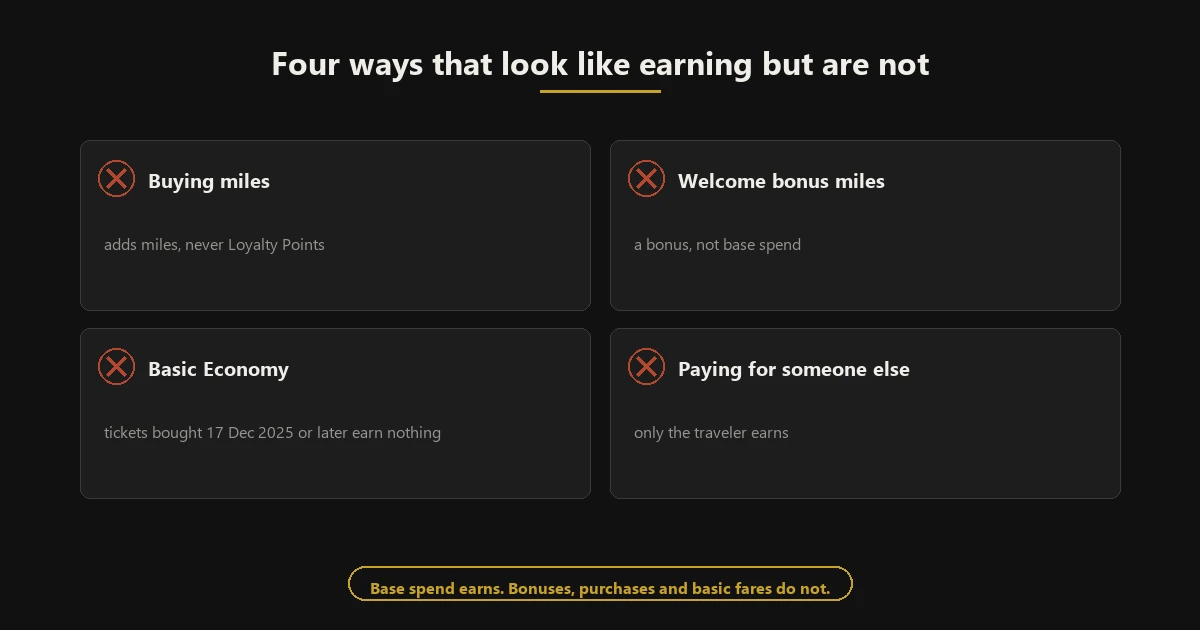
Buying, gifting or transferring miles adds miles you can spend and nothing to your status counter. The same is true of bonus miles — welcome offers, promotional bonuses and the extra miles attached to elite status all sit outside Loyalty Points. A welcome offer of 50,000 miles can look like a fast start toward Gold; in status terms it is worth nothing, because only the qualifying spend that generated it earns points.
Basic Economy is the second trap. Tickets bought on or after 17 December 2025 in Basic Economy earn no miles and no Loyalty Points, and this applies on partner airlines as well — Aer Lingus Saver fares, for example, follow the same cutoff. If your aim is to build a balance or reach a tier, a Basic Economy fare contributes zero no matter how far you fly or what you paid.
The last two exclusions are about who and where. Only the person who flies, stays or rents earns the miles and the points, so paying for someone else’s ticket does not credit your account. And a single trip can only earn in one loyalty program — if you hold both an AAdvantage number and a British Airways Executive Club number, you choose one for that trip. Holding both does not double the earn. None of these rules is obvious at the point of purchase, which is why they account for a lot of disappointed balance checks.
Tracking and missing miles
AAdvantage activity does not always post immediately. Card spending typically appears eight to ten weeks after the statement, while flights and partner activity post by the date of the activity. If a flight goes missing, you can request the miles online within twelve months of the flight date. For non-airline partners, the request goes directly to the partner rather than through American — a distinction that matters because the airline cannot credit activity it never received.
There is also a separate long-distance counter worth understanding. Million Miler status is based on flight distance on eligible American-marketed and partner-marketed flights, including tickets paid in cash or with a combination of cash and miles. Award flights booked entirely with AAdvantage miles do not qualify. Neither bonus miles nor Loyalty Points count toward Million Miler — it tracks distance actually flown, which makes it a different goal from elite status.
One final point connects earning to keeping the miles. AAdvantage miles expire after twenty-four months without qualifying activity, and almost any earn or redemption activity resets the clock; primary cardmembers of a Citi AAdvantage card are exempt while the account is open. That is a rule for the expiry guide to expand on, but it is worth knowing here because an earning plan that pauses for two years can quietly lose the balance it built.
Verdict
Earning AAdvantage miles is less about chasing flights and more about routing ordinary spending through the right channels. One eligible mile earns one Loyalty Point, so the same activity builds both your spendable balance and your status — as long as it is base activity rather than a bonus. Fly on American or oneworld, put everyday spend on a Citi AAdvantage card, and activate the shopping and dining portals before you buy. Those four habits cover most of what the program rewards.
The traps are few but costly. Buying miles, welcome bonuses, Basic Economy and paying for other travelers all fail the test in different ways, and each one is easy to count by mistake. Start with the earn channels that produce both currencies, and treat anything labelled a bonus as miles for spending only. For the full list of where those miles are worth most, continue to the best ways to use AAdvantage miles.
Last updated: 20 November 2026.
Frequently asked questions
How many ways are there to earn AAdvantage miles?
Four main channels: flights on American Airlines and partner airlines, spending on Citi AAdvantage cards, everyday activity with shopping, dining, hotel and car partners, and transfers from flexible currencies such as Citi ThankYou or Marriott Bonvoy. More than half of all AAdvantage miles come from spending rather than flying.
Do all AAdvantage miles earn Loyalty Points?
No. For every eligible mile you earn, you also earn one Loyalty Point. But bonus miles — from welcome offers, promotions or status — do not, and neither do miles from a buy, gift or transfer transaction. Only base miles from eligible activity count toward status.
How many miles do you earn per dollar on American Airlines flights?
Five base miles per qualifying dollar on American Airlines flights, before the elite bonus. Gold adds 40%, Platinum 60%, Platinum Pro 80% and Executive Platinum 120%. Government taxes and fees are excluded from the qualifying fare.
Do Citi AAdvantage cards earn Loyalty Points?
Yes. Every eligible dollar charged to a qualifying Citi AAdvantage card earns a mile and a Loyalty Point. The activity counts when it posts to the primary cardmember’s account — typically eight to ten weeks after the purchase — so late-February spending may post into the new status year.
Does Basic Economy earn AAdvantage miles?
No, not on tickets bought on or after 17 December 2025. Basic Economy fares on American and on partners earn neither miles nor Loyalty Points. If the goal is to build a balance or reach status, a Basic Economy ticket contributes nothing.
Can you earn AAdvantage miles for someone else’s flight?
No. Only the person who flies, stays or rents earns the miles and Loyalty Points. Paying for another traveler’s ticket credits their account, not yours. A trip can also earn in only one loyalty program, even if you hold numbers with two airlines.
More American Airlines guides
- AAdvantage elite status, for what the Loyalty Points you earn actually buy.
- How much AAdvantage miles are worth, and the 1.45-cent benchmark for valuing a balance.
- AAdvantage partner airlines, for the full list of where flights can earn and redeem.
- Buying AAdvantage miles, when a cash purchase makes sense — and why it does not earn status.
Audit where your ordinary spending already earns. Register for eShopping and Dining before the next purchase, check the earning rate on your next car rental, and confirm which Citi card posts to your account — then separate the base activity that builds status from the bonus miles that only spend.