AAdvantage elite status is unusual among airline programs: American Airlines lets you reach it without ever boarding a plane. Loyalty Points — not miles flown — decide every tier, and the four thresholds have not moved since 2024. This guide explains what each tier costs, how those points are actually earned, and which of the milestone rewards along the way are worth aiming for.
The short version: Gold is 40,000 Loyalty Points, Platinum 75,000, Platinum Pro 125,000 and Executive Platinum 200,000. Co-brand credit-card spending earns one point per dollar, so flying is optional. The most consequential jump is Platinum to Platinum Pro, where oneworld access moves from Sapphire to Emerald. And bonus miles from a welcome offer never count toward status — a distinction that quietly trips up a lot of people who assume every mile in their account is the same thing.
AAdvantage elite status at a glance
Before the detail, here is the frame. Four tiers, one currency, a qualification year that runs on the calendar rather than on your travel, and a set of milestone rewards stacked on top of the tiers themselves.
| Question | Short answer |
|---|---|
| How many tiers? | Four: Gold, Platinum, Platinum Pro and Executive Platinum, plus invite-only ConciergeKey with no published threshold |
| What are the thresholds? | 40,000 / 75,000 / 125,000 / 200,000 Loyalty Points — unchanged since 2024 and still the same on 20 November 2026 |
| When is the status year? | Loyalty Points accumulate from 1 March through the end of February; earned status is valid through 31 March the following year |
| Do you have to fly? | No. Co-brand card spend, shopping, dining and hotel or car partners all earn Loyalty Points at one point per eligible dollar or mile |
| Biggest trap | Bonus miles from welcome offers and promotions do not earn Loyalty Points, and Basic Economy tickets bought from 17 December 2025 earn none either |
Hold on to four numbers — 40,000, 75,000, 125,000 and 200,000 — and one idea: every one of them is counted in Loyalty Points, a currency distinct from the miles you spend on an award. Everything below expands from those. The stability of the thresholds is worth naming directly, because a program that leaves its qualification bar alone for three consecutive years is unusual, and it changes how you should plan. You are not racing a moving target, which means small, steady accumulation through everyday spending is a viable strategy rather than a consolation prize.
The four tiers
The tiers are separated by one currency, but the gaps between them are not equal. The first step is 40,000 points; the second adds 35,000; the third adds 50,000; the fourth adds 75,000. Each step buys more than the last, and the middle one — Platinum to Platinum Pro — changes your oneworld level outright.
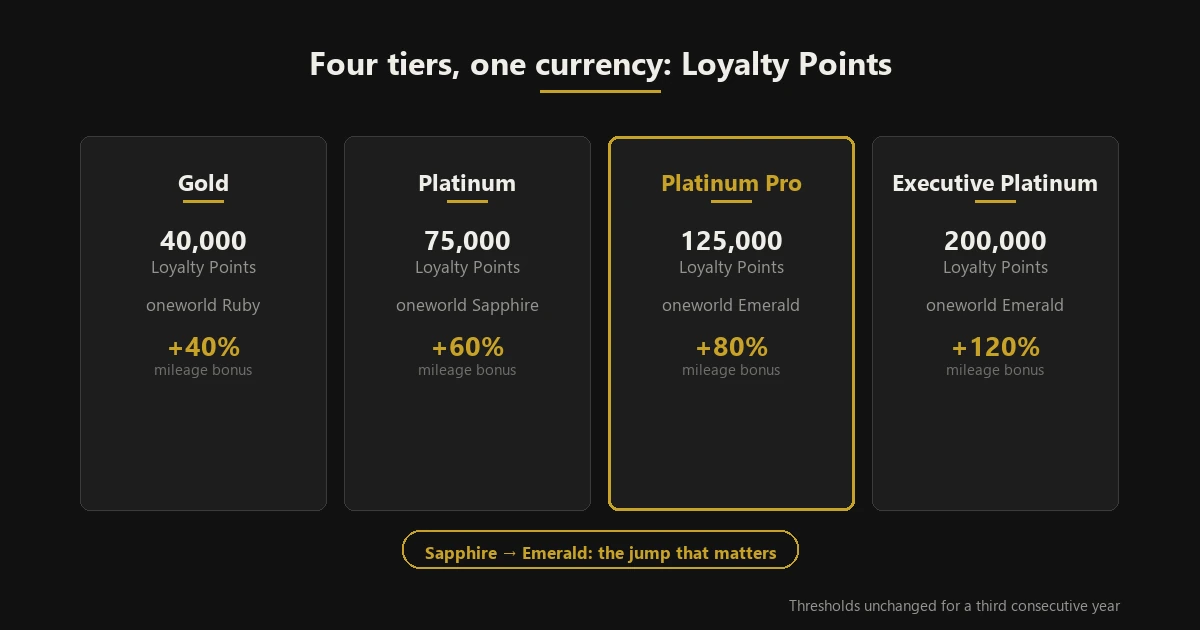
| Tier | Loyalty Points | oneworld level | Mileage bonus | Complimentary upgrade window |
|---|---|---|---|---|
| Gold | 40,000 | Ruby | 40% | 24 hours |
| Platinum | 75,000 | Sapphire | 60% | 48 hours |
| Platinum Pro | 125,000 | Emerald | 80% | 72 hours |
| Executive Platinum | 200,000 | Emerald | 120% | 100 hours |
Gold at 40,000 is the entry tier and the one most people can reach without flying much at all. It maps to oneworld Ruby, which gets you priority check-in and preferred seating but no lounge access on its own. The 40% bonus is real, and it applies to the miles you earn on eligible flights, but the practical value of Gold is often the upgrade window and the priority handling rather than the points themselves.
Platinum at 75,000 is where the program starts to feel like a full-service status. One world level up — Sapphire — brings business-class lounge access on qualifying international itineraries, and the 60% bonus plus a 48-hour upgrade window makes a noticeable difference on regular domestic travel. For most frequent travellers this is the sensible target: the points required are still achievable through a mix of spending and a moderate number of trips, and the benefits are close to those of the top tiers.
Platinum Pro at 125,000 is the tier that rewards a deliberate push. The extra 50,000 points over Platinum buy an 80% bonus, a 72-hour upgrade window, and — the important part — oneworld Emerald. That is the same alliance level as Executive Platinum, so the gap between these two tiers is much smaller in benefits than the 75,000-point gap in price suggests. If your travel is international and you value lounges and priority treatment, this is the best value step in the ladder.
Executive Platinum at 200,000 tops the published structure. It keeps Emerald status but raises the bonus to 120% and the upgrade window to 100 hours, which is the practical difference that frequent flyers notice on upgrade-clearance rates. The extra 75,000 points over Platinum Pro is a steep price for those two improvements. Above it sits ConciergeKey, which American does not publish a threshold for and which is granted by invitation; any guide quoting a points number for it is guessing.
One clarification saves a lot of confusion. The 15,000-point figure you will see in some articles is not the Gold threshold. It is the starting rung of Loyalty Point Rewards, a separate set of milestones described below. Gold remains 40,000. Conflating the two leads people to believe they have earned status when they have only unlocked a reward choice, and the two are not the same thing.
How to earn Loyalty Points
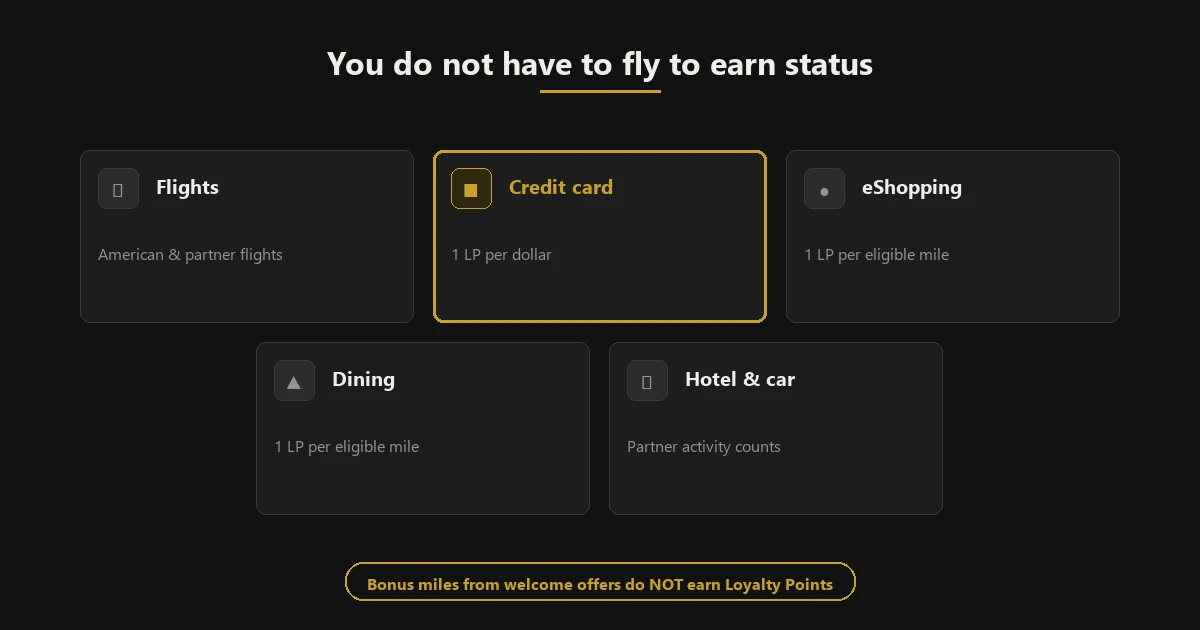
This is the part of AAdvantage that most differs from a conventional frequent-flyer program. Loyalty Points are not awarded only for distance. Five sources feed the same counter, and four of them have nothing to do with being on a plane.
On American flights, points are calculated from the qualifying fare paid, multiplied by five, then increased by your elite bonus. A Gold member therefore earns roughly seven miles per qualifying dollar, Platinum eight, Platinum Pro nine and Executive Platinum eleven. Note that the bonus sits on top of a fare-based figure and that the same flight produces both redeemable miles and Loyalty Points from one purchase — the two balances grow together, but they are tracked separately.
On partner flights the basis changes to distance and booking code rather than fare paid, though elite bonuses still apply. British Airways and Iberia are the exceptions and accrue by fare instead. The practical takeaway is the same as it is for redeeming: the fare class letter on the ticket matters more than the price, and choosing a slightly different booking code can change the status contribution of a trip.
Co-brand credit-card spending is the most reliable source, because it does not depend on travel at all. Every eligible dollar charged to a qualifying AAdvantage card produces one Loyalty Point, so a household that concentrates its ordinary spending — groceries, utilities, insurance — can accumulate tens of thousands of points over a year without stepping onto an aircraft. This is the mechanism that makes the four thresholds reachable for people who fly only a few times, and it is the single biggest reason AAdvantage status is worth considering even for a light traveller. We do not list specific cards here; the card comparison is a separate topic, and the mechanism is what matters for understanding the status ladder.
The AAdvantage eShopping and Dining programs, along with participating hotel and car-rental partners, contribute one point per eligible mile or dollar of qualifying activity. These are slower sources than card spend, but they are genuinely additive, and they are the reason a careful optimiser can close a small gap at the end of a qualification year without buying a flight.
The rule that causes the most misunderstanding is this: bonus miles are not Loyalty Points. A welcome offer, a promotional bonus or any miles labelled as a bonus land in your redeemable-mile balance and do nothing for status. If an offer advertises 50,000 bonus miles, those 50,000 do not move you toward Gold, Platinum or any Loyalty Point Rewards milestone. Only the base spending that generates the offer earns points, at the normal one-per-dollar rate. Buying miles outright has the same limitation — a cash purchase adds redeemable miles, not status credit. If you are short of a tier, confirm that an activity earns Loyalty Points before counting it, rather than assuming that a bigger mile balance means more status.
Because of that split, the miles and the points need to be valued differently. Redeemable miles have a use as currency — the working benchmark in the AAdvantage valuation guide is about 1.45 cents each — while Loyalty Points have value only as progress toward a tier or a milestone. A mile that cannot earn status is not therefore worthless; it is simply a different asset, and planning goes wrong when the two are treated as interchangeable.
Loyalty Point Rewards
Layered on top of the four tiers is a second ladder: Loyalty Point Rewards. These are milestones that unlock a choice of benefits at fixed point totals. Some are modest; two or three are genuinely valuable. The rewards do not replace status — reaching 60,000 points, for example, gives you the benefits of Gold plus a choice, even if your flight activity alone would not have qualified you for Gold.
| Loyalty Points | Status benefits granted | Worth noting |
|---|---|---|
| 15,000 | Group 5 boarding, plus one choice | The starting rung of the rewards ladder, not the Gold tier — a common point of confusion |
| 60,000 | Gold benefits, plus one choice | Choice includes Avis Preferred Plus or a 25% bonus on select-partner points, valid six months after registration |
| 100,000 | Platinum benefits | Choices include World of Hyatt Discoverist, Avis President’s Club and a 30% select-partner bonus |
| 175,000 | Platinum Pro benefits, plus one choice | Two systemwide upgrades, 20,000 bonus miles, a $250 trip credit or Hyatt Explorist are among the options |
| 250,000 | Executive Platinum benefits, plus two choices | Admirals Club membership is an option but counts as two choices, leaving only one other |
The 60,000 rung is the one most worth planning for. It grants Gold-level benefits outright and lets you choose a 25% bonus on points earned with selected partners, registered for and valid over six months. That 25% figure replaced an older 30% offer attached to a higher threshold; guides still quoting 30% at 100,000 are working from an outdated structure. If a large chunk of your spending runs through those partners, timing the registration around a heavy spending period multiplies its value.
At 175,000 the choice becomes more interesting. Two systemwide upgrades are the headline for anyone who regularly clears into a premium cabin, and the 20,000-mile and $250-credit alternatives are useful if upgrades are not realistic on your routes. The 250,000 rung tops out the published rewards, with Admirals Club access available only if you spend two of your two choices on it — a detail that matters because it leaves nothing else. Higher milestones at 400,000, 550,000, 750,000 and one million exist but are relevant to very few travellers.
A 2026 change is worth knowing about: once you qualify, you may choose your rewards at any point between the qualification date and 31 March 2027, rather than being forced to decide immediately. That removes the pressure to guess which option will be most useful before you know your next year’s travel. It does not extend the qualification period itself — only the window for claiming a reward you have already earned.
What the status actually buys
The headline benefits are the mileage bonuses and the complimentary upgrade windows, both of which scale with tier. The 40% through 120% bonuses apply to the miles you earn on eligible flights, so they compound with the fare-based accrual described above. The upgrade windows — 24, 48, 72 and 100 hours before departure — are the daily-use benefit that frequent domestic travellers notice most, because they determine how early your request enters the queue.
The oneworld levels are where the tiers differ in kind rather than degree. Ruby, attached to Gold, offers priority check-in and preferred seating but no lounge access. Sapphire, at Platinum, adds business-class lounge access on qualifying international itineraries. Emerald, shared by Platinum Pro and Executive Platinum, adds first-class lounge access and priority security where the airport provides it. The distinction is worth taking literally: a Sapphire member on a domestic United States itinerary does not automatically get a lounge merely because they hold an international-qualifying ticket, so the access rules of the specific trip govern.
Taken together, the benefits explain why Platinum Pro is often cited as the sweet spot. It reaches Emerald — the same alliance ceiling as the top tier — with 75,000 fewer points than Executive Platinum, and keeps an 80% bonus and a three-day upgrade window. The step from Platinum Pro to Executive Platinum is a refinement of the same benefits, not a new category of access.
The Basic Economy trap
One rule can erase the value of an otherwise productive trip. Tickets bought from 17 December 2025 in Basic Economy earn neither miles nor Loyalty Points, on American’s own flights and on partners. If your aim is status, a Basic Economy fare contributes nothing to the counter no matter how far you fly or how much you paid.
From 18 May 2026 the restriction widens: Basic Economy tickets purchased on or after that date also lose the complimentary upgrades and preferred or extra-legroom seating that status would normally confer. In other words, a status holder buying Basic Economy gives up the two benefits the status is largely for. For anyone working toward a tier, that makes Basic Economy a false economy — the cash saving is small next to the status progress and the upgrade chances it forfeits. Check the fare class before booking, not after, because the accrual is fixed at purchase and cannot be added later.
Verdict
AAdvantage elite status is built on a simple and unusually stable idea: four thresholds in a single currency, earned as much through spending as through flying. Gold at 40,000 is within reach of most households through ordinary card spend. Platinum at 75,000 is the balanced target. Platinum Pro at 125,000 is where the alliance benefit jumps to Emerald, and Executive Platinum at 200,000 refines the same benefits with a longer upgrade window and a bigger bonus.
The two mistakes to avoid are treating bonus miles as status progress and buying Basic Economy while trying to qualify. Both are easy to make and invisible at the point of purchase. Get those right, and the fixed thresholds mean you can plan a full year ahead with confidence rather than chasing a changing target.
Last updated: 20 November 2026.
Frequently asked questions
What are the AAdvantage elite status levels and their thresholds?
There are four published tiers: Gold at 40,000 Loyalty Points, Platinum at 75,000, Platinum Pro at 125,000 and Executive Platinum at 200,000. A fifth level, ConciergeKey, is invitation-only and has no published threshold. The four thresholds have been unchanged since 2024.
Can you earn AAdvantage elite status without flying?
Yes. Co-brand credit-card spending earns one Loyalty Point per eligible dollar, and AAdvantage eShopping, Dining and participating hotel and car partners also contribute. A household that concentrates everyday spending can reach the lower tiers with little or no air travel.
Which AAdvantage tier gives oneworld Emerald status?
Platinum Pro at 125,000 Loyalty Points and Executive Platinum at 200,000 both map to oneworld Emerald. Platinum maps to Sapphire and Gold to Ruby, so the move from Platinum to Platinum Pro is the jump from Sapphire to Emerald.
Do welcome-offer bonus miles count toward elite status?
No. Bonus miles from a welcome offer or promotion go into your redeemable-mile balance and do not earn Loyalty Points. Only the qualifying spend that generates the offer earns points, at the normal one-per-dollar rate, and buying miles outright adds no status credit either.
Is 15,000 Loyalty Points enough for Gold status?
No. Gold starts at 40,000 Loyalty Points. The 15,000 figure is the first rung of Loyalty Point Rewards, which unlocks Group 5 boarding and a choice of benefits. It is a rewards milestone, not an elite tier.
How long does AAdvantage elite status last?
Loyalty Points accumulate from 1 March through the end of February, and status earned in that period is valid through 31 March of the following year. That extra month after the qualification year ends is a benefit, not an extension of the period in which you can earn points.
More American Airlines guides
- How much AAdvantage miles are worth, and the 1.45-cent benchmark used throughout this guide.
- The best ways to use AAdvantage miles, including the premium-cabin sweet spots worth saving for.
- AAdvantage promotions, for the offers live as of 20 November 2026.
- AAdvantage partner airlines, for the full oneworld and bilateral partner list.
Next step
Pick your target tier before the qualification year starts on 1 March. Work out how many Loyalty Points your ordinary spending already produces, then decide whether the gap to the next tier is worth closing with a few extra trips — and check that any activity you count actually earns points rather than bonus miles.