Atmos Rewards partners cover more than 30 airlines and 1,000 destinations, which sounds like one of the most generous networks in travel. It is — but only if you know which partners actually give your points good value. The list splits into three very different groups: airlines you can both earn and redeem with, airlines you can only book through Alaska to earn, and transfer partners that mostly exist for topping up a balance. This guide sorts the whole list and tells you which parts are worth using.

The three tiers of partners
Not every Atmos partner works the same way. Some let you earn points and spend them; some only let you earn; and a handful let you move points in or out. The picture below is the fastest way to see the shape of the network before the detail:
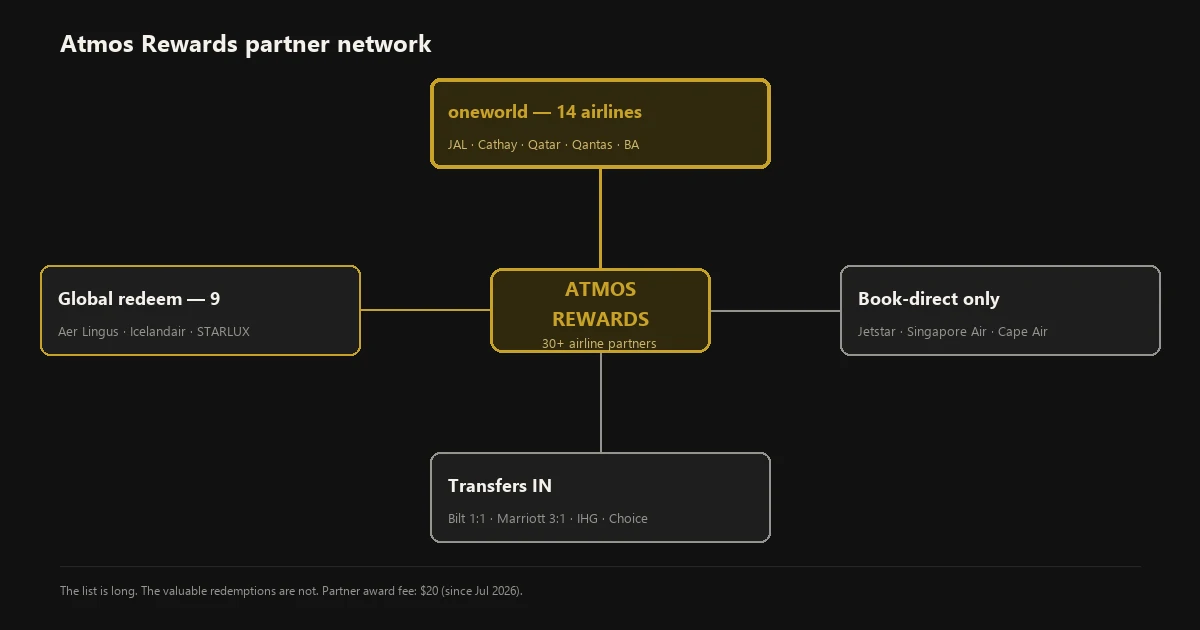
Tier one — oneworld airlines (14): earn and redeem freely, and your status is recognised as oneworld Ruby, Sapphire or Emerald. Tier two — global redeem partners (9): also earn and redeem, but without alliance status benefits. Tier three — book-direct partners: you can earn points when you fly them through Alaska or Hawaiian, but you cannot use Atmos points to book an award on them. On top of these sit the transfer partners, which move points in (useful) or out (usually not).
The practical takeaway: when someone quotes a big partner count, most of those airlines are tier three. The ones you can actually redeem with are a much shorter list, and the ones that return outsized value are shorter still.
The 14 oneworld airlines
These are the partners that behave like an extension of Alaska’s own network. You can book awards on them with Atmos points, your elite status maps to a oneworld tier, and flying them earns points and status. The full list is American Airlines, British Airways, Cathay Pacific, Fiji Airways, Finnair, Iberia, Japan Airlines, Malaysia Airlines, Oman Air, Qantas, Qatar Airways, Royal Air Maroc, Royal Jordanian and SriLankan Airlines.
For redemptions, this is where the famous sweet spots live — JAL and Cathay Pacific business class, Qatar Airways Qsuite, and Qantas long-haul. Their published starting prices are genuinely attractive, but the low-level seats are scarce, so treat them as set-an-alert deals rather than guaranteed bargains. Our guide to the best uses of Alaska miles separates the awards that still book from the ones that have become alert-only. If the seat appears but you are a few thousand points short, a top-up when buying Alaska miles can close the gap — price the bonus against the fare before you commit.
One detail worth knowing: booking a oneworld flight directly through Alaska or Hawaiian with a 027 ticket number earns points at a universal rate — 100% of miles flown in economy, and 250% in business. Booking the same flight through the operating airline can earn less, or nothing, depending on fare class. If you want the miles, book through Alaska.
The 9 global redeem partners
These airlines are not in oneworld, but you can still earn and redeem Atmos points with them: Aer Lingus, Air Tahiti Nui, Condor, Hainan Airlines, Icelandair, Korean Air, Philippine Airlines, Porter Airlines and STARLUX Airlines. No alliance status benefits apply, but several of them are excellent value on the right route.
Aer Lingus is the standout for most US travellers — a business-class award from the US East Coast to Dublin starts at a low price and is comparatively bookable. STARLUX and Korean Air are the newer premium names that draw attention, with competitive business fares on transpacific and Asian routes.
There is a catch that catches people out: Korean Air, Philippine Airlines and STARLUX only earn Atmos points when you book through Alaska, not when you buy direct from the airline. If earning matters, route the booking through Alaska. If you are short of the points for one of these awards and a bonus is running, you can buy Alaska miles during a bonus — just price the whole ticket first.
Book-direct-only partners
The longest part of the partner list is the one you cannot redeem with. These are regional and select global airlines where flying earns Atmos points, but you cannot book an award ticket using points: Aleutian Airways, Bahamasair, Cape Air, Contour Airlines, ITA Airways, Jetstar, Kenmore Air, Mokulele Airlines, Singapore Airlines and Southern Airways Express, among others. Air Tahiti and Air Rarotonga appear on the regional list as coming soon.
They are useful in two situations: filling a gap in an itinerary where Alaska itself does not fly, and adding points toward a balance you will redeem elsewhere. Singapore Airlines deserves a mention — it is a strong premium airline, but through Atmos it is effectively an earn-only partner. If your goal is a Singapore business-class seat, you will likely be redeeming a different currency, not Atmos points. For the redemption side of the equation, see what Alaska miles are worth.
Transfer partners in and out
Transfer partners are where the most mistakes happen, so keep this simple. Into Atmos, the only major bank currency that transfers at 1:1 is Bilt Rewards. Chase Ultimate Rewards, American Express Membership Rewards, Capital One miles and Citi ThankYou points do not transfer to Atmos at all — a fact that surprises people used to transferring to airlines from those programs.
Hotel points also transfer in, but the ratios are poor and should be treated as a last-minute top-up, not a source of value: Marriott Bonvoy at 3:1 (with a 5,000-point bonus per 60,000 transferred, roughly 2.4:1), IHG One Rewards at 10,000:2,000, Choice Privileges at 1,000:200, and Best Western Rewards at 5,000:1,000. Trading a flexible hotel balance for Atmos points only makes sense when you are a few thousand short of a specific award. If that is your situation, compare the transfer with simply using a buy-points offer to top up — during a bonus, buying is often cheaper than the value you surrender in a hotel transfer.
Out of Atmos, there is essentially one option: transfers to Marriott Bonvoy at 1:1. It is a bad trade. Atmos points are worth around 1.5 cents each toward award flights, while Marriott points are worth roughly 0.7 cents, so a 1:1 transfer gives away more than half the value on the spot. Treat it as an option that exists, not one you should use. Every other program that looks like an outbound partner will cost you even more.
Fees and the 2027 change
Two practical points before you book. First, awards on partner airlines carry a booking fee that was raised from $12.50 to $20 in July 2026; the exact amount shown at checkout is the one that counts, so check before you commit. The Summit Visa Infinite card waives partner award booking fees, which is one of its more useful perks if partner redemptions are your focus.
Second, from 1 January 2027, the way you choose to earn on flights — by distance, by price paid, or by segments — also applies to partner flights booked through the Alaska or Hawaiian sites and apps. That choice decides both redeemable and status points on those tickets. The details belong in our how to earn Alaska miles guide; the short version is that distance earning loses the cabin bonus and short-haul minimum, so pick deliberately. And if elite tier is the goal, remember that award travel on partners earns status points — our Atmos status guide explains how that fits into the four tiers.
Frequently Asked Questions
How many airline partners does Atmos Rewards have?
More than 30 airline partners across three groups: 14 oneworld airlines you can earn and redeem with, 9 global redeem partners that also allow redemptions, and a longer list of book-direct-only partners where you can earn but not redeem. Together they cover over 1,000 destinations.
Which credit card points transfer to Atmos Rewards?
Bilt Rewards is the only major transferable bank currency that transfers to Atmos, at 1:1. Chase, American Express, Capital One and Citi points do not transfer. Marriott, IHG, Choice and Best Western hotel points transfer in at much weaker ratios and are best used only to top off a balance.
Which Atmos airline partners are best for business class?
JAL, Cathay Pacific, Qatar Airways and STARLUX have attractive published starting prices, but low-level award seats are scarce and often need an alert. Aer Lingus to Dublin is the most consistently bookable premium award. See our guide to the best uses of Alaska miles for the current sweet spots.
Can I transfer Atmos points to Marriott?
Yes, at 1:1 — but it is poor value. Atmos points are worth about 1.5 cents each on award flights, while Marriott points are worth around 0.7 cents, so the transfer roughly halves your value. It is an option to be aware of, not one to use.
Do partner flights earn Atmos status points?
Yes. Award travel on partner airlines earns status points, and paid partner flights booked through Alaska or Hawaiian earn both points and status points at universal rates. Flights booked directly with a partner can earn less, depending on the airline and fare class.
Is there a fee to book an Atmos partner award?
Yes. Partner award bookings carry a fee that increased from $12.50 to $20 in July 2026; check the amount shown at checkout. The Atmos Rewards Summit Visa Infinite card waives partner award booking fees.