Buy Flying Blue miles and you are standing in one of two stores that happen to share a logo. One sells miles at a flat cash price, the way every airline does. The other lets you multiply miles you already flew, at a price that shifts with the multiplier you choose. In November 2026 those two stores are 1.81 cents apart on the same mile — a wider gap than any bonus either of them advertises.
That gap is the whole story here. Flying Blue miles are worth roughly 1.3 cents each when they are spent well. Only one of the two checkouts prices them below that. So the question is never whether a sale is running. It is which checkout you are at, and whether the miles land on an award that returns more than you paid.
Everything below is the current arithmetic: what each route costs, the caps that decide how many miles you can buy, and the redemptions where a bought mile still earns its keep. Check the price tiers your own account is showing as you read — these offers are targeted, so your multiplier menu may not match the one printed on this page.
The Two Checkouts, and Why They Are Not Interchangeable
Both products are run by Points.com on Flying Blue’s behalf. They are not the same purchase, and they are not priced as if they were.
| Buy & Gift Miles | Multiply Your Miles | |
|---|---|---|
| What you are buying | Straight miles, any amount you like | A multiple of miles you have already flown |
| Base price | $3.05–3.17 per mile | €1.60 per mile (about $1.86) |
| Best price seen in 2026 | 1.69¢ with an 80% bonus | €1.07 with a 50% bonus (about 1.24¢) |
| Who can use it | Any member | Only members with miles credited between 1 January and 31 October 2026 |
| Minimum purchase | 2,000 miles | 2× the miles you earned |
| Explorer limit | 100,000 miles per calendar year | 100,000 per transaction and per year |
| Elite limit | 300,000 miles per transaction | 300,000 per transaction |
| Counts toward status | No | No |
Buy & Gift is the conventional one, and the one most guides describe. It sells in 2,000-mile steps, deposits within 72 hours, and carries a public withdrawal right: you can reverse the whole purchase within 14 working days, for any reason, provided the miles are still sitting in your account.
Multiply is the odd one, and the reason this page exists. You do not choose a number of miles. You choose a multiplier — 2X, 4X, 6X, 12X or 16X — and it is applied to the miles you have already earned in a fixed window. No flights in that window means no offer: the page is simply blank for you. That single rule disqualifies a large share of readers, which is exactly why the price is good for the rest.
What a Flying Blue Mile Costs Right Now
Four prices, one mile. Three of them sit above what the mile is normally worth.
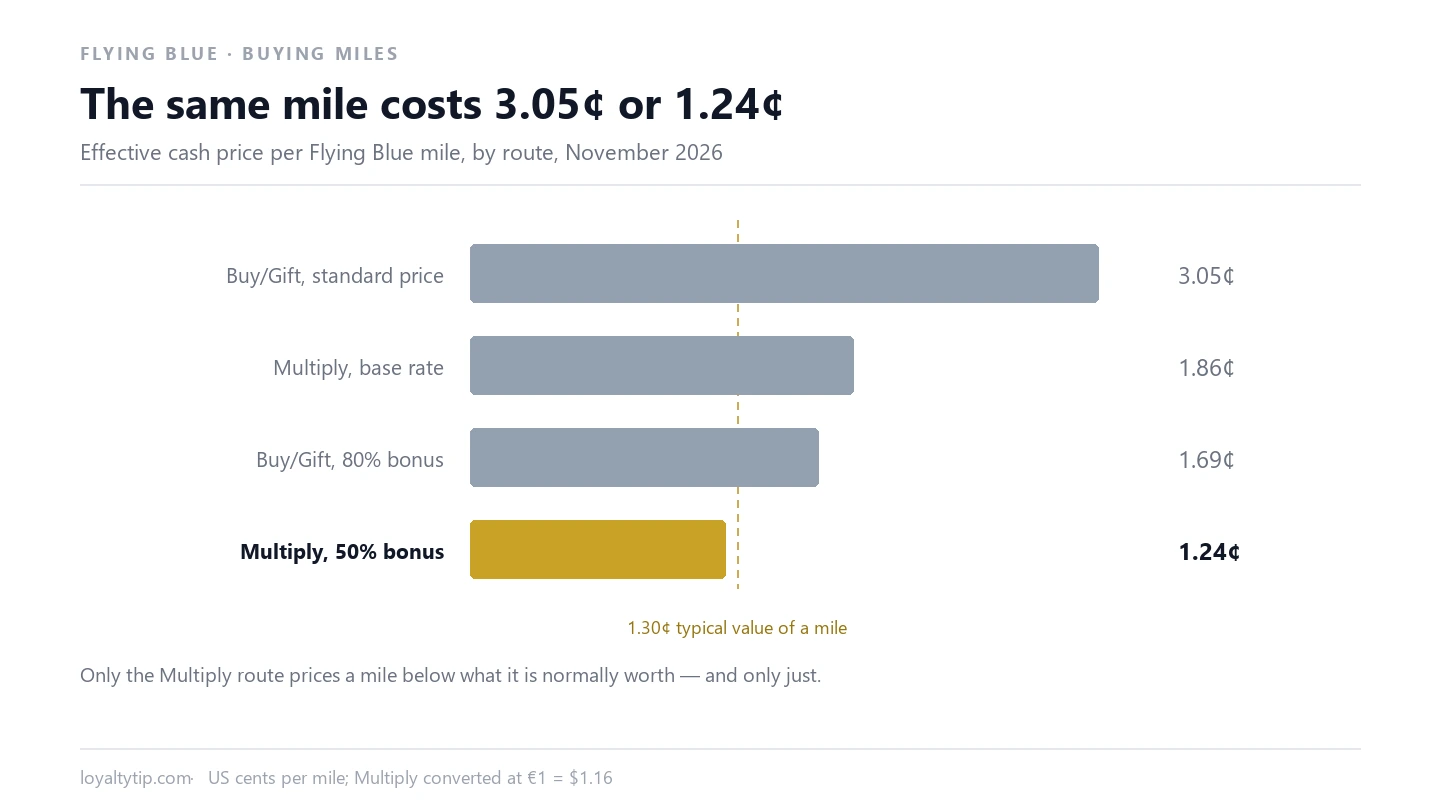
The standard Buy & Gift rate is the anchor, and it is steep: $30.50 to $31.70 per 1,000 miles. At that price you are paying more than twice what a mile is worth, which is why nobody sensible buys Flying Blue miles without a bonus attached.
An 80% bonus does most of the repair — 1.69 cents, roughly in line with the best Buy & Gift offers of the past two years. But Multiply starts lower and finishes lower. At the 16X tier with the current 50% bonus, a mile lands at €1.07, or about 1.24 cents at €1 = $1.16. That is the only one of the four below the 1.30-cent value line, and it clears it by six hundredths of a cent. This is the cheapest Flying Blue routinely gets — but “cheapest” and “cheap” are different claims.
The Multiply Offer Running Until 23 November
The current promotion is the Multiply product with a bonus stapled on, and the mechanics matter more than the headline.
| Term | Detail |
|---|---|
| Transaction window | 3–23 November 2026, 23:59 CET |
| Which miles can be accelerated | Only miles credited 1 January – 31 October 2026 |
| Multipliers available | 2X, 4X, 6X, 12X, 16X |
| Bonus by tier | Rises with the multiplier, caps at 50% on the 16X tier |
| Price at the top tier | €1.07 per mile (about 1.24 US cents) |
| Transaction limit during the offer | Raised to 1,000,000 miles, with a 500,000-mile cap on bonus miles |
| How often you can use it | Once during the promotion, and once per calendar month |
| Status credit | None — accelerated miles do not count toward tier qualification |
Two consequences follow, and both are easy to miss.
The first is that the offer is retrospective. It rewards the flying you have already done this year, which means a reader who has flown Air France or KLM since January has a menu waiting and a reader who has not has nothing. Check the page before you plan around it: if your 2026 balance came entirely from credit card transfers or hotel stays, those miles were not “earned from qualifying activity” and may not appear.
The second is that the multiplier you pick sets the price per mile, but not in the direction people expect. Every tier starts from the same €1.60 base; the bonus is what changes. So the 16X tier is not expensive because you are buying more — it is the only tier where the bonus reaches 50%, which is why the effective price is lowest exactly where the outlay is largest. If your target award needs 90,000 miles and you earned 6,000, the arithmetic points one way: buy the smaller multiplier and pay 1.86 cents, or buy the larger one, hold more miles than the award needs, and pay 1.24.
The Buy & Gift Ladder: Why 2,000 Miles Is the Worst Line on the Page
Buy & Gift is tiered by quantity, and the tiers are punitive at the bottom. Buying the 2,000-mile minimum earns no bonus at all — you pay the full $30.50-plus per 1,000 and receive exactly 2,000 miles. The 50% and 60% bands sit in the middle. The 80% band, where the product becomes vaguely defensible, has historically required a purchase of 24,000 to 25,000 miles, though some accounts report needing 50,000.
The practical rule: never buy a small top-up through Buy & Gift. If you are 3,000 miles short of an award, 3,000 miles at the full rate is the most expensive mile in the program. Buy at the top tier, take the surplus, and treat the extra as a discount on the ones you needed — a 24,000-mile purchase at 80% delivers 43,200 miles for about $730, which is only worth doing if you have plans for the remainder.
The two products also behave differently on refunds, which matters if you are buying before confirming award space. Buy & Gift gives you 14 working days to reverse the entire purchase. Multiply gives you the same window, on the same all-or-nothing basis — no partial withdrawals either way. In both cases the miles arrive within 72 hours, which is fast enough that you can search award space, buy, and ticket inside a single evening.
What the Miles Actually Buy
Flying Blue has no published award chart. What it does have is a floor price per route and cabin, and the floor is where bought miles either work or do not.
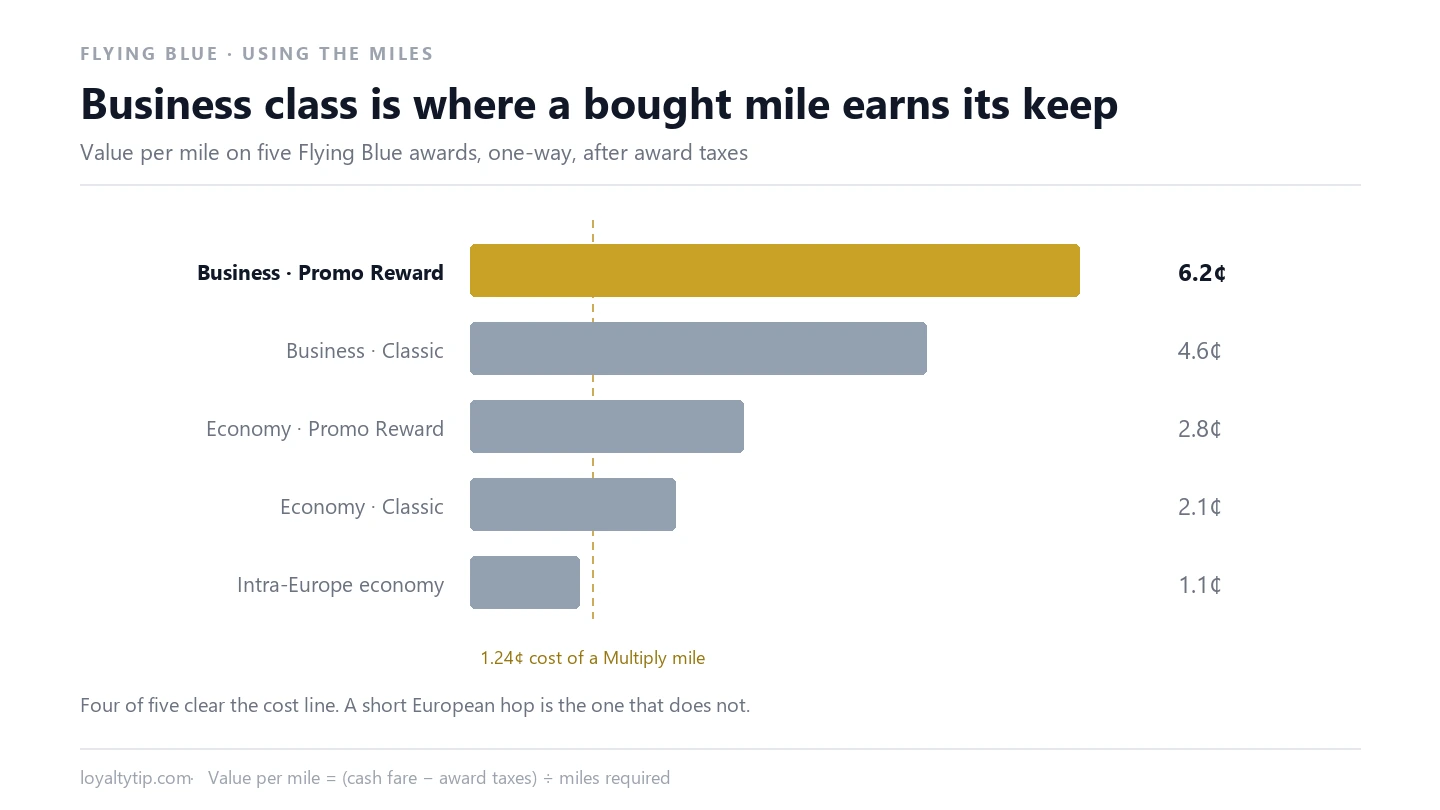
The spread runs from 6.2 cents a mile down to 1.1, and the thing that separates them is cabin, not distance. Business class across the Atlantic on a Promo Reward returns nearly six times the value of a short European economy seat — the same mile, in the same account, doing very different work.
| Route and cabin | Floor price (one-way) | Promo Reward price |
|---|---|---|
| Within Europe, economy | 8,000 miles | 6,000 miles |
| Within Europe, business | 20,000 miles | 15,000 miles |
| North America, economy | 25,000 miles | 18,750 miles |
| North America, premium economy | 40,000 miles | 30,000 miles |
| North America, business | 60,000 miles | 45,000 miles |
| Long-haul, business | 85,000 miles | 63,750 miles |
Those are floors, not quotes. Flying Blue prices dynamically, so a Tuesday in February and a Friday in July on the same route can differ by tens of thousands of miles. The floor is what tells you whether a purchase is viable at all: at 45,000 miles for a transatlantic business seat, a mile bought at 1.24 cents puts the miles portion of the ticket at $558 before taxes — against a cash fare that typically runs $2,500 to $3,000.
Award taxes are the part most comparisons skip. Flying Blue keeps them low by transatlantic standards, roughly $150 to $300 each way, with none of the fuel surcharge loading that makes British Airways awards hard to justify. That is a quiet structural advantage and one of the reasons a bought Flying Blue mile converts into a ticket more efficiently than a bought Avios.
Promo Rewards: The Discount That Makes Bought Miles Work
On the first of every month Flying Blue publishes a list of discounted routes, and this is where the value in the program concentrates. The discount runs up to 25% off the floor price, applies to Air France and KLM operated flights, and for long-haul covers one connecting flight inside Europe through Paris or Amsterdam, outbound or return.
Combining the two is the whole point. A business seat at the 60,000-mile floor becomes 45,000 during a Promo month; buy those 45,000 miles at 1.24 cents and the ticket costs $558 in miles plus taxes. Buy the same miles at the 1.69-cent Buy & Gift rate and it is $760. Same seat, same account, 26% more money — which is the practical argument for keeping your purchases on the Multiply side of the house.
Two changes landed in September 2026 that are worth knowing before you plan around a promo. The promo price is now the Light fare: no checked bag in economy or premium economy, no changes, no refunds. And the November selection books through 30 April 2027, so a November purchase can still be spent on spring travel rather than being stranded at the end of the year. Our July Promo Rewards guide walks through how a monthly drop is structured if you want the mechanics in more detail.
Buying Against Transferring
Six major currencies move into Flying Blue at 1:1, which sets a hard ceiling on what a bought mile is worth to anyone already holding transferable points.
| Source | Ratio | Notes |
|---|---|---|
| Amex Membership Rewards | 1:1 | Transfers instantly; 20–40% bonuses appear two or three times a year |
| Chase Ultimate Rewards | 1:1 | Instant |
| Capital One Miles | 1:1 | Instant |
| Citi ThankYou | 1:1 | Has run targeted bonuses, including 20% |
| Bilt Rewards | 1:1 | Instant |
| Marriott Bonvoy | 3:1 | 5,000 bonus miles per 60,000 points |
If you hold Amex points, a bought mile at 1.24 cents is competing with a transferred mile at zero — and with the 20–30% transfer bonuses Amex runs several times a year, a transferred mile can end up cheaper still. The honest sequence is: check for a transfer bonus first, transfer second, and buy only for the gap that transfer cannot cover.
Where buying wins outright is for people with no transferable currency, or with a specific award in sight and a gap too small to justify a transfer. Flying Blue is also the only route to Air France’s La Première cabin, which no partner program can book — Platinum and Ultimate members get access to it, and it is the one redemption where paying 1.24 cents a mile for the whole balance is comfortably rational.
The Caps That Decide How Much You Can Buy
Flying Blue’s limits are set by status, and they bind in ways that surprise people mid-purchase.
- Explorer members: 100,000 miles per transaction and 100,000 miles per calendar year. That annual figure counts purchases only — bonus miles on top are allowed within a promotion.
- Elite members (Silver, Gold, Platinum): 300,000 miles per transaction and no annual ceiling.
- Multiply during this offer: transaction limit lifted to 1,000,000 miles, with bonus miles capped at 500,000. Once for the promotion, once per calendar month.
- Bought miles never count toward status. They are spending currency, not progress.
- Miles expire after 24 months of inactivity. A large bought balance with no earning activity attached will evaporate.
The annual cap is the one that catches people. If you have already bought 80,000 miles this year as an Explorer, this sale can add 20,000 more — not another 100,000. Check your purchase history in the account before you count on a full tier.
How to Buy Flying Blue Miles, Step by Step
The flow is short, but the order matters because the offers are account-specific.
- Log in first. The buy-miles page shows public pricing until you are authenticated; the tiered offers only appear inside your own account.
- Find the award before the purchase. Search the route and date you actually want. Flying Blue lets you search with a zero balance, so there is no reason to buy speculatively.
- Confirm the price you are seeing. Note whether your account has been offered the bonus structure or a percentage discount — the two produce different effective prices and are not interchangeable.
- Check your remaining annual allowance if you are an Explorer member, then choose the purchase size that triggers your top tier rather than the amount you strictly need.
- Pay in the currency your account is priced in. Points.com quotes in local currencies and the totals diverge; a euro-denominated purchase and a dollar-denominated one on the same day are not the same price.
- Ticket the award inside the 14-day window. Miles post within 72 hours, and the withdrawal right stays open for 14 working days — that is your margin for error if the space disappears.
Open the Flying Blue miles page to see which of the two products your account is offering today. If the Multiply menu is empty, you have not flown enough in the qualifying window and Buy & Gift is your only route.
Every Flying Blue Buy-Miles Promotion in 2026
Flying Blue runs these constantly, which is useful: you rarely need to buy at a mediocre price, because the next offer is usually weeks away.
| Window | Offer | Effective price per mile |
|---|---|---|
| May 2026 | Up to 45% off Buy & Gift | 1.68¢ |
| June 2026 | Up to 50% bonus on purchases | 2.03¢ |
| July 2026 | Up to 80% bonus, closed 28 July | 1.69¢ |
| 27 August – 16 September 2026 | Up to 80% bonus | 1.69¢ |
| 3–23 November 2026 | Multiply at up to 16X with a 50% bonus | 1.24¢ |
Two patterns are worth internalizing. Buy & Gift has not gone below 1.68 cents all year regardless of how the offer was framed — 45% off and an 80% bonus land in the same place, because both are calculated back to the same base. And Multiply, when it appears, undercuts Buy & Gift by roughly a quarter. That is the whole reason to keep a Flying Blue account active even in years when you are not chasing status.
Frequently Asked Questions
How much does it cost to buy Flying Blue miles?
The standard price is $3.05 to $3.17 per mile, or about $30.50 per 1,000. With an 80% bonus that falls to 1.69 cents. Through the Multiply product, which lets you accelerate miles you have already flown, the price runs €1.60 at the base rate and €1.07 with the current 50% bonus — roughly 1.24 US cents.
Can I buy Flying Blue miles right now with a bonus?
Yes. The Multiply promotion runs until 23 November 2026 at 23:59 CET and stacks a bonus of up to 50% on top of the 16X multiplier tier. It is limited to miles credited between 1 January and 31 October 2026, and each member can transact once during the promotion.
How many Flying Blue miles can I buy?
Explorer members can buy 100,000 miles per transaction and 100,000 per calendar year. Silver, Gold and Platinum members can buy 300,000 miles per transaction with no annual cap. During the current Multiply promotion the transaction limit is raised to 1,000,000 miles, with bonus miles capped at 500,000.
Do bought Flying Blue miles count toward elite status?
No. Miles bought through Buy & Gift and miles added through Multiply are both excluded from status qualification, and Flying Blue states this explicitly in the offer terms. Status is earned through XP from flying and from qualifying partner activity.
Are bought Flying Blue miles worth it?
They are worth it when the award clears the purchase price. A transatlantic business seat at 45,000 miles on a Promo Reward returns around 6 cents a mile against a $3,000 cash fare; a short European economy hop at 12,500 miles returns barely 1.1 cents, which is below what the mile cost. Buy for premium cabins on discounted routes, not for short-haul economy.
What is the cheapest way to get Flying Blue miles?
A transfer bonus from Amex Membership Rewards, Chase Ultimate Rewards, Capital One, Citi ThankYou or Bilt, at 1:1 with a 20–40% boost on top, beats any cash purchase. If you have no transferable points, the Multiply product at 1.24 cents is the cheapest cash route Flying Blue offers, and it only appears for members with qualifying flight activity in the current year.
For the full list of programs that sell their miles, and what each one charges, see every official buy-points link in one place. If you are weighing a hotel purchase against an airline one, our guides to buying Marriott points and buying Hilton points use the same cost-per-point method. And if you are comparing airline currencies, United’s buy-miles pricing and American AAdvantage both sit higher per mile than Flying Blue at the Multiply rate. When you are ready to spend, buy Flying Blue miles at the current rate and confirm the tier your account is showing before you pay.