Atmos Global Concierge is Alaska Airlines’ new invitation-only status tier, and it sits above Atmos Titanium — the highest level any member could previously reach by flying. Invitations started landing in members’ inboxes on November 9, 2026, and membership runs through December 31, 2027.
There is no application form, no published qualification threshold, and no benefits page on Alaska’s website. Everything below comes from what invited members have shared publicly, cross-checked against how the three larger US airlines have run their own invite-only tiers for years.
That makes this the rare airline story where the interesting part is not the perk list. It is what the invitations reveal about who Alaska is trying to keep — and what it says that a member with 400,000 status points was passed over.
What Alaska Has Actually Confirmed
Alaska has confirmed very little, and that is deliberate. The invitation email describes Global Concierge as “our most elevated level of service” and offers two things at once: a complimentary upgrade to Atmos Titanium, and inaugural membership in the new tier.
Beyond that, the airline has not published terms, a benefits list, or a qualification standard. There is no landing page, no FAQ, and no mention in the Atmos Rewards programme terms that has been surfaced by members. When a loyalty programme launches a tier by email only, the usual reason is that it wants to keep the criteria flexible — changeable year to year without a public announcement that it moved the goalposts.
So treat everything in the next section as reported rather than guaranteed. It is what invitees have described, not what Alaska has promised in writing.
The Eight Benefits Invited Members Have Reported
The perks described so far cluster around service recovery rather than lounge access or seat inventory. Invited members have reported:
- A dedicated concierge team — reachable directly, with several members saying they were given a WhatsApp number rather than a phone queue
- Proactive itinerary monitoring — the airline watches the trip and intervenes before the member has to ask
- A next-flight guarantee — a commitment to get the member on the next available flight when something breaks
- Arrival assistance in Asia, Europe and Oceania — the three long-haul regions Alaska now serves or sells through partners
- A car transfer for tight connections at London Heathrow — specific to LHR, where a missed connection on a transatlantic arrival is the most common failure point
- Upgrade priority on global flights — ahead of the normal Titanium queue on long-haul routes
- CLEAR+ membership — the top tier of the US airport security programme, not the base CLEAR membership
- Avis Chairman’s Club — the highest published Avis loyalty tier
Some invitees also report being able to gift Atmos Gold status to another person. If that holds, it is quietly one of the more useful items on the list — Gold is oneworld Sapphire, which unlocks business class lounge access across the alliance.
Notice what is absent. No lounge membership of Alaska’s own. No extra checked baggage. No bonus earning rate. No confirmed seat upgrade certificate. This is a tier built to rescue trips, not to make the airport more comfortable.
The Four Things Nobody Knows Yet
These are the questions that determine whether Global Concierge is genuinely valuable or mostly a nice email.
1. What triggers an invitation. Alaska has not said. The reported pattern is covered below, but it is inference from a small sample, not policy.
2. The terms of the next-flight guarantee. This is the most valuable reported benefit and the least documented. A guarantee that puts you in economy on the next flight is worth far less than one that protects your cabin, or that rebooks you on another airline when Alaska has nothing. Until the terms surface, assume the weaker version.
3. Whether award availability widens. Status tiers at American, Delta and United do not unlock extra saver inventory, and nothing reported here suggests Alaska is doing anything different. If you were hoping Global Concierge makes partner business class easier to book with Atmos points, there is currently no evidence for that.
4. Whether there is a separate boarding group or security lane. Nothing reported so far. Invitees have described the same boarding process as Titanium.
On the balance of what is known, Global Concierge today looks closest to Delta 360° — a service tier rather than a perks tier. That is a sensible choice for an airline that only recently began flying its own metal to Europe and Asia and is still building out lounges and premium cabins. Service is cheaper to scale than real estate.
How Atmos Global Concierge Compares to ConciergeKey and 360
Alaska is now the fourth US airline with a tier you cannot see, qualify for, or apply to. The three that came before it have had years to define what these programmes are for.
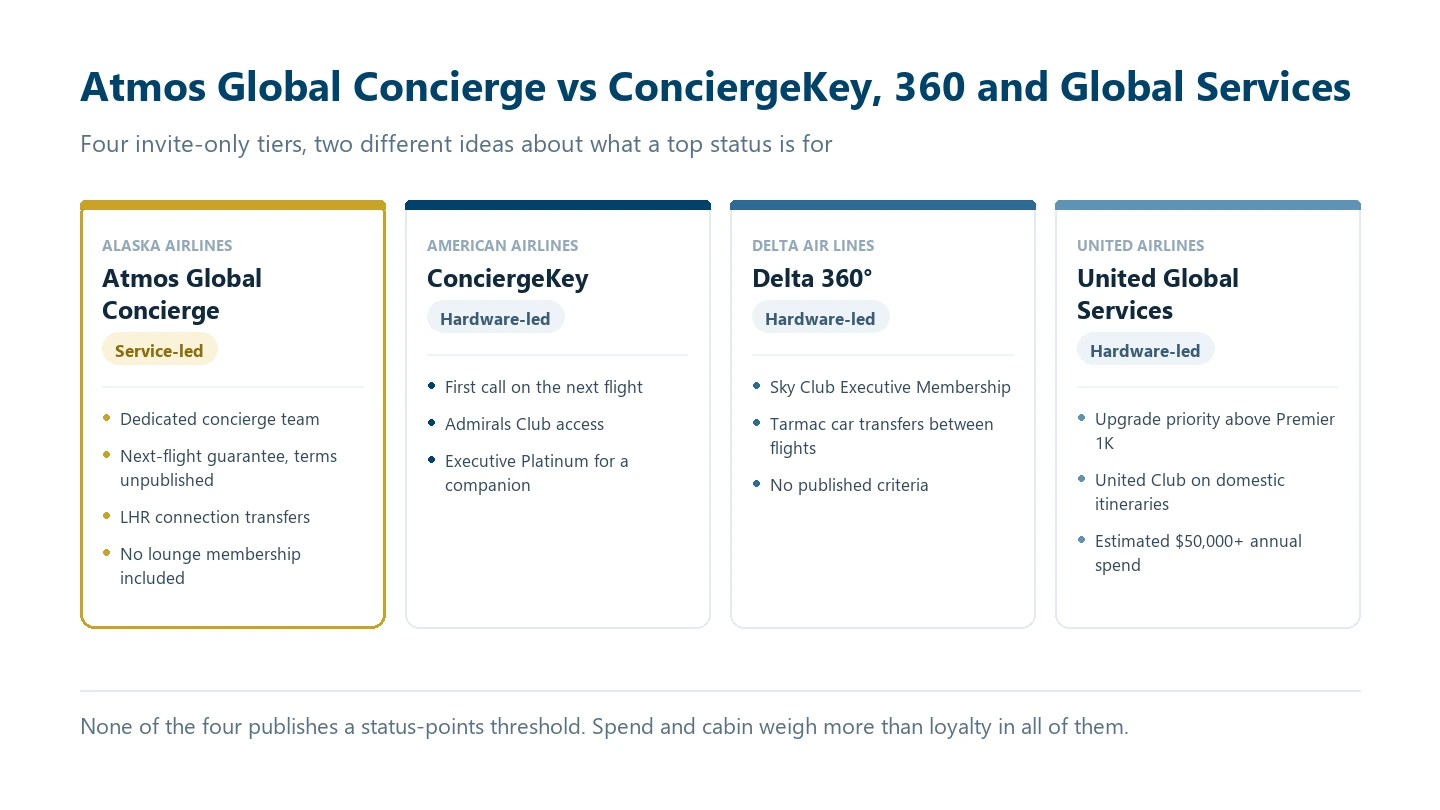
| Programme | Published criteria | What it is really for | Most concrete reported perk |
|---|---|---|---|
| American ConciergeKey | None | Keeping corporate travel decision-makers | First call on the next flight, plus Admirals Club and Executive Platinum |
| Delta 360° | None | Protecting the highest-revenue flyers | Sky Club Executive Membership, tarmac car transfers between flights |
| United Global Services | None; industry estimates put it around $50,000+ annual spend | Corporate accounts and top spenders | Upgrade priority above Premier 1K, United Club access on domestic itineraries |
| Atmos Global Concierge | None | Winning international business class buyers away from partners | Dedicated concierge team, next-flight guarantee, LHR connection transfers |
The pattern across all four is the same: none of them publishes a threshold, and all of them weigh revenue and cabin more heavily than loyalty. Status points alone do not get you into any of them.
The difference is what each airline chooses to spend money on. American and United buy loyalty with things you can hold — lounge access, a status card for a companion, a documented upgrade queue position. Alaska is buying it with attention. Whether that works depends entirely on whether the concierge team is actually good, which is the one thing no published benefit list can tell you.
The Invitation Went to Ticket Buyers, Not Mileage Runners
This is the part worth reading twice, because it contradicts how most frequent flyers think about status.
Early reports from invitees describe a consistent theme: paid international business class, not status points. One invitee had not yet reached Titanium but regularly buys last-minute business class from Seattle to Europe. Another member with more than 400,000 status points, all earned in economy, received nothing.
That is not a rounding error. It is the whole design. A member who flies 400,000 status points in the back of the plane generates a fraction of the revenue of someone who buys four walk-up business class tickets a year, even though the first member is the one with the status badge. Airlines have been solving this problem with unlisted tiers since American invented ConciergeKey, because moving the public thresholds would tell everyone exactly how little their economy flying is worth.
The practical implication, if you want an invitation: the lever is the fare class and the booking window, not the segment count. Buying expensive international premium cabin close to departure is the behaviour being rewarded. Grinding extra segments in Main Cabin is not.
Where Atmos Global Concierge Sits in the Ladder
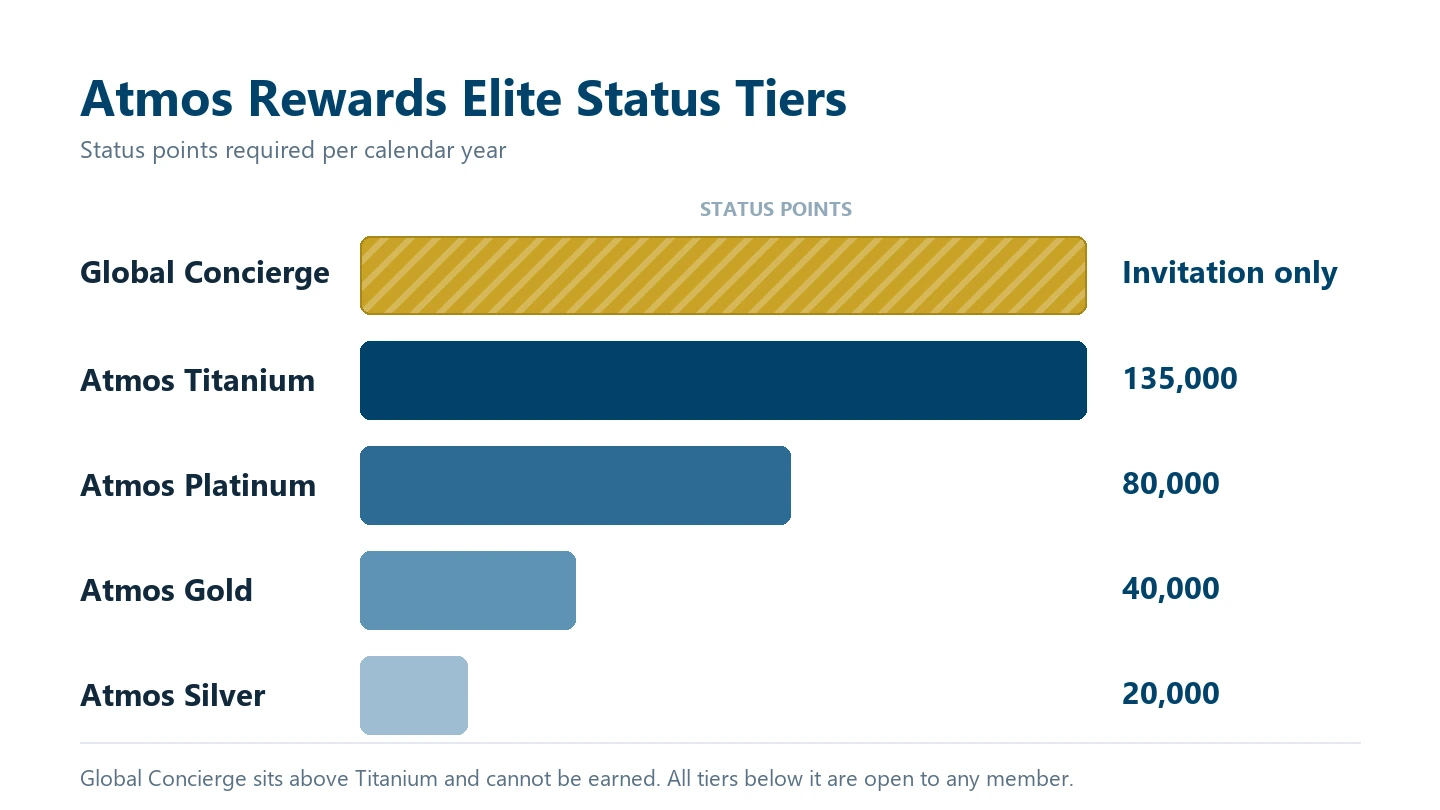
For context, here is the ladder below it — all of which is public, earnable and documented.
| Tier | Status points needed | oneworld equivalent | What changes in practice |
|---|---|---|---|
| Atmos Silver | 20,000 | Ruby | 25% points bonus, one free checked bag, upgrades 48 hours out |
| Atmos Gold | 40,000 | Sapphire | 50% bonus, two bags, business class lounge access on international flights, same-day changes free |
| Atmos Platinum | 80,000 | Emerald | 100% bonus, three bags, first class lounges, Premium Class upgrades at booking |
| Atmos Titanium | 135,000 | Emerald | 150% bonus, free meal in economy, day-of-departure business class upgrades on long-haul |
| Global Concierge | Invitation only | Not published | Concierge service and trip protection; frequently accompanied by a complimentary Titanium upgrade |
Two things stand out. First, Silver at 20,000 status points remains one of the lowest entry points of any major US airline, and Silver already gets you oneworld Ruby — priority check-in and preferred seating across the alliance. Second, the jump from Platinum to Titanium costs 55,000 more status points and buys you a free meal, a points bonus, and long-haul business class upgrades subject to availability. That is a real step up, but it is also where most members stop.
What You Can Still Do Without an Invitation
Since the tier cannot be earned, the useful question is what an ordinary Atmos member can actually move. Four levers, in order of speed.
Status match. Atmos matches elite status from Aeromexico, Air Canada, Delta, Frontier, JetBlue, Southwest and United for 90 days. To keep it past that window you need a set number of base points on Alaska or Hawaiian flights during the 90 days. It is available once per account, and the attached status must have been earned by flying rather than through a credit card or promotion. If you already hold status elsewhere, this is the fastest route into the programme.
Credit card earning. The Atmos Rewards Summit Visa Infinite carries a $395 annual fee and is the strongest status engine in the lineup: 10,000 status points every account anniversary, plus one status point per $2 spent with no cap. A cardholder who takes the anniversary bonus and then spends $20,000 more reaches Silver without boarding a plane. The Ascent and Business cards earn one status point per $3, which is slower but still uncapped.
Non-airline partners. Lyft earns one status point per dollar on base fare. CLEAR enrollment earns 500 status points. Stays booked through Alaska Vacations earn one per dollar. Atmos Rewards Shopping converts at roughly one status point per three base points. None of these are glamorous, but combined they can carry a member from zero to Silver in a year of ordinary spending.
Points, which are the one thing you can buy outright. Status points cannot be purchased — that distinction catches people out constantly. But the redeemable points you use for awards can be, and for anyone whose real goal is a premium cabin redemption rather than a status badge, buying during a bonus window is the cheapest route in. If your balance is close to a specific award, it is worth buying Atmos Rewards points against that redemption rather than against a vague future trip.
Atmos points also arrive from outside the programme. Marriott Bonvoy is the most accessible route for hotel-heavy travellers, and the conversion maths are worth understanding before you commit hotel points to an airline — our guide to transferring Marriott points to Alaska and other airlines sets out which partners pay a bonus and which do not.
The Bigger Change Arrives in January 2027
Global Concierge will touch a few thousand people. A different change, already announced, will touch every single Atmos member, and it is the one most readers should actually care about.
From January 1, 2027, Atmos Rewards stops applying a single earning formula and lets members choose one of three:
- Distance based — 1 point per mile flown
- Spend based — 5 points per dollar spent, excluding taxes and fees
- Segment based — 500 points per segment flown
Enrollment opened on October 1, 2026, and the choice can be changed once per calendar year. Members who do not choose keep earning on distance. Anyone joining on or after January 1, 2027 defaults to spend based.
This matters more than an invitation-only tier because it changes who the programme rewards. Under distance earning, a cheap long-haul economy ticket is the best value per dollar. Under spend earning, the same money spent on a short expensive business class trip earns more. For anyone flying Seattle to Tokyo in economy, distance remains the right choice and is worth locking in deliberately rather than by default. For anyone buying premium cabin on short routes, spend based will beat it.
The airline has also been rolling out Atmos Communities — themed membership groups including Global Locals, Families on the Go, Culinary Journeys and Active Escapes — with benefits described as free bags, exclusive fares and bonus point challenges. These opened in October 2026 and sit alongside the existing Club 49 for Alaska residents and Huaka’i by Hawaiian for Hawaii residents.
Frequently Asked Questions
How do you apply for Atmos Global Concierge?
You cannot. There is no application, no nomination form, and no published criteria. Invitations are issued by Alaska directly, and the airline has not said what triggers one. Based on early reports, paid international premium cabin flying appears to matter more than status points.
Is Global Concierge higher than Atmos Titanium?
Yes. Titanium at 135,000 status points is the top tier anyone can earn through flying or spending. Global Concierge sits above it and requires an invitation. Several invitees received a complimentary upgrade to Titanium at the same time, which suggests the two are being granted together rather than sequentially.
Does Global Concierge unlock better award availability?
There is no evidence of it. Nothing reported by invitees mentions expanded saver inventory or partner award access, and the equivalent tiers at American, Delta and United do not work that way either. If award availability is your goal, the lever is booking early and being flexible, not holding a service tier.
Can I buy Atmos Rewards points to reach Global Concierge?
No, and this is the most common misunderstanding. Purchased points are redeemable points, used for awards. Status points are a separate currency earned through flying, credit card spend and partner activity, and they cannot be bought. Buying points will get you a premium cabin award; it will not move you up the status ladder. If a redemption is what you actually want, though, topping up your Atmos balance during a bonus window is far cheaper than paying cash for the same seat.
What happens to Global Concierge after December 31, 2027?
Alaska has not said. Membership is stated as running through the end of 2027. Whether it renews, gets re-evaluated, or converts into something else has not been published — which is consistent with how these tiers are usually run, and a reason not to build a travel strategy around it.
The Bottom Line
Global Concierge is a real tier and a genuine signal, but it is not something most travellers can act on. If you were invited, the two benefits worth testing early are the concierge response time and the next-flight guarantee, because those are the ones with no published terms and the ones that decide whether the tier is worth anything.
If you were not invited, the ladder below it is unchanged and still unusually reachable — Silver at 20,000 status points is one of the lowest entry bars in the US industry, and the Summit card alone can carry a member there. And if what you actually want is the premium cabin rather than the badge, the most direct route is still points, bought deliberately against a specific award during a bonus window. You can check the current Atmos points price before you decide whether a top-up or a cash fare makes more sense for the trip in front of you.
For more on the programme itself, see our guide to buying Atmos Rewards miles, our Alaska Airlines promotions hub, and the Atmos Rewards elite status guide.