The Radisson Rewards award chart is the thing many people look for before redeeming points — and the honest answer is that the international programme no longer has one. Since October 2022 there has been no category table, no fixed price for an award night, and no calendar of off-peak dates. Points simply reduce the cash price of a room, so the number you need rises and falls with the rate you would otherwise pay. This guide explains how that pricing works and what it means for the value of your points.
Short version: there is no chart to memorise and no sweet spots to hunt. You can pay with as few as 10 points, choose how much of the bill points cover at checkout, and get roughly 0.15 to 0.22 cents per point depending on how much you cover. Online redemptions cap at 600 dollars per night, with the rest payable at the hotel. The Americas are a different programme — Radisson hotels there belong to Choice Privileges, which does use a category chart.
Because value is tied to the cash rate rather than a fixed table, buying points speculatively rarely works. The official points price is around 0.59 to 0.70 cents each, well above what redemptions return, so points are best earned through stays and spent rather than stockpiled.

Is there a Radisson Rewards award chart?
No, not for the international Radisson Rewards programme. Before October 2022 the scheme had a fixed award chart with set prices by hotel category, which created clear sweet spots and meant a points price could be planned months ahead. That was removed when Radisson moved to revenue-based redemptions, a model similar to the one Accor Live Limitless uses. There is now no published table of points prices, no separate award inventory, and no concept of an award night that is distinct from a paid booking.
What you will find online are unofficial charts and screenshots. These are either leftover data from the old system, estimates assembled by third-party sites, or tables for a different programme entirely. Treat them as illustrations at best. The only binding price is the one the booking screen shows for your chosen hotel, date and room, and that price changes as the cash rate changes.
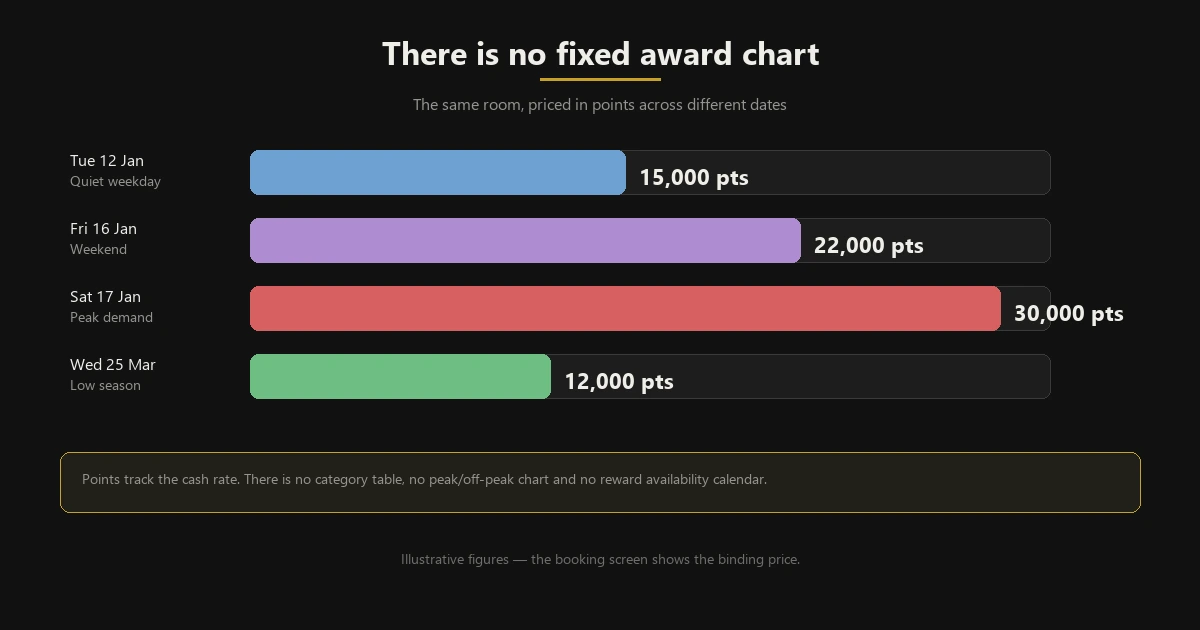
How dynamic pricing works
In practice you make a normal cash booking and then decide how much of it to cover with points. At checkout you choose any number of points from 10 upward, and the system converts them into a cash discount against the room rate. You are not redeeming for a specific award product; you are applying points to a price that already exists. The hotel, date and room type all affect that price, as they would for a cash guest.
The consequence is that the same room can cost very different numbers of points on different nights. A quiet weekday in a low season might be covered for a modest balance, while a busy weekend in a peak city can consume far more. There is no way to game a category boundary or find a property that is underpriced relative to its tier, because tiers no longer exist. If you want the detail on typical cent-per-point returns by redemption type, our Radisson points valuation guide breaks down the numbers.
What points are worth per dollar
Because points offset a cash rate, the return per point depends on how much of the bill they cover. Covering the whole room with points gives the highest rate, roughly 0.20 to 0.22 cents per point. A large partial payment lands around 0.17 to 0.20 cents, and a small partial payment around 0.15 to 0.17 cents. The spread is modest, and it is the reason Radisson points are often described as a fixed-value currency rather than one with redeemable upside.
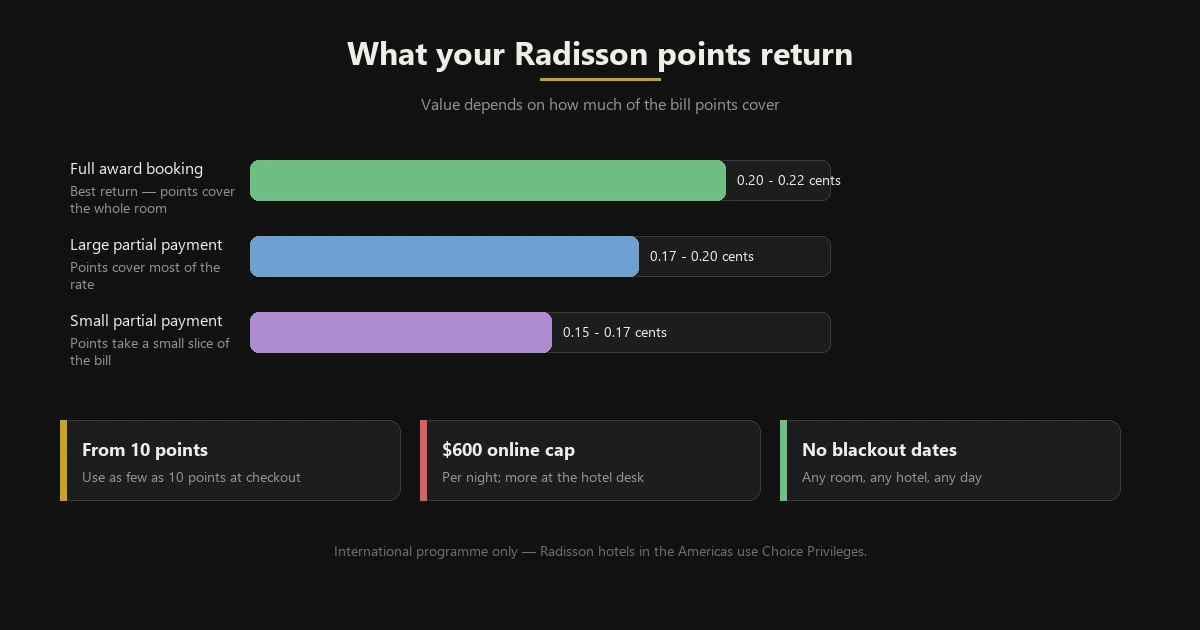
That structure has one genuine advantage: you can book any room type, including suites, and redeem at any hotel where points are accepted, because you are discounting a cash booking rather than drawing from a limited award pool. It also means there is little reason to hoard. A balance earns a small, predictable discount and will not suddenly become a high-value luxury award. If you are short of a specific booking, check the price of buying points and compare it with that discount before you decide — the numbers rarely justify a top-up.
| Redemption | Typical return per point | Comment |
|---|---|---|
| Full award booking | 0.20 – 0.22 cents | Highest return; covers the whole room |
| Large partial payment | 0.17 – 0.20 cents | Points cover most of the rate |
| Small partial payment | 0.15 – 0.17 cents | Points take a small slice of the bill |
| Transfer to Avios | Variable, generally lower | 10 points to 1 Avios via Finnair Plus |
Limits: 10 points, 600 dollars and blackout dates
Several practical rules are worth knowing. You can use as few as 10 points toward a booking, which makes it easy to clear a small balance or keep an account active. Online redemptions are capped at the equivalent of 600 dollars per night; if the cash rate is higher and you want to cover more of it with points, the remaining points can be used at the hotel checkout desk. Points can also pay for eligible charges during a stay, deducted from the bill at the front desk.
There are no blackout dates and no separate award availability, because any bookable room can be paid for partly or wholly with points. One important limit is geographic: this flexible redemption model applies to the international programme. Radisson hotels in the Americas are run under Choice Privileges, where points and status do not cross over and a traditional category chart still applies. Stays booked through third-party sites do not earn points in the first place, so the redemption question never arises for those bookings.
The Americas exception: Choice Privileges
If you are comparing Radisson programmes, the distinction matters. Radisson Rewards covers Europe, the Middle East, Africa, Asia-Pacific and Brazil, and has no award chart. Radisson Rewards Americas was folded into Choice Privileges in July 2023, and that programme uses category-based award pricing with off-peak, standard and peak levels. Points and elite status do not transfer between the two. An article quoting a four-category Radisson chart is almost certainly describing the Americas side, not the international programme this site covers.
For travellers based in the United States, the practical takeaway is that Radisson points earned in the Americas are Choice Privileges points, redeemed on Choice terms. For everyone earning in the international programme, the absence of a chart means value is steady and unspectacular — which is why the strategy is to earn on stays you were going to make anyway and redeem promptly. The best way to use Radisson points sets out where that return is highest.
Verdict: how to redeem without a chart
The lack of an award chart is not a loophole to exploit; it is the defining feature of the programme. There are no sweet spots, no off-peak bargains and no reason to wait for a particular hotel to drop into a lower category. There is also no risk that a chart devaluation will quietly halve the value of a balance you were saving, because the value is tied to cash rates and stays within a narrow band.
The sensible approach is to treat Radisson Rewards points as a modest discount on future stays. Cover the full room when the rate is low and your balance is healthy, use a partial payment otherwise, and redeem before points sit idle for too long. For the mechanics of earning enough to matter, start with the guide to earning Radisson points; for the wider context, the promotions hub tracks what is currently worth booking.
Next step: price a stay you already want on the Radisson site, toggle points at checkout and read the cents-per-point figure directly. If it is below the 0.15-cent floor, keep the points for a pricier night instead. If you need a small top-up, compare the official purchase price with the discount you would receive first.
Frequently Asked Questions
Is there a Radisson Rewards award chart?
No. The international Radisson Rewards programme removed its award chart in October 2022 and now uses revenue-based pricing. Points offset the cash rate of any bookable room, so the points required change with the price of the stay. Any chart you find online is unofficial, outdated, or belongs to a different programme.
How many points do I need for a free night at Radisson?
There is no fixed number. You can apply from 10 points up to the full cash value of a room at checkout, so a free night costs whatever that room’s rate converts to in points. Online redemptions are capped at the equivalent of 600 dollars per night; higher balances can be used at the hotel desk.
Are there blackout dates or award availability limits?
No. Because you are discounting a cash booking rather than using a separate award inventory, any room you can book can generally be paid for with points. You can also redeem for higher room categories, including suites, which many programmes with award charts restrict.
What are Radisson points worth per point?
Roughly 0.15 to 0.22 cents when redeemed against a room. Covering the entire rate gives the highest value at about 0.20 to 0.22 cents; a small partial payment returns closer to 0.15 cents. With no award chart, these figures move only with the cash rate, not with hotel category.
Do Radisson points expire?
Yes, after 24 consecutive months with no qualifying activity. An eligible stay, a redemption, or buying or gifting points resets the window; the terms effective 6 October 2026 say transfers do not count. See our dedicated expiry guide for the full rules and the cheapest ways to keep a balance alive.
Is the Radisson award chart the same in the Americas?
No. Radisson hotels in North, Central and South America belong to Choice Privileges, which uses a category-based award chart with off-peak, standard and peak pricing. Points and status do not move between that programme and the international Radisson Rewards described here.
More Guides
- Buy Choice Privileges points, the full price ladder, the 2026 promotion calendar and the rule that decides whether to buy now or wait.
- Radisson Rewards promotions, the live offers and which are worth booking.
- How much Radisson points are worth, the valuation behind the 0.3-cent benchmark.
- The best ways to use Radisson points, redemptions ranked from strongest to weakest.
- How to earn Radisson Rewards points, stays, partners and the Louvre Hotels channel.
- Do Radisson points expire, the 24-month rule and why transfers do not reset it.
- Marriott Bonvoy promotions, live offers and how Bonvoy points compare.
Last updated 23 November 2026.