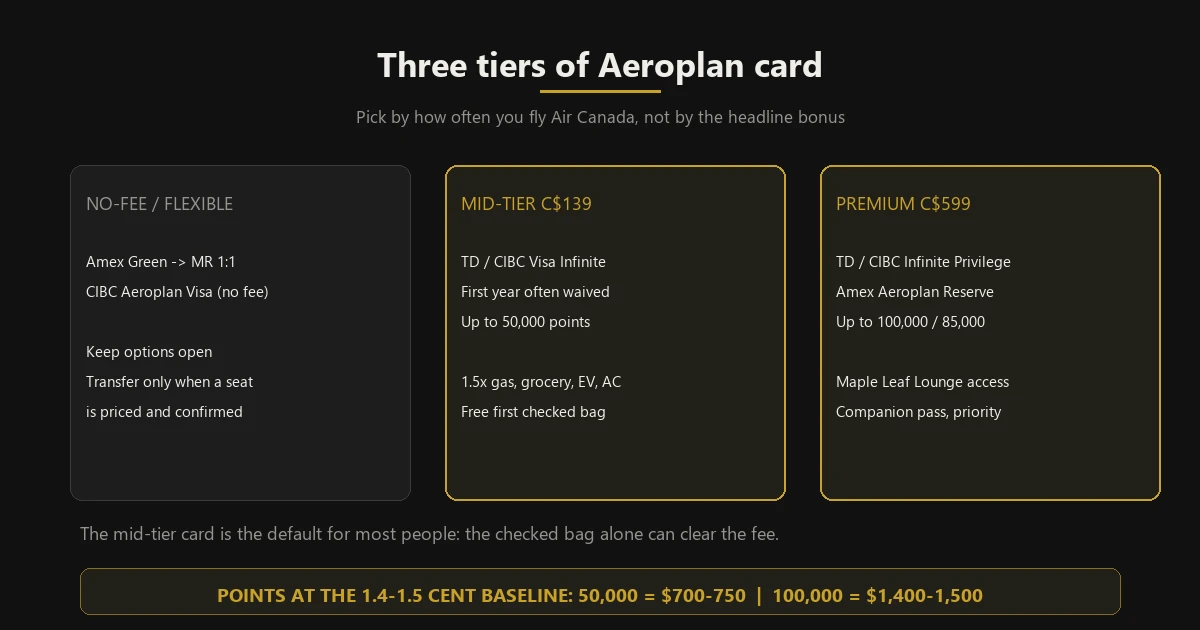
Aeroplan credit cards come in three tiers in Canada, plus one US option, and the right choice depends almost entirely on how often you fly Air Canada. Mid-tier cards around C$139 suit most people; premium cards at C$599 only pay back for frequent flyers; and a no-fee flexible card can be enough if you transfer points only when you have a specific award in mind. This guide compares the line-up and the perks that are not in the headline bonus.
The short version: the primary cardholder of any TD, CIBC or American Express Aeroplan card is permanently exempt from the 18-month expiry rule that returns on 30 November 2026 — supplementary cardholders are not. Premium cards also generate up to 25,000 Status Qualifying Credits a year. Before the welcome bonus, decide whether you will actually meet the spending requirement.

The card line-up at a glance
Canadian Aeroplan cards are issued by TD, CIBC and American Express. Each bank offers a mid-tier and, except for CIBC’s basic product, a premium card. All earn Aeroplan points directly, which means the points do not expire while you hold the primary card and can be redeemed without transferring anything first.
| Card | Annual fee | Headline bonus | Best for |
|---|---|---|---|
| TD Aeroplan Visa Infinite | C$139, often waived in year one | Up to 50,000 points | Everyday holders who check a bag |
| CIBC Aeroplan Visa Infinite | C$139 | Up to 50,000 points | Same case, CIBC clients |
| Amex Aeroplan Card | C$120 | Lower bonus than premium | Amex users wanting mid-tier perks |
| TD / CIBC Visa Infinite Privilege | C$599 | Up to 100,000 points | Lounge access and elite-style service |
| Amex Aeroplan Reserve | C$599 | Up to 85,000 points | Frequent Air Canada flyers |
Mid-tier: the default choice
The TD and CIBC Aeroplan Visa Infinite cards are close to identical. Both charge C$139 a year, both earn 1.5 points per dollar on gas, EV charging, groceries and Air Canada purchases up to C$80,000 a year, and 1 point elsewhere. Both include a free first checked bag when your trip starts on Air Canada, and both ask for C$60,000 personal or C$100,000 household income.
The welcome offers reach about 50,000 points: 10,000 on the first purchase, 15,000 after C$3,000 in 90 days and a one-time 25,000 anniversary bonus after C$12,000 in 12 months, though the exact structure differs between the two banks. At our 1.4 to 1.5 cent baseline, 50,000 points are worth roughly C$700 to C$750 — enough to clear the fee several times over in year one.
Because they come from different issuers, you can hold both bonuses over time. Pick the card from the bank you already use, or chase whichever has the better fee waiver this quarter. The first checked bag alone is worth around C$35 each way, so two round trips a year largely justify the fee.
Premium cards
The C$599 tier exists for people who will use its travel perks, not for points alone. TD and CIBC Visa Infinite Privilege cards offer unlimited Maple Leaf Lounge access, priority boarding and baggage, an annual round-trip companion pass with conditions, a partial NEXUS application rebate and elevated earn rates — 2 points per dollar on Air Canada and at participating Hyatt properties, 1.5 on travel and dining, and 1.25 elsewhere.
The Amex Aeroplan Reserve is the premium Amex option at the same C$599 fee. Its current offer reaches 85,000 points: 70,000 after C$7,500 in the first three months and 40,000 after a further C$2,500 in month 13, depending on the version of the offer. It earns 3 points per dollar on Air Canada, 2 on Canadian dining, food delivery and Hyatt stays, and 1.25 on everything else, with lounge access and an annual companion pass.
Do the arithmetic before applying. A C$599 card needs to return roughly C$600 a year in lounges, bags, priority service and bonus points to break even. If you fly Air Canada twice a year, the mid-tier card is the better answer.
No-fee and flexible alternatives
You do not need an Aeroplan card to collect Aeroplan points. The CIBC Aeroplan Visa has no annual fee, and flexible-points cards such as the Amex Green Card earn Membership Rewards that transfer to Aeroplan at 1:1. This route suits someone who books an award occasionally: keep the flexible currency until you have found a seat and priced it, then transfer exactly the points required.
The trade-off is that a flexible card does not give you expiry immunity or Aeroplan-specific travel perks. With the 18-month inactivity rule returning on 30 November 2026, a no-fee Aeroplan card or any small qualifying activity is worth keeping alongside it.
The US Chase Aeroplan card
In the United States, Chase issues the Aeroplan card. Its welcome offer can reach 115,000 points — 75,000 after $4,000 in the first three months and 40,000 after $20,000 in the first twelve. The standout benefit is a 15% discount on Air Canada award redemptions, including itineraries on partner airlines as long as one segment is operated by Air Canada. Household members can use the discount when one person in the account holds the card.
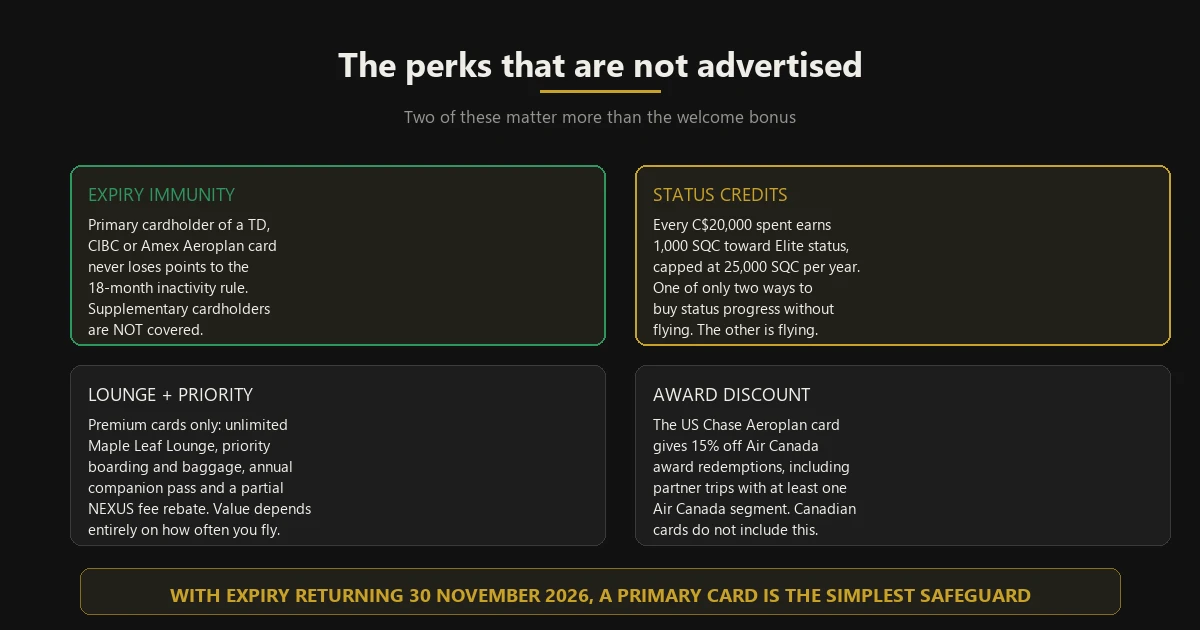
That discount is not available on Canadian-issued cards, which is the main reason a US-based reader would choose Chase over a domestic flexible-points card.
Expiry immunity and status credits
Two benefits matter more than the welcome bonus for most holders. First, being the primary cardholder of a TD, CIBC or American Express Aeroplan card gives permanent immunity from the 18-month inactivity rule. This is the single simplest way to protect a balance now that expiry resumes on 30 November 2026. Supplementary cardholders do not receive the exemption — the primary account holder does.
Second, Aeroplan cards generate Status Qualifying Credits. Every C$20,000 of spending earns 1,000 SQC, up to 25,000 SQC a year, which is the same annual ceiling that bank cards can reach. For someone close to a tier threshold, that is a meaningful shortcut in the SQC-only status system introduced on 1 January 2026.
Which card to choose
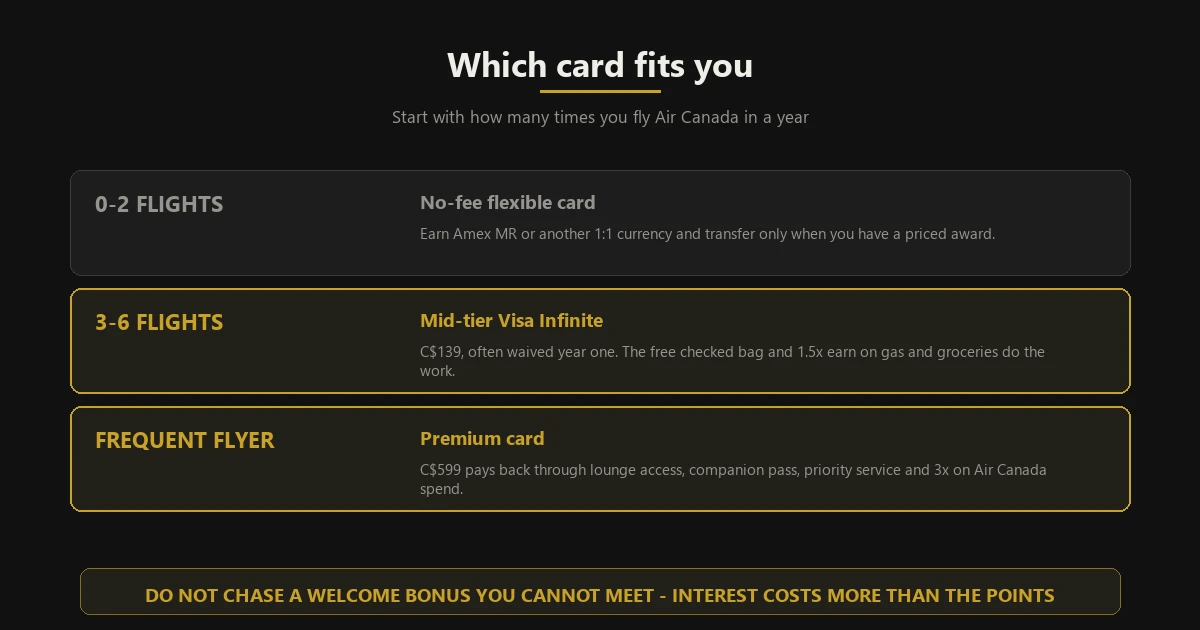
If you fly Air Canada zero to twice a year, keep a no-fee flexible card and transfer points only when you have a specific award. If you fly three to six times and check a bag, the C$139 Visa Infinite is the default. If you fly frequently and would use a lounge, the C$599 premium tier can pay back through access, the companion pass and priority handling.
One final rule: never carry a balance to earn points. Interest charges in a single month will exceed the value of a welcome bonus, and the points are not worth the cost. All figures here are as of 22 November 2026; confirm the current offer and fee waiver before you apply.
Frequently asked questions
Which Aeroplan credit card is best in Canada?
For most people, the TD or CIBC Aeroplan Visa Infinite at C$139 is the best balance of fee, earn rate and the free checked bag. The C$599 TD or CIBC Infinite Privilege and the Amex Aeroplan Reserve suit frequent Air Canada flyers who will use lounge access and the companion pass.
Does an Aeroplan card stop points from expiring?
Yes, if you are the primary cardholder of a TD, CIBC or American Express Aeroplan card. You are permanently exempt from the 18-month inactivity rule that resumes on 30 November 2026. Supplementary cardholders are not covered.
Can Aeroplan cards help with Elite status?
Yes. Every C$20,000 spent earns 1,000 Status Qualifying Credits, up to 25,000 SQC per year. That matters under the SQC-only system introduced on 1 January 2026, where tiers are set entirely by credits.
Is the C$599 premium card worth it?
Only if you use the perks. Unlimited Maple Leaf Lounge access, priority boarding and baggage, an annual companion pass and higher earn rates can justify the fee for a frequent flyer. Two or three trips a year rarely will.
Can I hold both the TD and CIBC Aeroplan cards?
Yes. They are issued by different banks, each with its own application waiting rules, so you can earn both welcome bonuses over time. Choose the one from your existing bank first, then consider the other when you can meet a new minimum spend.
Do I need an Aeroplan card to earn Aeroplan points?
No. Flexible cards whose points transfer at 1:1 — Amex Membership Rewards, Chase Ultimate Rewards, Capital One Miles, Bilt and Rove — can build a balance without a co-branded card. The trade-off is no expiry immunity and no Air Canada travel perks.
More Aeroplan Guides
- Aeroplan promotions, what is live and which offers are worth taking.
- Do Aeroplan miles expire, the 18-month rule and who is exempt.
- Aeroplan Elite Status, the 2026 SQC tiers and benefits.
- How to earn Aeroplan points, bank transfers, hotel ratios and routing traps.
- How much are Aeroplan points worth, the 1.4 to 1.5 cent baseline.
- Aeroplan award chart, the two pricing systems and current bands.
Last updated: 22 November 2026. Fees and welcome offers change frequently; confirm the current terms with the issuer before applying.