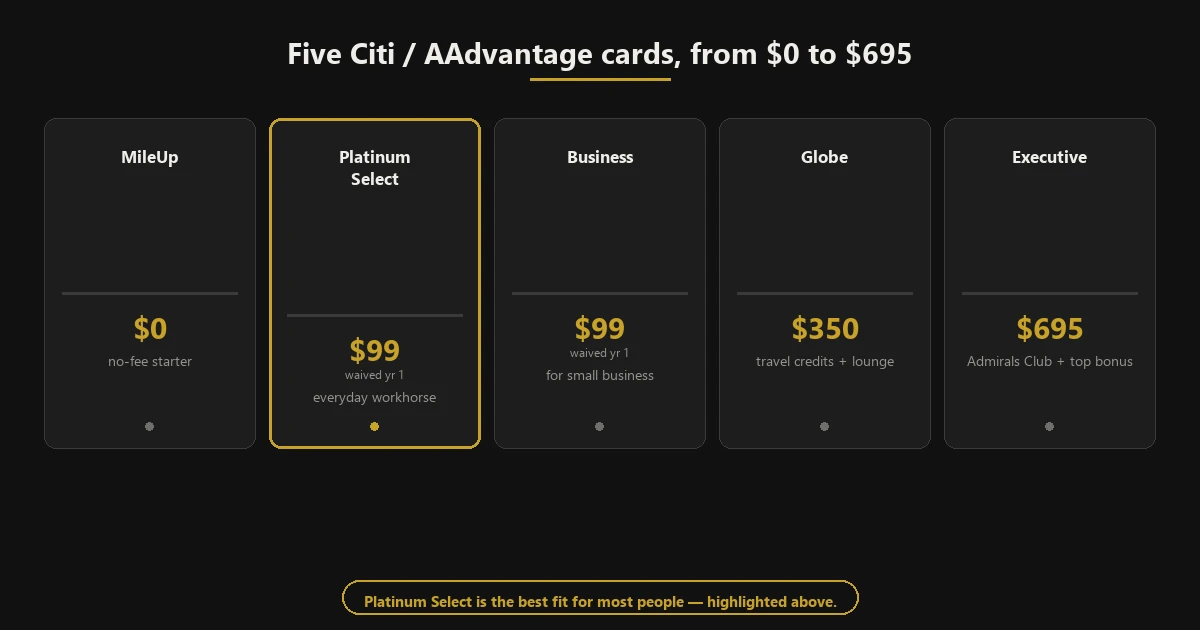
AAdvantage credit cards are issued solely by Citi, and there are five of them — from a no-fee starter card to a $695 club membership card. Which one is worth it comes down to a simple question: how much will you actually spend on American Airlines and everyday categories? This guide compares all five on annual fee, welcome offer, earn rates and the perks that justify the higher fees, then tells you which card fits which kind of traveler.
The short version: most people do best with the Platinum Select — a $99 fee that is waived the first year, plus a welcome offer in the 50,000 to 80,000 mile range. The free MileUp is the easiest way to keep a balance alive. The $695 Executive only makes sense if you fly enough to use an Admirals Club membership. Welcome offers change often, so treat the figures here as a 2026 snapshot and confirm the current terms on citi.com before you apply.

AAdvantage credit cards at a glance
All five cards earn AAdvantage miles, and every eligible mile you earn also produces one Loyalty Point toward status — a detail covered in full in the earn miles guide. The differences are the annual fee, the welcome offer and the category bonuses.
| Card | Annual fee | Welcome offer (2026 snapshot) | Best for |
|---|---|---|---|
| MileUp | $0 | 15,000 miles + $100 statement credit after $500 in 3 months | No-fee starter, keeping miles alive |
| Platinum Select | $99, waived year 1 | 50,000–80,000 miles after $2,500–$3,500 | Most everyday travelers |
| Business | $99, waived year 1 | 65,000 miles after $4,000 in 4 months | Small business owners |
| Globe | $350 | 60,000 miles after $4,000 in 3 months | Frequent travelers who use travel credits |
| Executive | $695 | 80,000–125,000 miles after $8,000–$15,000 | Travelers who want Admirals Club access |
Welcome offers are the most volatile number on this table. Citi regularly runs limited-time versions alongside standard ones, and the Executive figure in particular has appeared at both 80,000 and 125,000 miles. Read the range as a guide, not a promise, and check the live offer on citi.com at the moment you apply. All figures were last checked on 20 November 2026.
Why these are all Citi cards
American Airlines issues no cards of its own — Citi is the exclusive issuer of AAdvantage-branded credit cards. Barclays, which had long offered the Aviator AAdvantage cards, completed its exit in 2026 and those accounts moved over, so new applications now go through Citi only. If you still hold an old Aviator card, it continues to work, but it is no longer the card to apply for.
This matters for two reasons. First, the 48-month bonus rule is now a single Citi-wide clock, so juggling two issuers no longer gives you a second shot at a welcome offer. Second, every card funnels into the same AAdvantage account, which means the miles and Loyalty Points from any of them count toward the same balance and the same status track.
MileUp: the no-fee starter
The MileUp is the only card here with no annual fee, and its entry offer is typically 15,000 bonus miles plus a $100 statement credit after $500 of purchases in the first three months. It earns 2 miles per dollar at grocery stores (including grocery delivery) and on eligible American Airlines purchases, and 1 mile per dollar everywhere else. Like every Citi AAdvantage card, it also earns one Loyalty Point per eligible mile.
Is it worth it? Yes, if you want a zero-cost way to keep a mileage balance active. Because the primary cardmember exemption stops AAdvantage miles from expiring while the card is open, the MileUp is the cheapest possible insurance against losing a balance — a point expanded on in the mile expiration guide. The trade-off is a thin earn rate outside groceries and American, and no travel perks. For someone who wants a single card that earns meaningfully on travel, the Platinum Select is the better step up.
Platinum Select: the everyday workhorse
The Platinum Select carries a $99 annual fee that is waived in the first year, and its welcome offer has been running in two versions: 50,000 miles after $2,500 in three months, and a limited-time 80,000 miles after $3,500 in four months. It earns 2 miles per dollar on eligible American Airlines purchases, at gas stations and at telecommunications, cable and satellite merchants, plus 1 mile per dollar on everything else.
Is it worth it? For most people, yes — this is the card to beat. The first bag checked free and preferred boarding are modest but real travel perks, and the earn rate on American purchases is strong enough that a few trips a year cover the fee. If you are choosing one AAdvantage card and you are not running a business or chasing lounge access, start here. Just watch which version of the welcome offer is live when you apply, since the two differ by 30,000 miles.
Business: for small business owners
The AAdvantage Business card charges $99, waived in year one, and its current offer is 65,000 bonus miles after $4,000 of purchases in the first four months. It earns 2 miles per dollar on eligible American purchases, at gas stations, telecommunications, cable and satellite merchants, and car rentals, with 1 mile per dollar elsewhere. A useful wrinkle: you earn miles on purchases made by authorized users, so employee spend feeds the same balance.
Is it worth it? Yes, if you have genuine business spend to put through it. The authorized-user earning is the feature that separates it from the Platinum Select — a small operation can concentrate employee purchases here and build miles faster than a personal card allows. Without business expenses, it is essentially a Platinum Select with a different fee structure, so the personal card is the cleaner choice.
Globe: travel credits and lounge passes
The Globe is the mid-premium card at a $350 annual fee, with a recent offer of 60,000 miles after $4,000 in three months. It earns 6 miles per dollar on eligible hotel stays, 3 miles per dollar on American Airlines purchases and 2 miles per dollar at restaurants. Its perks are the point: four Admirals Club Globe passes, a Turo credit, an in-flight purchase credit and other travel benefits that together are designed to offset the fee.
Is it worth it? Only if you will actually use the travel credits. The hotel earn rate is excellent, but the $350 fee needs the lounge passes and credits to be used, not merely available. If you fly American a handful of times a year and mainly want a good earn rate and a welcome offer, the Platinum Select delivers most of the value for a fraction of the fee. The Globe suits someone who travels often enough to walk into a lounge four times a year.
Executive: the Admirals Club card
The Executive is the top card at $695 a year, and the one that includes an Admirals Club membership rather than passes. It earns 4 miles per dollar on eligible American Airlines purchases and 1 mile per dollar elsewhere. Its welcome offer has varied widely — roughly 80,000 to 125,000 miles after $8,000 to $15,000 of spend — so check the live terms carefully before committing to that much spending.
Is it worth it? For a narrow group, yes. The Admirals Club membership alone is worth roughly the fee at list price, so if you would buy a membership anyway, the card effectively bundles the club with a strong earn rate and a large bonus. If you rarely visit an airport lounge, the Executive is the hardest card here to justify — no other perk closes a $695 gap. Before paying that fee, it is worth pricing what the bonus miles would cost to buy outright; the buy miles guide shows the going rate.
Two rules before you apply
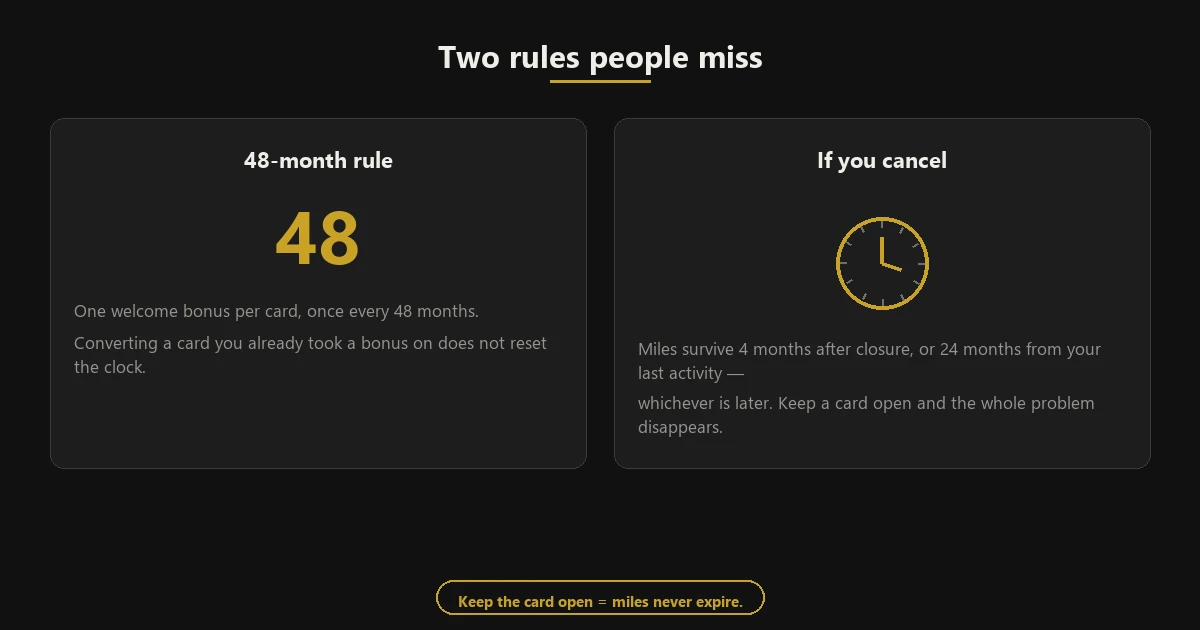
Two details trip up most applicants, and neither appears in the welcome-offer headline.
First, the 48-month rule: you can earn the welcome bonus on a given Citi AAdvantage card only once in any 48-month period. Converting a different Citi card you already took a bonus on into an AAdvantage card does not reset the clock either. If you opened and closed a Platinum Select three years ago, applying again now will likely produce no bonus — so check your history before assuming the headline offer is yours.
Second, think about what happens to the miles if you close the card. While an AAdvantage card is open, the primary cardmember exemption protects the whole balance from expiration. After closure, you have four months from the closing date or 24 months from your last qualifying activity, whichever is later, to keep the account active. Keeping at least one card open is the simplest way to avoid ever thinking about that clock.
Which card fits you
| If you are… | Pick | Why |
|---|---|---|
| Just starting, or want to protect a small balance | MileUp | No fee, and the cardmember exemption stops miles expiring |
| An everyday flyer wanting one solid card | Platinum Select | Best mix of bonus, earn rate and fee; first year free |
| A small business with employee spend | Business | Earns on authorized-user purchases |
| A frequent traveler who uses lounge passes and travel credits | Globe | Credits and hotel earn rate offset the $350 fee |
| Someone who would buy an Admirals Club membership anyway | Executive | Bundles the membership with a big earn rate and bonus |
The common thread is that the right card is the one whose perks you will actually consume. A higher fee is not a better card if its credits go unused, and a free card beats a premium one if it keeps a healthy balance alive at zero cost.
Verdict
For most readers, the answer to which AAdvantage card to get is the Platinum Select: a waived first-year fee, a strong welcome offer and enough American Airlines earning to justify keeping it. The MileUp is the sensible free card, especially as a way to stop miles expiring. The Business card earns its place only if you have real business spend, the Globe only if you will use its travel credits, and the Executive only if you wanted an Admirals Club membership regardless.
Whichever you choose, the miles land in the same account and feed the same status track — so the decision is about the fee and the perks, not about the points themselves. And if the welcome offer looks weak at the moment you apply, remember that buying miles is a separate, usually more expensive route, laid out in the buy AAdvantage miles guide. For the full picture of what these cards sit inside, see the AAdvantage promotions hub.
Last updated: 20 November 2026. Welcome offers and annual fees change frequently; confirm current terms on citi.com before applying.
Frequently asked questions
How many Citi AAdvantage cards are there?
There are five: MileUp, Platinum Select, Business, Globe and Executive. Citi is the sole issuer of AAdvantage credit cards following Barclays exit from the Aviator cards in 2026.
Which AAdvantage card is best for most people?
The Platinum Select. Its $99 fee is waived in the first year, it typically carries a 50,000 to 80,000 mile welcome offer, and it earns 2 miles per dollar on American Airlines purchases and common everyday categories.
Do AAdvantage credit cards earn Loyalty Points toward status?
Yes. Every eligible mile earned with a Citi AAdvantage card also earns one Loyalty Point, which counts toward AAdvantage elite status. See the elite status guide for the four thresholds.
How often can I get an AAdvantage card welcome bonus?
Once per card every 48 months. You are not eligible for a new cardmember bonus on a card if you received one for that same card in the past 48 months, or if you converted another Citi card on which you earned a bonus into it.
Do AAdvantage cardholders avoid the miles expiration rule?
Yes, if you are the primary cardmember and the card is open. After you close the card, your miles need qualifying activity within four months of closure or 24 months of your last activity, whichever is later.
Is the Executive card worth the $695 fee?
Only if you would otherwise buy an Admirals Club membership. The membership is the main value; without regular lounge use, the lower-fee Platinum Select or Globe delivers better value.
More American Airlines guides
- How to earn AAdvantage miles, and how card spend fits into the bigger picture.
- AAdvantage elite status, explaining what the Loyalty Points from these cards build toward.
- Do AAdvantage miles expire, including the primary cardmember exemption.
- AAdvantage promotions hub, for what is currently on offer.
Compare the live welcome offers on citi.com before you apply, since the headline bonus can differ by tens of thousands of miles. If you are mainly trying to protect an existing balance rather than earn a big bonus, the no-fee MileUp is the lowest-cost way to do it.