How loyalty points work decides whether a balance buys a luxury suite or quietly expires unused. The mechanics are simple once you see them: a programme issues a private currency, you earn it through stays and cards, and its value is set at the moment you redeem, not when you earn. This guide walks through all six parts in plain English, then points you to the brand-by-brand guides that go deeper.
The short version: treat points as a prepaid hotel budget, not a trophy. Three things decide what that budget is worth — how you earn, the redemption rate at the property you actually want, and how long you hold the balance. Everything else is detail.

What points actually are
A point is a promise, not money. The programme decides what it is worth when you redeem, not when you earn, and it can change that value whenever it likes. That is why 100,000 points can be a luxury suite in one programme and a mediocre night in another.
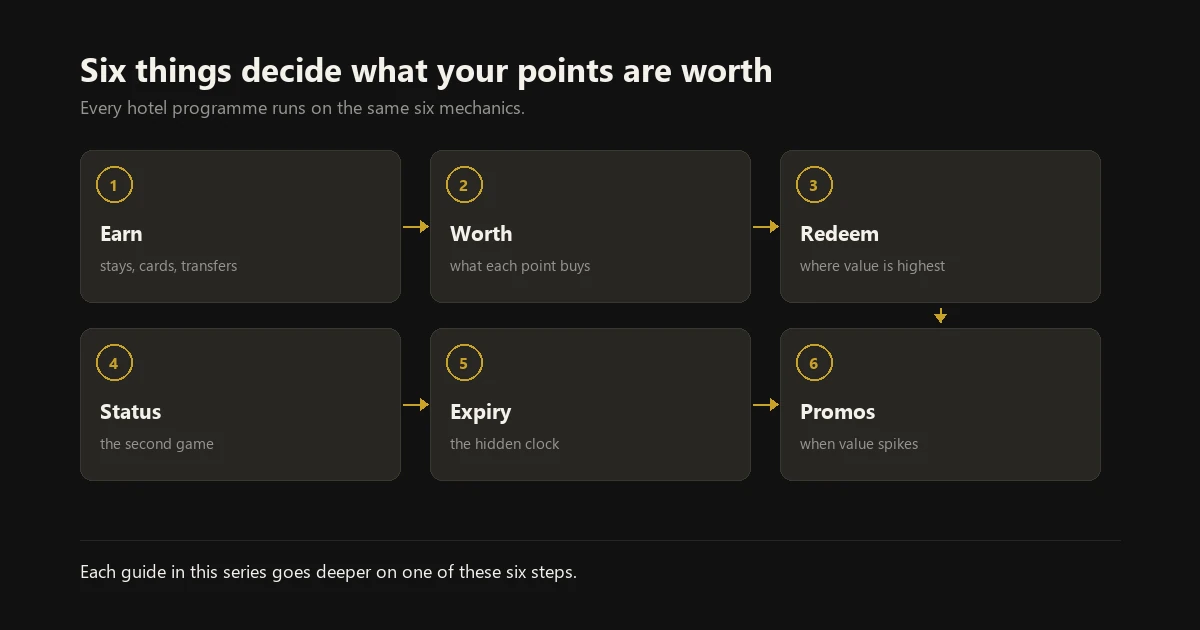
Three things set the value of any point. The first is the redemption rate: how many points a night costs, and whether that number is fixed or floats. The second is pricing structure — a fixed chart you can plan around, or dynamic pricing that moves with the cash rate and the calendar. The third is what else you can do with the points: transfer them, combine them, or let a companion certificate do the work.
Hotel currencies also run on a different scale from airline miles. Programmes issue roughly ten points per dollar on a room rate, so balances look enormous and each point is worth a fraction of a cent. That is not a flaw, just a different exchange rate. What matters is the ratio between what you earn and what a night costs — which is exactly why thinking in dollars, not points, is the single most useful habit you can build.
Membership itself is free at every major chain. Joining a hotel loyalty programme takes about a minute and unlocks member rates immediately, whether or not you ever earn a point. For most travellers that discount, usually five to ten percent off the public price, is the first real return.
Earn: the three routes
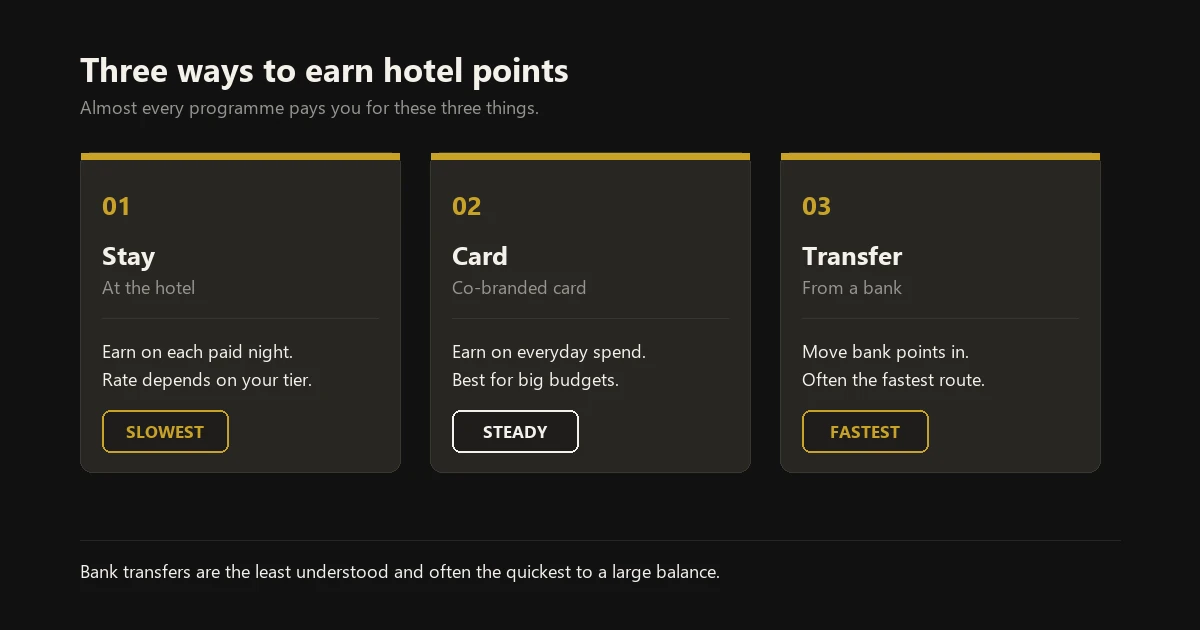
Almost every programme pays you for the same three things: staying, spending on a co-branded card, and moving points in from a bank. They are not equal, and knowing which faucet is fastest changes how quickly a balance becomes useful.
Stays
This is the base rate. Most chains pay around ten points per dollar of eligible room spend, with elite members earning a bonus on top — applied to base points, not to the total. Eligible usually means the room rate and incidentals charged to the room; taxes and some third-party charges are excluded. Stays are reliable but slow, which is why a single welcome bonus on a card often out-earns a whole year of travel.
Co-branded cards
For most members the card is the bigger faucet. Welcome bonuses routinely dwarf what actual stays produce, and everyday spend keeps the balance ticking over between trips. The trade-off is an annual fee and the temptation to spend for points. A card earns its keep when its bonus covers the fee and its category matches something you already buy.
Bank transfers
This is the least understood route and often the fastest way to a large balance. Transferable bank currencies convert into hotel points, but the ratios are frequently unkind — hotel points are cheap, so a one-to-one transfer is rarely good value. The exceptions matter, and they change by promotion. Our guide to buying points and miles keeps the official links and current ratios in one place.
One rule cuts across all three: promotions matter more in hotel programmes than almost anywhere else. Chains run quarterly offers and targeted bonuses that can multiply the base rate several times over. Registration usually takes a minute and costs nothing. People who never register quietly subsidise the people who do.
What your points are worth
The only valuation that matters is the one for your intended night. The formula is short: cash price of the room ÷ points required × 100 = cents per point. A $300 room costing 30,000 points returns exactly 1 cent per point. A $150 room costing the same 30,000 returns half that.
Published averages are useful as a benchmark, not a quote. Independent 2026 estimates put most major currencies roughly in the range of half a cent to a cent per point, with fixed-chart programmes at the top and large dynamic programmes at the bottom. The spread is wide enough that the average of your programme is a poor substitute for the value of your specific redemption.
| Question | Where to find the answer |
|---|---|
| What is my programme worth on average? | Hotel points value chart, updated for 2026 |
| What is this specific programme worth? | The valuation guide inside each brand hub below |
| How many points do I need for a free night? | That brand’s award chart or redemption guide |
| Should I buy points to reach a redemption? | The buy-points guide, which prices each bonus tier |
Note the direction of the calculation. You start with the room you want, price it in cash, then check the points cost. Doing it the other way round — counting your balance and hunting for somewhere to spend it — is how people burn 30,000 points on a $150 room.
If the maths says you are a few thousand points short, the gap can sometimes be bought. Buying points to top up a balance only makes sense against a named redemption you have already priced; buying speculatively is how a balance becomes an inflated asset you can never spend well.
Redeem: what points are good for
Free nights are the headline, but they are not the only use and often not the best one. Programmes also let you transfer to airlines, pay for upgrades, cover dining credits, and book packages. Each route has a different value, and the best one depends on what you were going to buy anyway.
Free nights, and the fifth-night trick
A free night is worth the cash price you avoid, not the points you spent. Two of the largest programmes, Marriott Bonvoy and Hilton Honors, give a fifth consecutive award night free — four nights of points, five nights of hotel. On a five-night stay that is roughly twenty percent off, on top of whatever value the redemption already had. It is the rare perk without a catch large enough to ruin it, and it is why experienced members book in blocks of five.
Transfers to airlines
Most hotel-to-airline transfers are poor. Hotel points are cheap per unit, and conversion ratios are set so that the receiving currency is smaller. There are exceptions where an airline award is worth far more than the hotel night you gave up, but the default answer is to use hotel points for hotel nights. Check the ratio before assuming a transfer is clever.
Better value at the top end
The gap between cash and points is usually widest at expensive properties on busy dates, because dynamic programmes cap or smooth award pricing while cash rates spike. That is the classic sweet spot: a $600 room priced at a fixed 40,000 points returns 1.5 cents, well above the programme average. This is also where a fixed chart matters — when the cash rate triples, the points price does not.
Status: the second game
Elite status is a separate system from points, and confusing the two is the most common mistake in loyalty. Status improves your paid stays: room upgrades, late checkout, lounge access, bonus points, breakfast at some brands. It does not reduce the number of points a free night costs. Holding Diamond or Platinum will never make a 40,000-point room cheaper.
Tiers are earned through qualifying nights or spend, typically in the range of ten to fifty nights for a mid level and fifty to seventy-five for the top. The useful question is what a tier actually gives you at the properties you visit. A programme with no lounge and no breakfast has a thin middle tier, even if the tier list looks impressive. Our brand guides break down each level in cash terms.
One more distinction: promotional status grants benefits but not progress. A status match or a holiday upgrade gives you the perks for a window, but it does not roll into next year’s qualification. If your plan depends on keeping a tier, you still have to earn the nights.
Expiry: the clock you cannot see
Points are a currency that decays. Most programmes expire balances after a stretch of inactivity — commonly twelve to twenty-four months — and any earning or redeeming activity can reset the clock. The details vary enough that the same habit that saves one balance does nothing for another.
Three traps catch people repeatedly. First, some programmes only expire points at a particular tier, while higher tiers never expire as long as the membership is active. Second, some expire the entire balance at once rather than individual points on a rolling basis. Third, a few programmes run two clocks: an inactivity clock you can reset, and a hard lifespan from the date each point was earned that you cannot.
The practical defence is simple. Keep one qualifying activity — a stay, a card swipe that posts points, or a small purchase — inside every window. If a balance is genuinely at risk and you have a redemption in mind, the cheapest reset is usually the minimum purchase of points, but check the brand’s rule first: in at least one major programme, redeeming points does not count as activity at all.
Promotions: when value spikes
Promotions are where the whole system tilts. A bonus on stays, a discounted points sale, a status gift, or a targeted offer can multiply the base rate or drop the cost of a redemption. They run constantly across the industry, and the pattern is predictable enough to plan around.
Four types are worth knowing. Buy-points sales appear several times a year and cut the price per point for a limited window. Stay bonuses pay extra points or nights for registering and completing qualifying stays. Status promotions gift a tier or accelerate qualification. Targeted offers land in individual accounts and are usually the richest, but only work for the people who receive them.
The rule that matters: register before you stay, and read the deadline. A promotion you did not register for is a promotion you did not get. Each brand hub below tracks what is live, what has ended, and whether any of it is worth your time — which is the only place you should check before acting.
| Brand hub | What it tracks |
|---|---|
| Hilton Honors promotions | Live offers, points sales, More Points to Play |
| Marriott Bonvoy promotions | Live offers, buy-points bonuses, Escapes |
| IHG One Rewards promotions | Live offers, double and triple points, new-hotel discounts |
| World of Hyatt promotions | Live offers, category changes, GOH and milestones |
| ALL Accor promotions | Live offers, status bonuses, subscription deals |
| Wyndham Rewards promotions | Live offers, status gifts, award-chart changes |
| Alaska Airlines promotions | Live offers, double-points deals, buy-points sales |
| American Airlines AAdvantage promotions | Live offers, buy-miles discounts, transfer bonuses |
| United MileagePlus promotions | Live offers, buy-miles bonuses, targeted discounts |
The verdict: a simple order of operations
If you remember nothing else, use this order. Earn through the fastest route available for the trip you already have. Price the room in cash before you look at points. Redeem only where the cents-per-point clears your programme’s average. Keep one activity inside the expiry window. Register for every promotion before you stay. That sequence beats almost any optimisation trick.
Points are neither a scam nor a bargain by default. They are a tool whose value you set at redemption. Understanding how loyalty points work gives you the one thing the programmes would rather you did not have: the ability to say no to a bad redemption and wait for a good one.
Frequently Asked Questions
What are hotel loyalty points actually worth?
Most major currencies fall between half a cent and one cent per point in 2026, but your own redemption is what counts. Cash price of the room divided by the points required, times 100, gives you the exact cents-per-point for that night. Compare that to your programme’s average to know if it is a good use.
How do I work out the value of a point?
Price the same room in cash and in points for the same dates, then divide the cash price by the points required and multiply by 100. A $300 room at 30,000 points is exactly 1 cent per point. Do this before every redemption, because the same property can return very different values on different dates.
Do all hotel programmes use dynamic pricing?
No. Most large chains now float the points price with the cash rate and the calendar, but some still publish a fixed award chart with set prices per category. A fixed chart is easier to plan around and often better value on expensive dates. Check which model your programme uses before you assume a price.
How long do hotel points last?
It depends on the programme. Common windows are twelve to twenty-four months without qualifying activity, and activity usually resets the clock. Some programmes only expire points for lower tiers, some expire the whole balance at once, and a few have a second clock from the date each point was earned. Check your brand’s expiry guide for the exact rule.
Is it better to pay cash or use points?
Use points when the cash price divided by the points required beats your programme’s average value, and pay cash when it does not. Points also tend to win at expensive properties on busy dates, where award pricing is capped while cash rates spike. If you are short of a good redemption, paying cash keeps your balance intact.
Do I need elite status to get value from points?
No. Status improves paid stays through upgrades, lounge access, bonus points and sometimes breakfast; it does not lower the points price of an award night. A free-night redemption costs the same at every tier. Join for the member rate, and treat status as a separate goal only if you stay enough nights to reach it.
Whatever your balance looks like, the next useful step is to price one real night in cash and in points. That single comparison tells you more than any generic valuation chart. Our hotel points value chart gives the 2026 benchmarks to compare against.
More guides
- How much are hotel points worth? The 2026 value chart
- Buy hotel points and airline miles: every official link in one place
- Hilton Honors promotions
- Marriott Bonvoy promotions
- Wyndham Rewards promotions
Next step: pick the programme you already stay with most and book a stay through the official site to start earning, then price your next free night in cash before you spend a single point. The member rate alone usually pays for joining.
Last updated: 21 November 2026. Programme rules change without notice, so confirm earning rates, expiry windows and award prices on the official page before you act.