The best way to use Alaska miles is to spend them on partner business-class seats and fixed-price premium awards, where a single mile can return several cents instead of one. Alaska’s Atmos Rewards program prices partner flights by distance rather than by cash fare, which means a transpacific business seat can cost the same 60,000 miles whether the ticket sells for $2,000 or $8,000. That is where the points do their best work.
The short version: aim at the premium-cabin sweet spots, add a free stopover on a one-way partner award, and ignore the temptation to cash miles out for gift cards. One honest caveat matters in 2026 — several famous sweet spots still have attractive published starting prices but are scarce in practice, so treat them as alert targets rather than guaranteed bargains. This guide separates the awards you can actually book from the ones worth waiting for.

The business-class sweet spots
Alaska is one of the few programs that still publishes distance-based partner charts, and that is the source of nearly all its best value. The strongest redemptions are premium cabins on partners where the cash fare is high but the mile price is fixed. The chart shows the published starting prices for the headline awards.
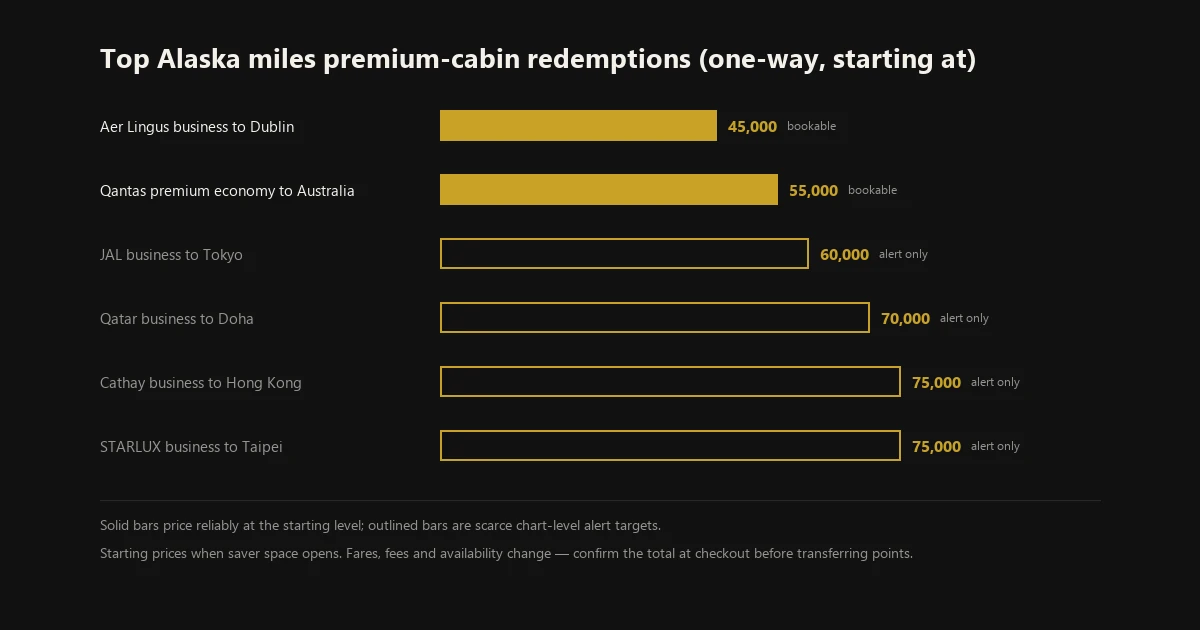
| Redemption | Starting price (one-way) | Reality in 2026 |
|---|---|---|
| Aer Lingus business, U.S. East Coast to Dublin | 45,000 miles | Reliably bookable; the best all-round deal |
| Qantas premium economy, U.S. to Australia | 55,000 miles | Good availability on the published price |
| JAL business, Seattle or Honolulu to Tokyo | 60,000 miles | Scarce; low-level seats need flexibility |
| Qatar Airways business, U.S. East Coast to Doha | 70,000 miles | Often priced far above the floor |
| Cathay Pacific business, U.S. to Hong Kong | 75,000 miles | Very scarce at the starting level |
| STARLUX business, U.S. West Coast to Taipei | 75,000 miles | Scarce; economy opens more easily |
JAL to Japan is the award the program’s reputation rests on. From Seattle or Honolulu, business class starts around 60,000 miles one-way on a flight that often sells for several thousand dollars. That is the cleanest example of fixed-chart value in the program, though the low-level seats go quickly.
Aer Lingus to Dublin is the sleeper hit. Business class from Boston or New York starts at 45,000 miles for the under-3,500-mile band, and availability at that price has been comparatively good. If you want one dependable premium-cabin win from this program, this is it.
Cathay Pacific, Qatar Airways and STARLUX round out the aspirational list. Cathay first and business to Hong Kong, Qatar Qsuites to Doha, and STARLUX’s new U.S. routes all have published prices that look extraordinary next to cash fares. The catch is availability, covered in the next section.
If a priced award is just out of reach, topping up your Atmos balance during a bonus can be the quickest way to complete it — but only when the miles you buy cost less than the seat is worth to you.
Published price vs. bookable price
Here is the distinction that separates a good guide from a hopeful one. A published starting price is the floor the chart allows when saver inventory exists. It is not a quote, and it is not always what you will see at checkout. A recent six-month search of live availability found that several headline business-class awards were rarely available at their floor prices: JAL, Qatar and STARLUX business frequently appeared around 150,000 to 175,000 miles instead of 60,000 to 75,000, and Cathay business seats at the starting level were almost absent.
That does not make the charts useless. The lower published prices still surface, and the right way to use them is as alert targets — set a search, wait for the level to appear, and book immediately when it does. Meanwhile the awards that do price reliably, such as Aer Lingus business to Dublin and Qantas premium economy to Australia, are the ones to build a trip around when you need certainty.
The practical rule: never transfer bank points or buy miles on the assumption that a scarce sweet spot will be there. Find the seats first, price the exact itinerary, and only then move points. A sweet spot you have not found is not a redemption — it is a wish.
The free stopover
The most underrated use of Alaska miles is not a particular airline, but a routing trick. Atmos allows one enroute stopover of up to 14 days on an eligible one-way award, and booking a round trip as two one-ways can give you one stop in each direction. The stopover adds no miles; you pay only the extra taxes, fees and your own hotel costs.
Use it to turn one ticket into two cities. Fly the U.S. to Hong Kong on Cathay, pause in Hong Kong for a week, then continue to a third destination on the same award. Or route the U.S. to Europe through Dublin on Aer Lingus and see Ireland before continuing. The stop has to sit on a sensible partner routing, award space must exist on every segment, and the total distance still sets the price — a longer routing can push the award into a higher band.
Some partners, notably Cathay Pacific and LATAM, cannot be ticketed with a stopover online and require a call to Alaska reservations. Search with the multi-city tool first, and confirm the final routing and price on the checkout screen before you make any plans around it.
Short hops and own-metal flights
Not every good redemption is a lie-flat seat. Flights on Alaska and Hawaiian metal within North America start as low as 4,500 miles for routes under 700 miles, and 7,500 miles for the next band up — on both Alaska and American. When a last-minute domestic fare is high, those short awards can return more per mile than a carefully planned economy ticket, and they are far easier to find.
Flights to Hawaii and cross-country routes are the middle ground. They commonly return around 1.3 to 1.6 cents per mile, above the program average on the right date, with better availability than partner premium cabins. For a family booking several seats at once, or for anyone who values certainty over a headline cents-per-mile figure, this is often the smarter use.
Where the program is weak is the obvious place: cash-equivalent redemptions such as gift cards and merchandise return roughly half a cent per mile. Using Atmos points there gives away most of their value. Save short-haul awards for expensive fares, and keep the balance for the premium cabins above.
Fees, rules and the fine print
Four rules shape every Atmos redemption:
Partner booking fee. A nonrefundable $20 fee applies per person, each way, on qualifying partner awards. An eligible Atmos Rewards Summit card can waive it. Phone bookings add around $30 unless you hold Gold, Platinum or Titanium status.
No fuel surcharges. Atmos does not pass on the carrier-imposed surcharges that British Airways, Hainan and Icelandair add to awards booked through other programs. That alone can make a partner business ticket hundreds of dollars cheaper here.
Single-partner awards. With a few exceptions such as American, British Airways and Finnair, you generally cannot mix two different partners on one one-way award. A stopover therefore has to be on an eligible routing with the same partner, not an arbitrary city you invent.
Award tickets earn status. Award travel on Alaska, Hawaiian and partners earns one status point per mile flown in any cabin, provided your Atmos number is on the booking and you choose to earn by distance. That is a genuine advantage over programs where award flights earn nothing, and it makes a mileage run in a premium cabin do double duty.
There are no change or cancellation fees on awards, so speculative bookings carry little risk — lock space when you find it and cancel if plans change. The partner booking fee is the one cost that is not refunded.
How to search and book
Start with the hardest segment. Choose your destination, identify a logical partner hub for the stopover, then search the long-haul leg on its own with flexible dates. AwardFares and similar tools can show which dates have the low level before you commit; setting an alert is reasonable for the scarce business-class awards.
Once every segment has space, build the full itinerary with Alaska’s multi-city search and read the total distance band, the points and the cash due. Compare that total with two separate one-way tickets before you decide — a stopover is only valuable if the combined award actually costs less than booking the cities separately. Check our guide to buying Alaska miles if you are short of the total, and only buy to complete a priced award.
Book the award as soon as the screen shows the routing and price you expect. Partner space can disappear without notice, and many awards are blocked inside 72 hours of departure. Because cancellations are free, there is little downside to grabbing a good itinerary early.
Whatever the chart promises, the best way to use Alaska miles is the one that returns the most value on a flight you actually want to take. Find the space, price the whole trip, then spend the points.
Frequently Asked Questions
What is the best way to use Alaska miles?
The strongest use is partner business class on fixed-distance charts, especially Aer Lingus to Dublin, JAL to Japan, Cathay Pacific to Hong Kong and STARLUX to Taipei. Add a free stopover on a one-way award to cover a second city. Short hops under 700 miles and flights to Hawaii are reliable alternatives when premium-cabin space is scarce.
Are Alaska business-class sweet spots still bookable?
Some are and some are not. Aer Lingus business to Dublin at 45,000 miles remains comparatively easy to find, while JAL, Qatar, Cathay and STARLUX business at their published starting prices have become scarce and often appear much higher in live searches. Treat the low published prices as alert targets and verify the real total before transferring points.
How does the free Alaska stopover work?
One eligible one-way partner award can include one enroute stopover of up to 14 days at no extra miles, and two one-way tickets can give one stop in each direction. The stop must fit the partner’s routing, award space is needed on every segment, and taxes and fees still apply. Some partners require a phone call to ticket it.
Can I combine partners on one Alaska award?
Generally no. Most one-way awards must use a single partner, with exceptions such as American, British Airways and Finnair. A stopover therefore has to be on an eligible routing with that same partner rather than on any city you choose.
Do Alaska awards charge fuel surcharges or booking fees?
Atmos does not pass on carrier-imposed fuel surcharges, which is a major advantage on partners such as British Airways. A nonrefundable partner booking fee of $20 per person each way applies to qualifying awards, though an eligible Summit card can waive it. There are no change or cancellation fees.
Do award flights earn Alaska status points?
Yes. Award travel on Alaska, Hawaiian and partner airlines earns one status point per mile flown in any cabin, as long as your Atmos number is on the booking and you choose to earn by distance. This makes premium-cabin awards useful for keeping or building elite status as well as for travel.
More guides
- Alaska Airlines promotions: what is live and worth it
- How much are Alaska miles worth? The 2026 value chart
- Buy Alaska miles: cost, bonus tiers and when to buy
- Alaska Atmos Global Concierge: how the invite-only perk works
- Buy airline miles and hotel points: every official link
Next step: pick one route you want to fly, check whether the low-level partner space exists, and review Alaska’s current buy-miles offer only if a bonus makes completing the award cheaper than paying the cash fare.
Last updated: 19 November 2026. Award prices, charts and availability change without notice, so confirm the current price and routing before you transfer or buy points.