How much are Alaska miles worth? On average, about 1.5 cents each — but that number hides the whole story. Alaska’s Atmos Rewards points are worth closer to 0.5 cents when you cash them out and 8 cents or more in a partner first-class seat. The value is not fixed in the points; it is created by how you redeem them. This guide gives you the 2026 benchmarks, the redemptions that beat them, and a simple formula for pricing your own award.
The short version: treat 1.5 cents as a planning average, not a promise. Own-metal flights to Hawaii and across the country often land near that figure, short domestic hops less, and partner business class far more. Because Atmos charges no fuel surcharges and allows a free stopover on one-way partner awards, a good redemption stretches further here than in most programs.

The 1.5-cent benchmark
Most 2026 valuations put Alaska’s Atmos Rewards points around 1.5 cents each. That figure is a blended average: it mixes high-value partner premium cabins with ordinary domestic economy tickets and lower-value cash-equivalent uses. Independent estimates cluster close to it, which makes it a useful baseline — but an average is the middle of a wide range, not the value of any particular redemption.
Two structural features push the top end higher than the headline. Atmos does not pass on partner fuel surcharges, so a business-class award can cost little more in cash than the airport taxes. And the program permits a free stopover on one-way partner awards, letting one ticket cover two cities. Both raise the return you get per point without spending more points.
Value by redemption type
The same 1.5-cent point behaves very differently depending on where it goes. The chart shows the rough range each type of redemption returns in 2026. Treat the bands as directional — the exact value is always the fare you avoid divided by the points you spend.
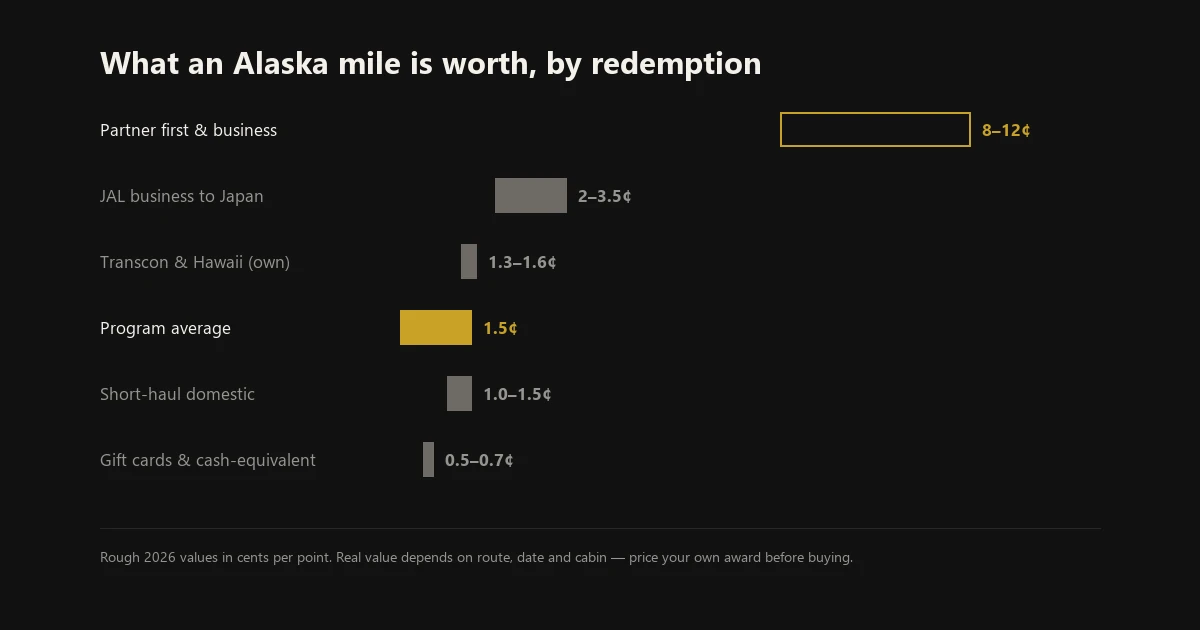
| Redemption | Typical value per mile | Notes |
|---|---|---|
| Partner first & business | 8–12¢+ | Cathay, JAL, Qatar; no fuel surcharge |
| JAL business to Japan | 2–3.5¢ | From 60,000 miles one-way west coast |
| Own-metal transcon & Hawaii | 1.3–1.6¢ | Above the average on peak routes |
| Program average | ~1.5¢ | Planning baseline, not a quote |
| Short domestic hops | 1.0–1.5¢ | Lower when the cash fare is cheap |
| Gift cards & cash equivalent | 0.5–0.7¢ | Almost always poor value |
The spread is the lesson. Converting points to gift cards throws away two-thirds of their potential value. Using them for a partner business-class seat can multiply it several times over. Same points, same account — the only variable is the redemption you choose.
The sweet spots that beat the average
A handful of partner awards do the heavy lifting in Atmos Rewards. They are fixed-chart, which means the price does not climb with the cash fare — the exact situation where points win.
Japan Airlines to Japan
Business class from the west coast starts around 60,000 miles one-way, roughly 75,000 from the east coast. Against a transpacific business fare of several thousand dollars, that is commonly 2 to 3.5 cents per mile — and JAL’s product is consistently rated among the best in the sky. Availability is the constraint, so search early and be flexible on dates.
Cathay Pacific to Hong Kong
Cathay business and first class to Hong Kong is the flagship use. Premium-cabin fares can run five figures, which is why this redemption regularly clears 8 cents per mile and sometimes far more. The free stopover lets you add a second city on the same award, stretching the value further.
Qatar Airways and other oneworld partners
Qatar’s Qsuite and oneworld partners such as Qantas, Aer Lingus and Fiji Airways round out the high-value options. Aer Lingus to Ireland from the east coast is a notable transatlantic business bargain at fairly low mile prices. Because partner pricing is chart-based, these are the awards to price first when you are deciding whether a balance is worth keeping.
You do not need to buy miles to reach these sweet spots — most members earn them through flying and the co-branded cards. But if you are a few thousand short of a fixed-chart business seat and a sale is running, topping up your Atmos balance during a bonus can be the fastest route to a ticket worth several times what you paid. Check the price per mile before you commit.
Own-metal flights and Hawaii
Not every good use is a premium cabin. Alaska and Hawaiian flights to Hawaii, and cross-country routes, often return 1.3 to 1.6 cents per mile — comfortably above the average on the right date. A Seattle–Honolulu award, for example, can land around 1.6 cents against a high cash fare. Short domestic flights under 700 miles are cheaper in points but return closer to 1 cent, because the cash fare is usually low too.
Own-metal awards also tend to have better availability and no blackout dates, which matters for families or anyone booking five seats at once. The trade-off is that the absolute cents-per-mile is lower than a partner business seat. If your goal is to stretch a large balance across several trips rather than seek one premium experience, this is where it goes furthest.
How to price your own award
You do not need an estimate when you have a real itinerary. Use this formula:
(cash fare − taxes and fees paid on the award) ÷ miles required × 100 = cents per mile.
Search the same flight twice — once in cash, once as an award — for the exact dates you want. Subtract the taxes you would pay on the award, because those are not avoided. Then divide by the miles. If the result beats 1.5 cents, it is a good use by the program’s own benchmark; if you can get a premium cabin at 5 cents, it is an excellent one. If it comes out below 1 cent, consider paying cash and saving the miles for a better date.
Doing this before you transfer or buy points is the single habit that separates good redemptions from wasteful ones. The published average tells you what a mile can be worth; the formula tells you what your mile is worth on the flight you actually want.
Does the value justify buying miles?
Sometimes. If you are a few thousand miles short of a redemption worth 3 cents each, paying roughly 1.9 cents to complete it during a bonus is a sensible trade — you are buying something for less than it is worth. If you are buying with no award in mind, you are speculating in a currency whose value is set by someone else.
Our guide to buying Alaska miles breaks down the current bonus tiers and shows exactly when the maths works. The rule of thumb: buy to complete a priced award at a bonus, never to build a balance in hope.
Frequently Asked Questions
How much are Alaska miles worth?
On average about 1.5 cents each in 2026, but the range is wide. Partner business and first-class awards can return 8 cents or more, while gift cards return roughly half a cent. The value of a mile is whatever you get back when you redeem it, so price your specific flight rather than relying on the average.
Is 1.5 cents a good value for Alaska miles?
It is a solid planning benchmark, not a ceiling. Many Alaska and Hawaii redemptions land near that figure, and partner premium cabins beat it comfortably. If a redemption returns more than 1.5 cents per mile you are doing better than average; below 1 cent, consider paying cash instead.
Which redemption gives the most value for Alaska miles?
Partner premium cabins, especially Cathay Pacific and Japan Airlines business or first class, typically deliver the highest cents per mile because the cash fares are high and the mile prices are fixed. Qatar, Qantas and Aer Lingus are also strong. Free stopovers and no fuel surcharges make these go further.
Do Alaska miles expire?
No. Alaska removed mileage expiration in 2023 and the Atmos Rewards program kept that policy, so points do not expire with inactivity. An account left completely dormant for a long stretch may be flagged for verification, but the balance is not forfeited.
Are Alaska miles worth buying during a bonus?
Often, if you have a specific award in mind. At a 100% bonus the cost is about 1.88 cents per mile, so buying to complete a redemption worth 3 cents or more is reasonable. Buying speculatively is riskier, because value only appears at redemption. Check the current bonus level before deciding.
Why are Atmos Rewards miles more valuable than some airline miles?
Two reasons: generous fixed partner charts for premium cabins, and no fuel surcharges on partner awards. A free stopover on one-way partner tickets also lets a single award cover two destinations. Together those features raise the return per mile compared with programs that price dynamically or add hefty surcharges.
Whatever a chart says, the value of Alaska miles is decided at the moment you redeem. Price one real award in cash and in points, and you will know more than any published average can tell you.
More guides
- Alaska Airlines promotions: what is live and worth it
- Buy Alaska miles: cost, bonus tiers and when to buy
- Buy airline miles and hotel points: every official link
- How much are hotel points worth? The 2026 value chart
- Alaska Atmos Global Concierge: how the invite-only perk works
Next step: pick one route you actually want to fly, price it in cash and in miles, and check Alaska’s current buy-miles offer only if a bonus makes completing the award cheaper than paying the fare.
Last updated: 19 November 2026. Award prices and valuations change without notice, so confirm the current chart and cash fare before you redeem.