Do Wyndham points expire? Yes, and Wyndham Rewards uses two separate clocks at the same time, so whichever finishes first takes your points. Under its four-year rule, every point expires four years after the stay or activity that earned it posted to your account. Separately, all the points in an account can be forfeited after roughly 18 months with no account activity. The short version: earn, redeem or transfer something at least once a year and the inactivity clock never bites, but that does nothing for the four-year date on older points. Only a Caesars transfer round trip or an Earner Premier card deals with that. This guide covers both clocks, exactly what counts as activity, and the small number of ways to protect a balance you already hold.

The short answer: two clocks run at once
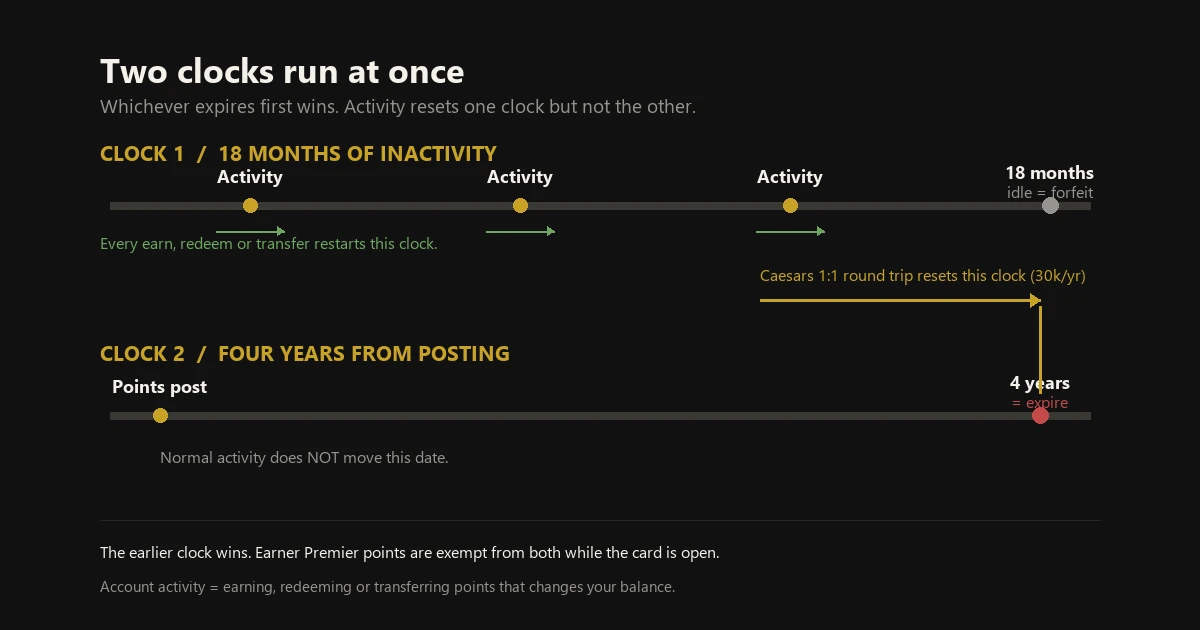
Most loyalty programs have one expiry rule. Wyndham has two, and they are independent of each other. An account can be perfectly active and still lose points to the four-year rule, or hold brand-new points that vanish because the whole account went quiet. You have to satisfy both clocks, not one.
| Clock | What starts it | What resets it | What it wipes out |
|---|---|---|---|
| 18-month inactivity | No account activity for approximately 18 months | Any earn, redeem or transfer that changes your balance | Every point in the account at once |
| Four-year rule | The posting date of each individual batch of points | Only a Caesars round trip, or the Earner Premier exemption | Just the points in that batch |
The distinction matters because people often assume one fix covers both. It does not. A single paid night resets the inactivity clock for the whole account, yet the points from a stay three years ago keep marching toward their own four-year date. For the value side of that calculation, see our Wyndham points value guide.
Clock 1: roughly 18 months of inactivity
Wyndham’s terms say points may be cancelled or forfeited if a member has no account activity for a period of approximately, but never less than, 18 consecutive months. That wording is deliberately loose. There is no single expiry date shown in the app and no countdown, so the practical deadline is well before 18 months.
This is an account-wide rule. A forfeiture here takes the entire balance, not a subset of old points. It also applies to the four-year-exempt question in reverse: keeping the account busy protects recent points, while doing nothing for points that are already close to their four-year date.
A useful mental model is a yearly touch. Earn something on a stay, redeem a short award, transfer a small balance, or buy a cheap top-up and the clock starts again. Note that buying points is itself a point-earning transaction, so it counts. Our buy-points guide explains the price and the annual cap if you would rather keep a small balance alive that way.
Clock 2: four years from the posting date
The four-year rule is the one that surprises people, because activity does not pause it. Each batch of points expires exactly four years after it posted, and posting dates vary by the type of activity that earned it. A batch from a hotel stay in March 2023 reaches its date in March 2027 whether you stayed ten times in between or never logged in again.
Because batches are tracked separately, one balance can contain several different four-year deadlines. When you redeem, programs generally draw down the oldest points first, which is helpful, but you should not rely on that as a strategy. The only robust approach is to know which batches are getting close and use them before their date.
Three situations produce posts worth watching:
Transferred partner points. Points arriving from a bank partner or Caesars carry their own posting date, which may be weeks after the transfer request.
Purchased points. Points.com credits bought points within roughly 72 hours, and that credit date starts their four years.
Bonus and promotion points. Promotional bonuses usually post as a separate batch with its own date, distinct from the base earning on the same stay.
What counts as account activity
Wyndham defines account activity more broadly than some programs. Under its terms it means point earning, plus redemption or transfer activity that changes the member’s point balance. A redemption is therefore a qualifying activity here, which is worth stating plainly because readers coming from other programs often assume spending points does nothing for expiry.
Things that do count: a paid stay that posts points; buying or gifting points; transferring points in from a bank partner; transferring points out to Caesars or a travel partner; and redeeming for a free night, discounted night or gift card. In short, anything that moves the balance up or down.
Things that do not count: logging in, browsing the site, updating your profile, holding a co-branded card without earning, or a cancellation that leaves no points behind. A quiet balance with only logins behind it is still heading for forfeiture.
One honest caveat. sign in and review your Wyndham points activity shows your activity history, but it does not display a single “expires on” date. If you want certainty about a specific batch, the safest route is to use the points rather than guess at the exact day a promotion posted them.
The Caesars transfer reset
There is one known way to give older points a fresh four-year window. Wyndham lets members transfer up to 30,000 points per year to Caesars Rewards at a 1:1 ratio. Points sent to Caesars leave the Wyndham account; points eventually transferred back post as a new balance with a new posting date, and with it a new four-year clock.
The mechanics are simple but slow. Wyndham quotes roughly 10 to 14 days for a transfer to Caesars, and the return leg takes time too. Do not start this in the final weeks before a deadline, and confirm both accounts can complete the round trip before you move anything. The annual 30,000-point ceiling also means this protects a modest balance, not a six-figure one.
It is also worth being precise about what this is. Wyndham’s published terms describe the four-year rule and the two exemptions; they do not market the Caesars round trip as an expiry-extension feature. It is a consequence of how transferred points re-post, long used by frequent flyers. Treat it as a useful technique, not a guarantee, and keep written records of both transfer dates. Caesars stays booked through Wyndham have their own rules too, including a resort fee payable in cash, covered in the award chart guide.
The Earner Premier exemption
The cleanest protection is structural. Wyndham’s terms state that points earned by a Wyndham Rewards Earner Premier cardmember do not expire under the expiry section while the cardmember’s account is open and in good standing. That exemption covers both clocks: the 18-month inactivity rule and the four-year limit.
Two details keep this accurate. First, the exemption attaches to points earned by the cardmember, so points accumulated years before you opened the card are a separate question and should not be assumed covered. Second, it lasts only while the account is open and in good standing. If the card is closed or the account is not in good standing, plan as though the normal clocks apply again.
For most members the card is not worth opening purely for expiry protection. It makes sense if the annual spend already earns enough points to matter, and the exemption becomes a useful side benefit. Otherwise a transfer or a modest redemption once a year is cheaper.
How to check your own dates
Since Wyndham does not publish a single expiry date in the app, a quick audit is worth doing once or twice a year:
1. Look at your activity history. sign in to your Wyndham Rewards account opens your account, where each earning and redemption line carries a posting date.
2. Add four years to each posting. Focus on batches older than three years, since those are the only ones that can be close to the hard limit.
3. Note your last balance-changing activity. If that was more than a year ago, make one earn, redeem or transfer now rather than waiting for the 18-month threshold.
4. Decide which points to use first. Spend the batches with the earliest dates, and keep the recent ones for later trips.
One more edge case is worth knowing: beyond the two expiry clocks, Wyndham may terminate an account after 60 consecutive months with no account activity, forfeiting whatever remains. In practice the 18-month rule would have removed the points long before that, but it underlines the same lesson. A dormant account is a liability, not an asset.
FAQ
Do Wyndham points expire?
Yes. Two clocks run at once: all points can be forfeited after roughly 18 months with no account activity, and every point also expires four years after it posted to your account. Whichever comes first wins. Earning, redeeming or transferring points resets the 18-month clock, but only a Caesars round trip or an Earner Premier card protects the four-year date.
Is the Wyndham inactivity period exactly 18 months?
No. Wyndham’s terms say points may be cancelled after approximately, but never less than, 18 consecutive months without account activity. Treat 12 months as your own safe deadline rather than waiting for the exact date, because there is no published countdown in your account.
Does redeeming Wyndham points stop them expiring?
Redeeming counts as account activity, so it resets the 18-month inactivity clock. It does not touch the four-year expiry date on points already in your account. A free night booked on any date still leaves older points with their original four-year deadline.
Can I extend the four-year expiry on Wyndham points?
Normal earning and redeeming cannot. The known method is to transfer up to 30,000 points a year to Caesars Rewards at 1:1 and later transfer them back; the returning points post as a fresh balance and start a new four-year window. Allow 10 to 14 days each way and check both accounts before relying on it.
Do Wyndham Rewards Earner Premier card points expire?
Points earned by an Earner Premier cardmember do not expire under the program’s expiry rules while the account is open and in good standing. That covers both the 18-month inactivity rule and the four-year limit. Points earned before you held the card are a separate matter.
What happens if my Wyndham account is completely inactive for five years?
Beyond the 18-month and four-year rules, Wyndham may terminate an account after 60 consecutive months with no account activity, and any points left at termination are forfeited. In practice the 18-month clock would usually forfeit the points first.
More Guides
Wyndham Rewards promotions hub — every live offer, its deadline and what it is worth.
Wyndham Rewards award chart — the four tiers, per-bedroom pricing and the 2026 changes.
How much are Wyndham points worth? — how to value a balance before you decide to keep or spend it.
Buy Wyndham points — prices, the annual cap and when a top-up makes sense.
Do Marriott points expire? — how Marriott’s expiry rules compare.
Next step: Check the posting dates in your account and add four years to any batch older than three. If your last balance-changing activity was more than a year ago, sign in to your Wyndham account and make one small earn, redeem or transfer to restart the clock. For everything else, our promotions hub tracks the offers worth using your points on.
Last updated: 19 November 2026. Program terms can change, so confirm the current expiry language in your own account before relying on a specific date.